A question, and an answer I didn't expect
When I announced what I'm working on, I asked a question underneath it: where have you seen structure make the difference? I was thinking small — someone's notes, a team's shared vocabulary, a cleaner pipeline.
Pieter Kirsten answered with something much bigger. He pointed at Block — Jack Dorsey's company (the one behind Square, Cash App and Afterpay) — and an essay Dorsey co-wrote with Roelof Botha of Sequoia, From Hierarchy to Intelligence. It describes reorganising the entire business around AI. Not a department. The whole thing. And when I read it, I realised he'd handed me the org-scale version of the exact argument I keep making at the scale of one person.
What Block actually did
The reflex most companies have with AI is to sprinkle it on top of what already exists. A copilot here, a chatbot there, a model wired into the current org chart to make the current process a bit faster. AI as a productivity enhancer, laid over the hierarchy.
Block did the opposite. They rebuilt around it, in three layers:
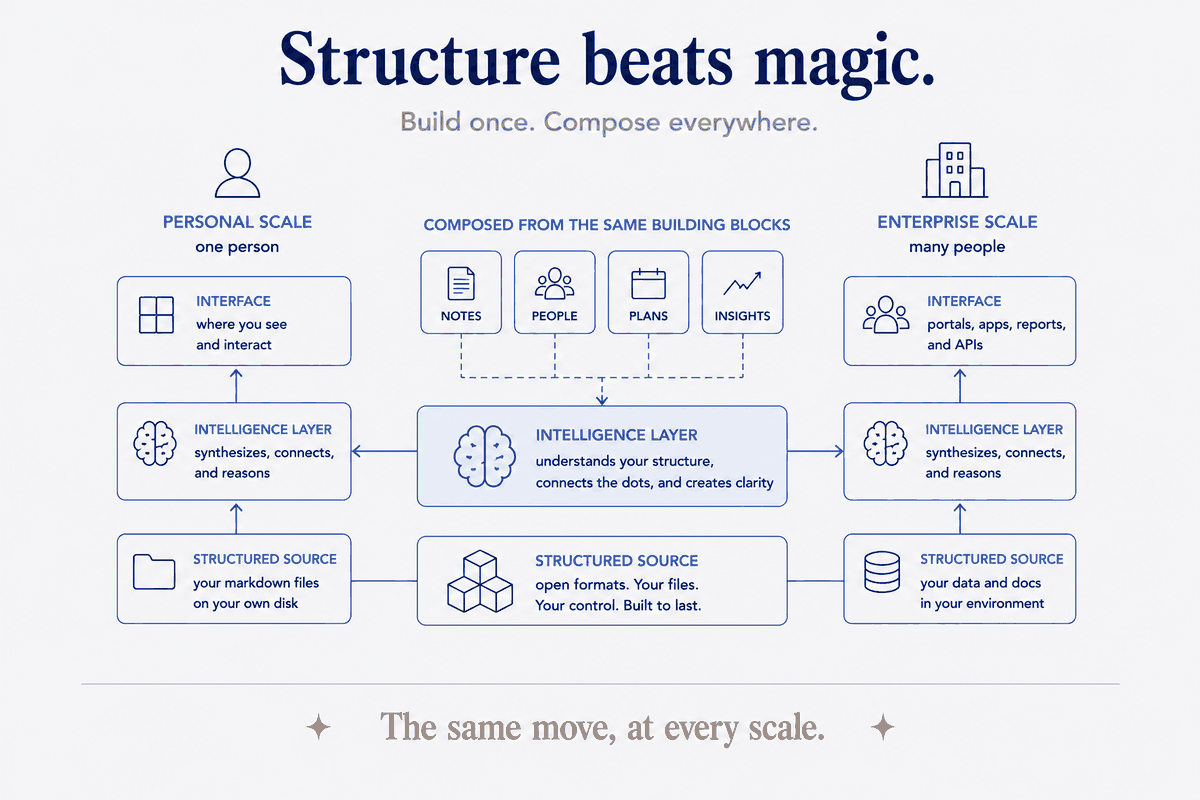
- A Capability Layer — the financial primitives: payments, lending, card issuance, banking. Clean, hard-to-copy building blocks, with no interface of their own. Just the raw capabilities, made composable.
- An Intelligence Layer — the part that composes those primitives into proactive, customer-specific solutions, informed by models of how the company runs and how each customer behaves.
- An Interface Layer — where it all surfaces: Square, Cash App, Afterpay.
The framing that stuck with me is what a hierarchy is even for. The essay walks it back two thousand years — the Roman legion, the Prussian general staff, the first railroad org chart — and lands on one point: a hierarchy is an information-routing protocol, built around a human limit ("span of control": one person can manage maybe three to eight others). Every layer exists to aggregate information from below and relay decisions from above. And here's the trap they name: "narrowing span of control means adding layers of command, but more layers mean slower information flow." Two thousand years of org design has been working around that tradeoff without ever breaking it.
Block's move is to break it. As they put it: "The question was never whether you needed layers. The question was whether humans were the only option for what those layers do. They aren't anymore." Once the work is machine-readable — and at a remote-first company, "everything we do creates artifacts" — a system can carry the information the middle layer used to carry. Their line for the inversion: "In a conventional company, the intelligence is spread throughout the people and the hierarchy routes it. In this model, the intelligence lives in the system. The people are on the edge."
Why this is "structure beats magic"
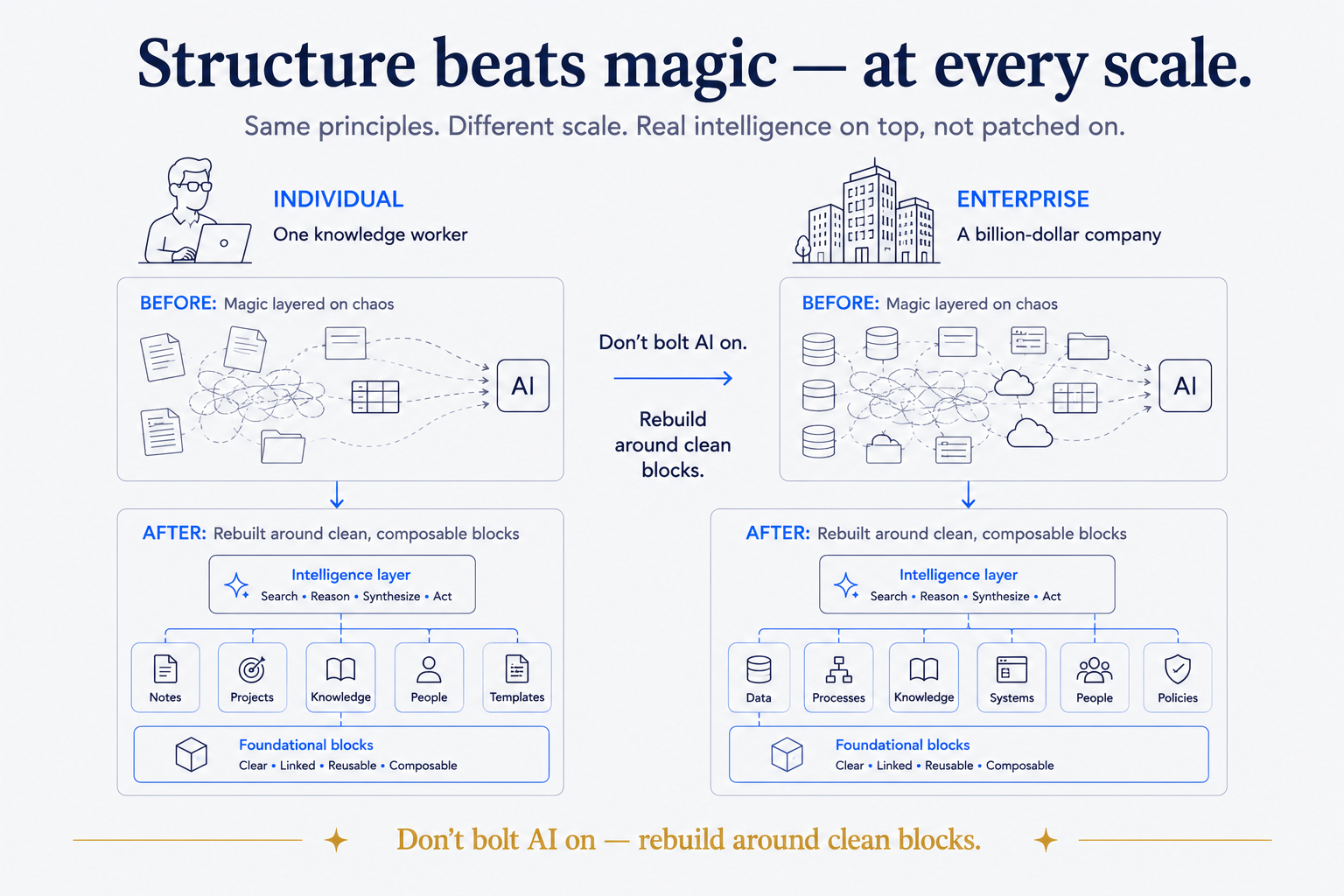
Strip away the scale and it's the same claim I make about a single person and an AI: the magic isn't in the model — it's in the structure you give it.
Block didn't win by having a better model than everyone else. The model is roughly the same for everyone; that's the whole point. They won by building the structure the intelligence composes from — clean, reusable primitives, and a layer whose job is to combine them. Bolt a model onto an unstructured organisation and you don't get intelligence. You get faster mess.
That phrase is the tell. Speed without structure just gets you to the wrong place sooner. The leverage was never the model. It was the building blocks, and the discipline of keeping them clean enough to compose.
There's a detail in the essay I keep thinking about, because it's what clean primitives buy you. When Block's intelligence layer tries to solve a customer's problem and can't — because a capability doesn't yet exist — "that failure signal is the future roadmap." The structure doesn't just answer questions; it tells you what's missing. Customer reality generates the backlog directly, instead of a product manager guessing. That only works because the primitives are clean enough for the gaps between them to be legible. Structure that can show you its own holes is worth far more than a model that confidently papers over them.
The same move, at every scale
Here's what made me sit up: it's the same move whether you're a person, a system, or a company.
- A knowledge worker gives an AI a structured vault — connected notes, written-down rules, a decade of context — and gets output it can actually trust, because the model has something clean to reason over instead of a blank guess.
- A content system — the one I'm building — turns articles into small reusable blocks (one idea each), and composes those blocks into trainings, into other articles, into flashcards. Build the block once; the intelligence recombines it for each occasion.
- A company like Block turns its business into capability primitives and lets an intelligence layer compose them per customer.
Three scales. One shape: clean, reusable building blocks + a layer that composes them. The primitive is a note, a block, a payment rail — the size changes, the move doesn't. This is why I keep saying it's one formula at two scales, personal and organisational. Block is the same sentence, written large enough that a whole company is the proof.
The honest part
Rebuilding around structure is not the easy path, and I'd be lying if I pretended otherwise.
Laying a model over your existing setup is fast. You ship something next week. Rebuilding around clean primitives is slow and expensive — you have to figure out what the real building blocks are, make them genuinely reusable, and resist the pull of "just wire the AI into what we already have." Most of the cost is up front, and most of the payoff is later. That's a hard trade to sell, in an org or in your own week.
And it only works if the blocks are actually clean. Compose from messy primitives and you get messy solutions, faster — the same failure mode, industrialised. The discipline isn't "add a composition layer." It's "make the primitives worth composing." Skip that and the layer just launders the mess.
So the claim isn't "restructure everything around AI." It's narrower and more useful: the reliable leverage comes from the right primitives, kept clean enough to recombine — at whatever scale you're working.
The leverage is the structure
Whether it's your notes, a content system, or a company the size of Block, the move is the same and the lesson is the same: don't reach for a better model. Build the structure the model composes from.
That's the recipe, and it's free — it's the whole point of writing this down. If you find yourself thinking I want this working in my organisation, not just in a LinkedIn post — that part, the doing of it in your real business with its real constraints, is the conversation to have.
Structure beats magic. It just turns out that's true at every size — from a single vault to a billion-dollar org rebuilt around the same idea.
(With thanks to Pieter Kirsten, who pointed me at the Block example.)