The pile everyone has
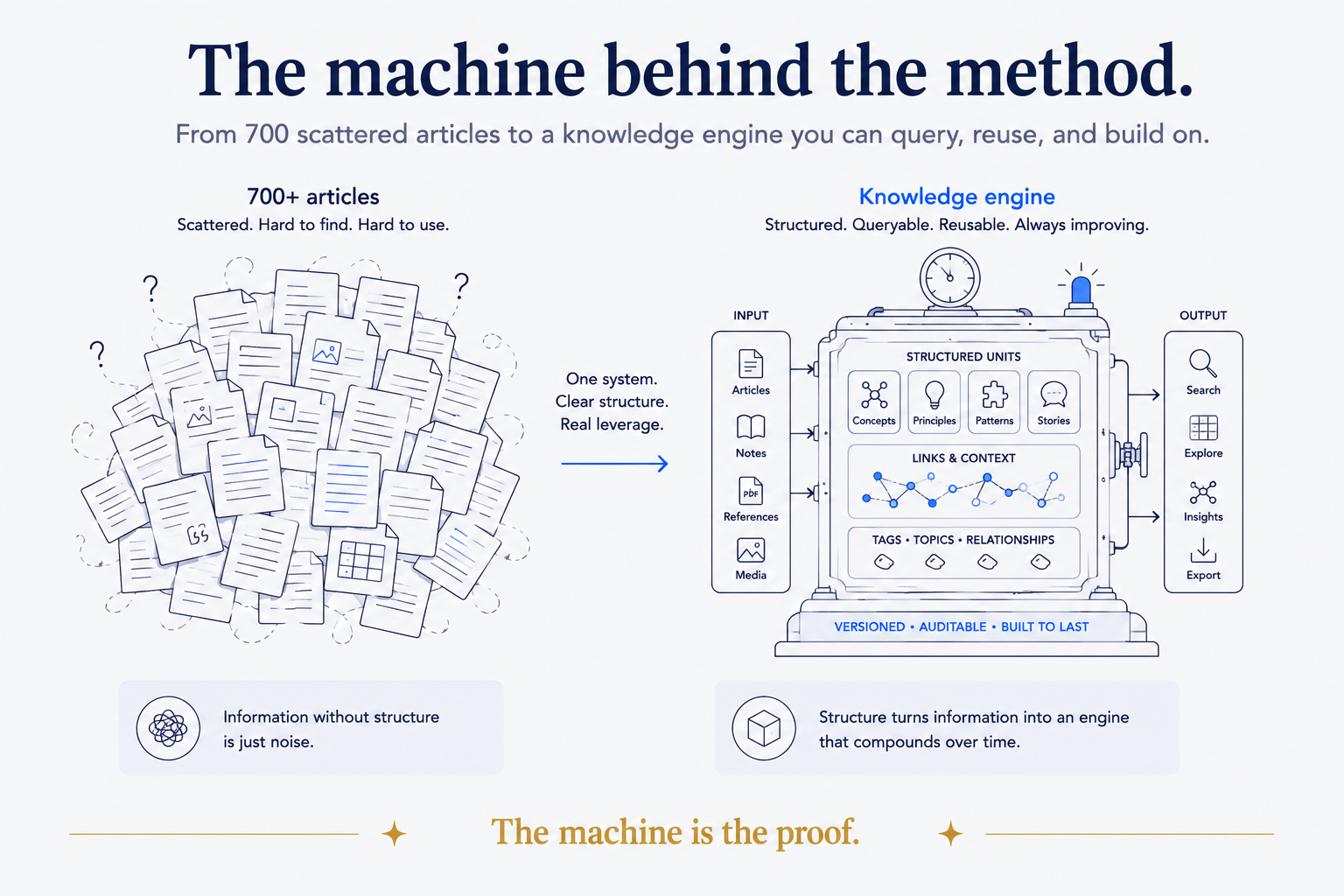
If you've been writing, teaching, or consulting for any length of time, you have a pile. Mine was north of seven hundred articles — drafts half-finished, pieces published on three different platforms, ideas that never left a notes app, a few genuinely good pieces buried under a naming scheme that made sense for about a week in 2024.
Everyone who produces expertise for a living has some version of this. Slide decks from four different clients that all say almost the same thing but none of them say it the same way. A Google Drive that's really just a graveyard with a search bar. Notion pages that started as a system and became a landfill.
The pile is not a filing problem. It's a structure problem wearing a filing problem's clothes. And the fix most people reach for — a better folder tree, a tagging convention, "I'll clean it up next quarter" — treats the symptom. I wanted to know what happens if you treat the actual disease: no structure, no way to query it, no way for anything (human or AI) to recompose it into something new without starting from a blank page every time.
So I built a machine to fix it. Not a metaphorical machine — an actual one, running against my own backlog, right now. This is what it looks like from the inside, and why the fact that it exists is a more useful signal than anything I could write about structure.
The idea underneath: files are the truth, the database is a view
Here's the one mechanic worth taking away from this whole piece, because everything else follows from it.
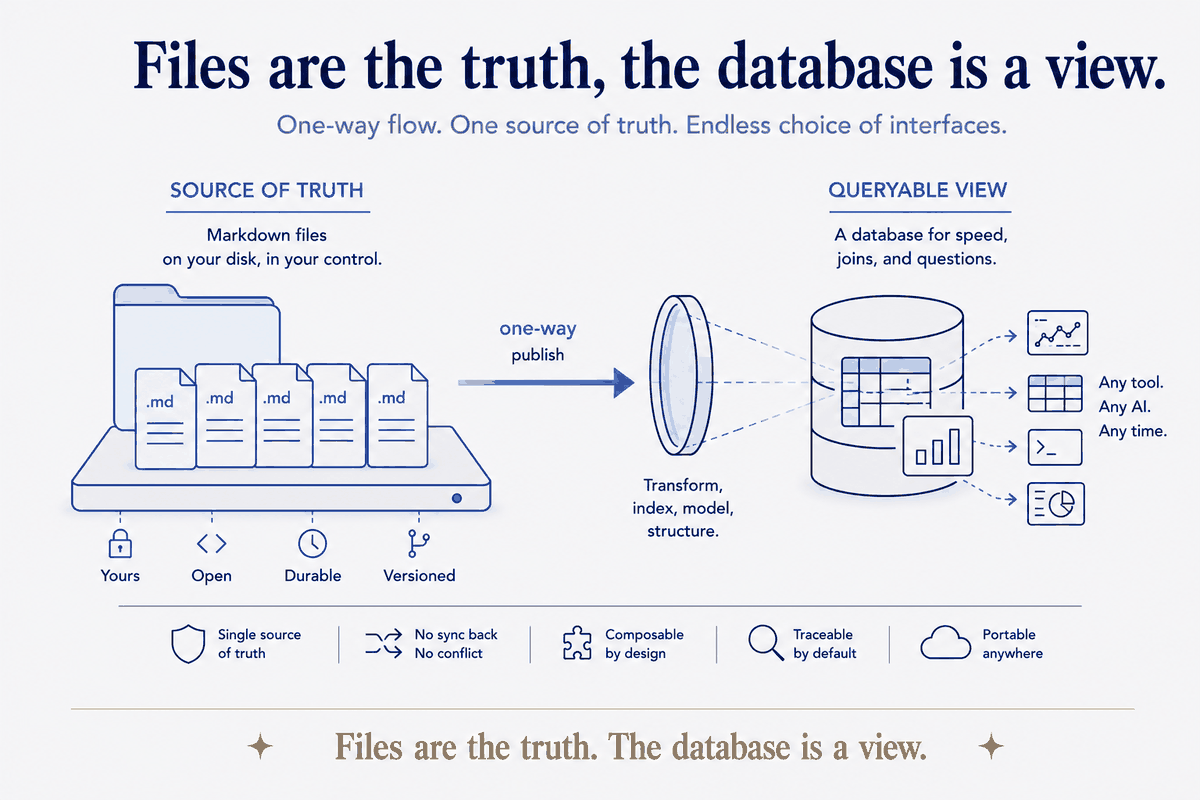
Every article, every image, every reusable idea lives as a plain file with structured metadata attached to it — a folder, a note, a small set of facts about what this thing is and how it relates to everything else. That's the source of truth. Nothing more authoritative exists.
A database sits on top of it. But it is not a second copy of the truth — it's a view, rebuilt from the files every time it runs. If the database and the files ever disagree, the files win, always, by construction. You can delete the database and regenerate it in minutes. You could not do the reverse.
This sounds like a small technical preference. It isn't. It's the difference between a system you can trust and a system you have to babysit. The moment a database becomes its own source of truth, it drifts — someone edits a record by hand, a script writes to it directly, and within a month nobody knows which copy is real. Keeping the files in charge means the queryable layer is disposable and the knowledge underneath it never is.
For a knowledge worker, the equivalent question is: where does your truth actually live? If the honest answer is "scattered across whichever tool I opened that day," you don't have a knowledge base — you have a rumor of one.
Atoms, not monoliths
The second move is smaller than it sounds but changes everything downstream: nothing is one big document. Every unit — an article, an image, a snippet of reusable material, a concept worth naming — is its own atomic, self-contained thing, sitting in its own folder, with its own short note describing what it is.
This is Zettelkasten thinking — the old index-card method of atomic, densely cross-linked notes — applied at a scale and with tooling that makes the composing part tractable. The point of an atomic unit was never atomicity for its own sake. It's that atoms recombine. A monolithic 4,000-word article can only ever be republished as itself. An atomic collection of ideas, properly tagged and cross-referenced, can become an article, a slide, a workshop exercise, or a paragraph in something else entirely — because the unit of reuse is small enough to move.
Concepts sit at the center of this. Not generic tags like "productivity" or "AI," but named, opinionated ideas — the kind of thing you'd actually say out loud in a meeting — that link back to every piece of writing that touches them. That link layer is what turns a pile of documents into something closer to a mind: connected, not just stored.
The two lanes: what a machine should decide, and what a human must
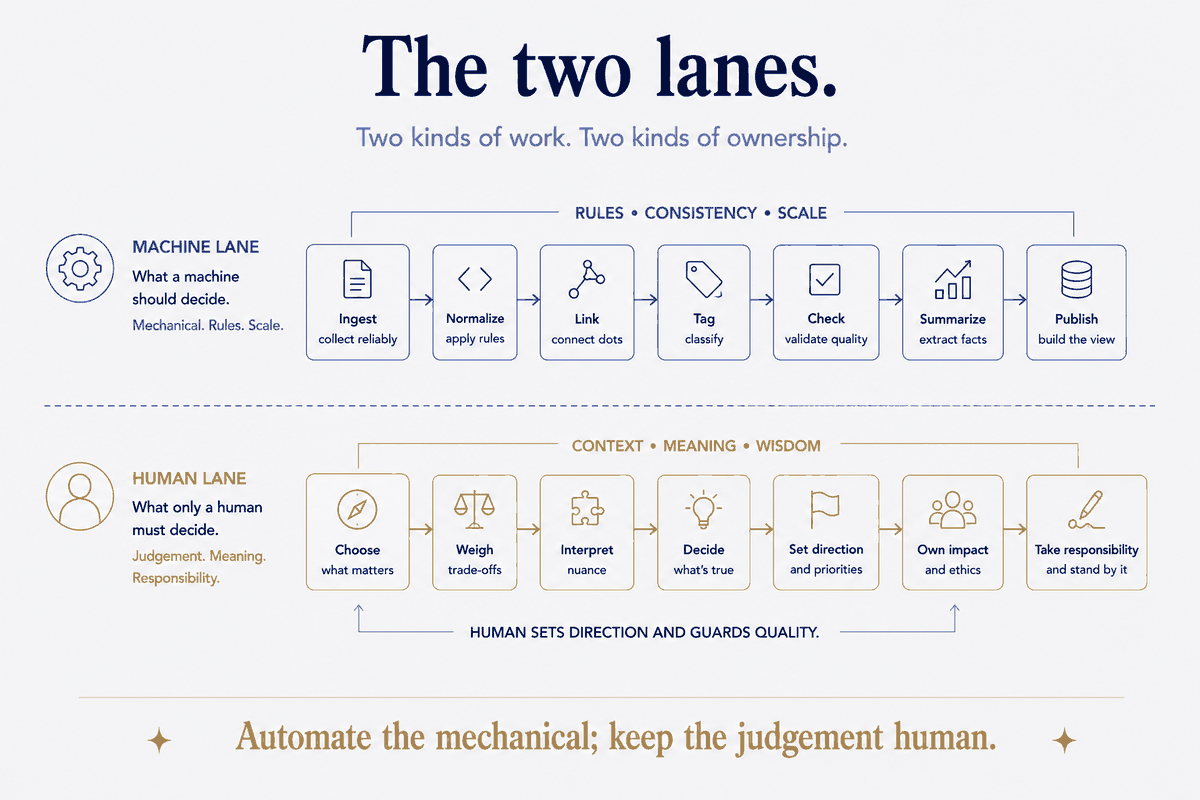
None of this works if "AI-assisted" means "AI decides." So the editorial pass over the whole backlog runs in two lanes, and the split is deliberate.
Lane one is mechanical. Broken formatting, encoding glitches from years of copy-paste across platforms, duplicate headings, dead links, footers from a platform the piece no longer lives on. These get fixed automatically, no human in the loop, because there's no judgment involved — there's one correct answer and a machine can find it reliably.
Lane two is editorial. Sharpening the actual argument, cutting the parts that were hype instead of substance, making sure a claim is grounded rather than asserted, deciding whether a piece belongs to a bigger series. That lane produces a proposal, not a change. It sits next to the original, waiting for a human to look at it and decide. The machine can suggest the edit; it does not get to make it.
That split is the whole ethic in miniature. AI does leverage — the parts that are genuinely mechanical, tedious, and low-risk to automate. Humans hold the gates that actually matter: does this argument hold up, does this represent what I actually believe, is this worth publishing. Anyone building with AI right now is making this same choice, consciously or not, for every task they hand over. Naming the split explicitly is the difference between a tool that extends your judgment and one that quietly replaces it while you're not looking.
What's honestly still frontier
It would be easy to write this piece as though the machine is finished. It isn't, and that's worth saying plainly.
The article layer — the writing itself, tagged, reviewed, cross-linked — is in good shape. Most of the corpus has been through the editorial pass; the structure holds. What's still barely built is the layer above it: turning atomic ideas into the building blocks of an actual course or workshop. The idea is that a well-tagged concept, reused across enough articles, is already halfway to being a training module — you're not writing the course from scratch, you're composing it from material that already proved itself in public. That composition layer exists as an intention right now more than as a working system.
I'd rather say that out loud than imply the machine is more finished than it is. The credibility of "practice what you evangelize" evaporates the moment the evangelizing outruns the practice. So: the foundation is real, it's running, it's already producing better output than the pile ever did. The part where it turns into a course engine is next, not now.
Why this is the whole business, not a side project
Here's the part that matters if you're deciding whether any of this is relevant to you rather than just interesting.
The machine isn't a tool I built in order to do the real work of writing and consulting. It is the real work, made visible. Every claim I'd make in a workshop about structured knowledge, atomic content, or AI-as-leverage-not-replacement is a claim I've already tested against seven hundred of my own files, with my own name on the outcome. When something breaks, I find out first, on my own material, before it's ever a recommendation to anyone else.
That's a different kind of proof than a case study or a slide with someone else's logo on it. A demo can be staged. An operating system you actually run your own output through, day after day, can't be — it either produces better work or it doesn't, and you'd notice.
If you're sitting on your own pile — a backlog of decks, notes, client work, half-finished pieces that all know something true but say it in eleven inconsistent ways — the question isn't whether AI can help you tidy it. It's whether you have a structure underneath worth feeding it in the first place. That's the harder, more interesting question, and it's the one worth starting with before anyone touches a tool.
That's the conversation I have at jacovanderlaan.com — not "clean up your files," but "what's the structure your expertise actually runs on."