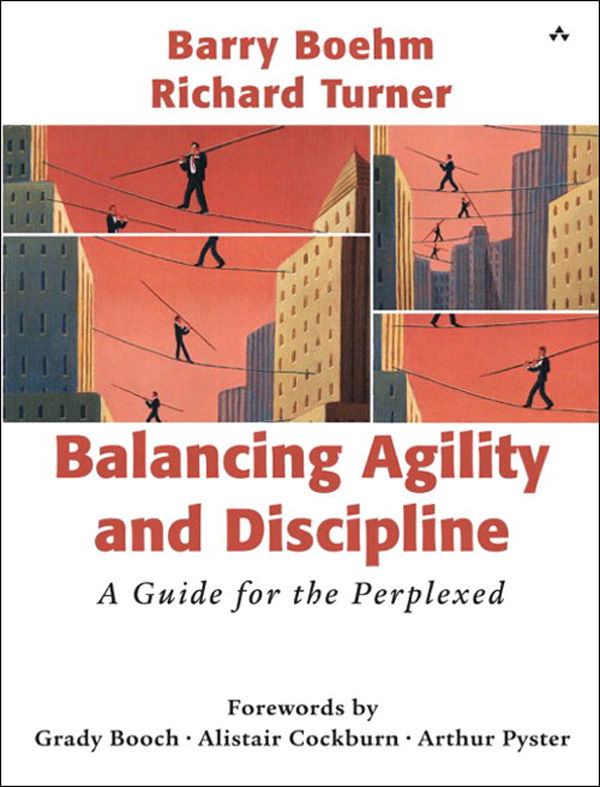
Highlights
- Agility and discipline are dials, not camps — Boehm and Turner refuse the agile-vs-plan-driven religious war and treat both as method properties to be dosed per project; the mature position behind every "how much structure is enough" decision.
- Five factors decide the mix — team size, criticality, personnel capability, dynamism, and culture form an explicit decision model for method choice; turning a gut-feel methodology debate into assessable criteria is itself a structural act.
- Risk is the balancing mechanism — their method uses risk analysis to decide where plan-driven rigor pays and where agile speed wins; rules for when to apply rules, one level up.
- Discipline is the foundation agility stands on — the book argues true agility presupposes strong engineering practice rather than replacing it; undisciplined "agile" is just chaos with standups — the software-craft ancestor of structure-beats-magic.
- Home grounds map where each approach is native — every method has an environment where it excels and degrades badly outside it; the antidote to one-size-fits-all frameworks, whether in delivery methodology or data architecture.
- People factors dominate process factors — a capable team with a mediocre process beats the reverse; process and structure amplify capability, they do not substitute for it.
Highlights on this page are generated with the help of AI.