Highlights
- A business is something you model before you build — the book's core move is treating a business model as an explicit design artifact rather than something that lives implicitly in founders' heads; the same shift MDDE makes for data platforms, where the model is the deliverable and the implementation follows from it.
- Nine building blocks act as a metamodel — customer segments, value propositions, channels, revenue streams and the rest form a fixed schema every business description must fill in, which is what makes descriptions comparable, discussable, and checkable for gaps; a constrained structure doing the work that intuition alone can't — structure beats magic.
- The Canvas is a shared visual language — its lasting contribution is less the specific boxes than the idea that strategy conversations need one precise, business-friendly vocabulary on a single page; a concept-library for business models, doing for boardrooms what conceptual modeling does for data teams.
- Named patterns beat one-off cleverness — the book catalogs recurring business-model patterns (unbundling, long tail, multi-sided platforms, freemium, open models) as reusable, combinable templates; the same pattern-density logic that makes Data Vault generative — once a pattern has a name, you can recognize it, teach it, and instantiate it deliberately.
- Prototype the model, not the company — sketching and iterating alternative canvases is presented as cheap, disposable design work done before committing capital; validate-don't-guess applied at business scale, and a reminder that the model is the durable asset while any given implementation is just one rendering of it.
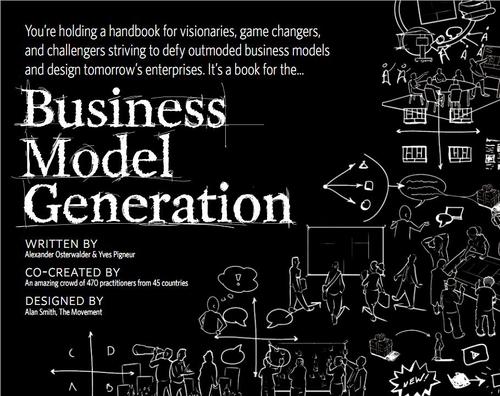
- Co-created and field-tested, not armchair theory — the book was famously developed openly with hundreds of practitioners worldwide, which is why the Canvas became a de-facto standard; a template's authority comes from validation against real cases, not from the elegance of its diagram.
Highlights on this page are generated with the help of AI.