Why this is in my collection
From the publisher:
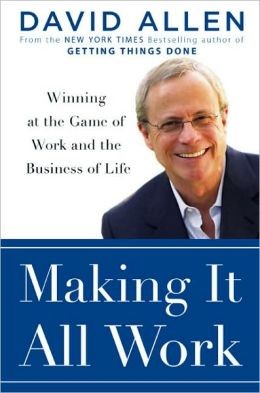
The long-awaited follow-up to the New York Timesbestseller Getting Things Done.David Allen’s Getting Things Donehit a nerve and ignited a movement with businesses, students, soccer moms, and techies all the way from Silicon Valley to Europe and Asia. Now, David Allen leads the world on a new path to achieve focus, control, and perspective. Throw out everything you know about productivity-- Making It All Workwill make life and work a game you can win. For those who have already experienced the clarity of mind from reading Getting Things Done, Making It All Workwill take the process to the next
Highlights
- Control and perspective are two independent axes — Allen's matrix says you can be organized yet directionless, or visionary yet drowning; a second brain needs both dimensions engineered deliberately: capture-and-review machinery for control, horizon structure for perspective.
- The mind is for having ideas, not holding them — the follow-up doubles down on GTD's core claim that commitments must live in an external, trusted system; this is the founding axiom of any serious personal knowledge vault: externalize everything, then let structure do the remembering.
- Horizons of focus form a layered model of your life — from next actions up through projects, areas, goals, vision, and purpose, Allen stacks commitments into levels that inform each other; it is, in effect, a conceptual data model of a person's obligations — and once modeled, they can be reviewed systematically instead of anxiously.
- Getting things done vs. making it all work — where GTD gave the mechanics, this book supplies the why behind each step, arguing the five phases (capture, clarify, organize, reflect, engage) are universal self-management principles, not app features; principles outlive tools, exactly as models outlive platforms.
- Appropriate engagement, not maximum efficiency — the goal is renegotiating agreements with yourself so attention lands where it should; a rules-flavored idea: the system's job is deciding what matters now, not doing more per hour.
- Review is the maintenance loop — without the weekly review the whole apparatus decays into another pile; every durable knowledge system has the same lesson baked in — structure without a refresh cadence rots into stale status-docs.
- Bottom-up beats top-down for gaining traction — Allen argues you earn the right to think about purpose by first clearing the runway; a useful counterweight to architecture-first instincts: sometimes clean the inbox, then model the enterprise.
Highlights on this page are generated with the help of AI.