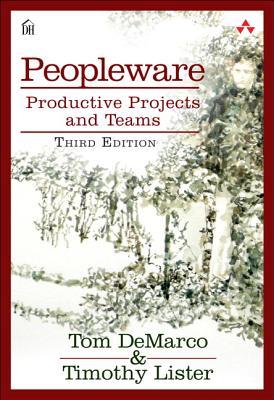
Why this is in my collection
From the publisher:
Few books in computing have had as profound an influence on software management as Peopleware . The unique insight of this longtime best seller is that the major issues of software development are human, not technical. They're not easy issues; but solve them, and you'll maximize your chances of success. “Peopleware has long been one of my two favorite books on software engineering. Its underlying strength is its base of immense real experience, much of it quantified. Many, many varied projects have been reflected on and distilled; but what we are given is not just lifeless distillate, but vivi
Highlights
- The major problems of software work are sociological, not technological — DeMarco and Lister's founding claim relocates project failure from tools to humans; a standing corrective for any model-driven practice: MDDE automates the mechanical layer precisely so the human layer gets the attention this book says it needs.
- Environment determines output — their coding-war-games data showed the same programmer performing wildly differently depending on workspace quietness and interruption load; performance is a property of the designed environment, not the individual — structure beats heroics, measured.
- Flow is the unit of knowledge-work production — deep uninterrupted concentration takes time to enter and shatters in a second; protecting it is an architectural decision about how work is arranged, the same logic behind protected modeling days and deep-work calendar blocks.
- Teamicide: management can't make teams jell, only prevent it — defensive management, bureaucracy, physical separation, and quality-cutting each kill the emergent thing that makes teams great; a catalogue of anti-rules worth as much as any methodology's rules.
- Quality beyond what the market demands is a productivity strategy — craftsmen permitted to meet their own standard work faster over time, not slower; the long-game argument for doing the model right rather than shipping the quick hack.
- Overtime is borrowed, not free — sustained overtime is repaid in undertime, turnover, and defects; systems thinking applied to human energy, and a lesson a smart-teams operating model has to encode rather than assume.
- You can't measure knowledge workers like machines — crude productivity metrics distort the very work they claim to observe; for a data person this is the essential humility: not everything that matters survives being turned into a KPI.
Highlights on this page are generated with the help of AI.