Why this is in my collection
From the publisher:
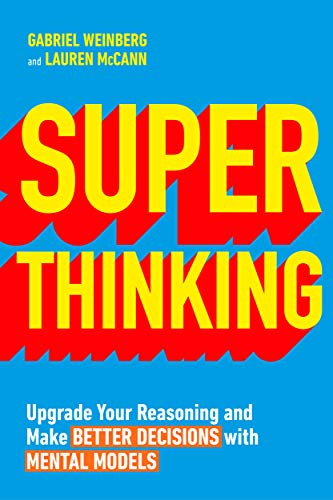
Turn yourself into a superthinker and make the right decisions every time. The world's greatest problem-solvers, forecasters and decision-makers all rely on a set of shortcuts that help them separate good ideas from bad. They're called mental models, and in this smartly illustrated anthology, you'll learn hundreds. - Use the 5 Whys model to better understand people's motivations - Prioritize an overwhelming to-do lists with the Eisenhower Decision Matrix - Set up forcing functions to help grease the wheels for changes you want to occur Distilled into a single, digestible, indispensable book, S
Highlights
- A latticework of named models is a concept library — Weinberg and McCann's anthology of hundreds of named, cross-referenced thinking tools is structurally the same artifact as a folder-per-concept library: naming plus curation makes ideas addressable and reusable.
- Naming a pattern makes it deployable — once "5 Whys" or "Eisenhower matrix" has a handle, you can invoke it under pressure; the same reason concepts in a knowledge graph need canonical names before they can link articles together.
- Forcing functions beat willpower — the book's advice to engineer situations where the right behavior happens by default is structure-beats-magic stated as a mental model: build the mechanism, don't rely on discipline.
- The wrong model is worse than no model — applying a mental model outside its domain produces confident nonsense, which argues for curation and fit over sheer collection size; a lesson for both concept libraries and architecture pattern catalogs.
- Inversion and first principles as analysis rules — working backwards from failure and rebuilding from fundamentals are repeatable procedures, not talents; codifiable moves that belong in any decision-record practice.
- Models compound across domains — the payoff of the latticework comes from combinations (feedback loops + incentives + inertia), mirroring how a connected note vault outperforms isolated notes: value lives in the edges.
Highlights on this page are generated with the help of AI.