Why this is in my collection
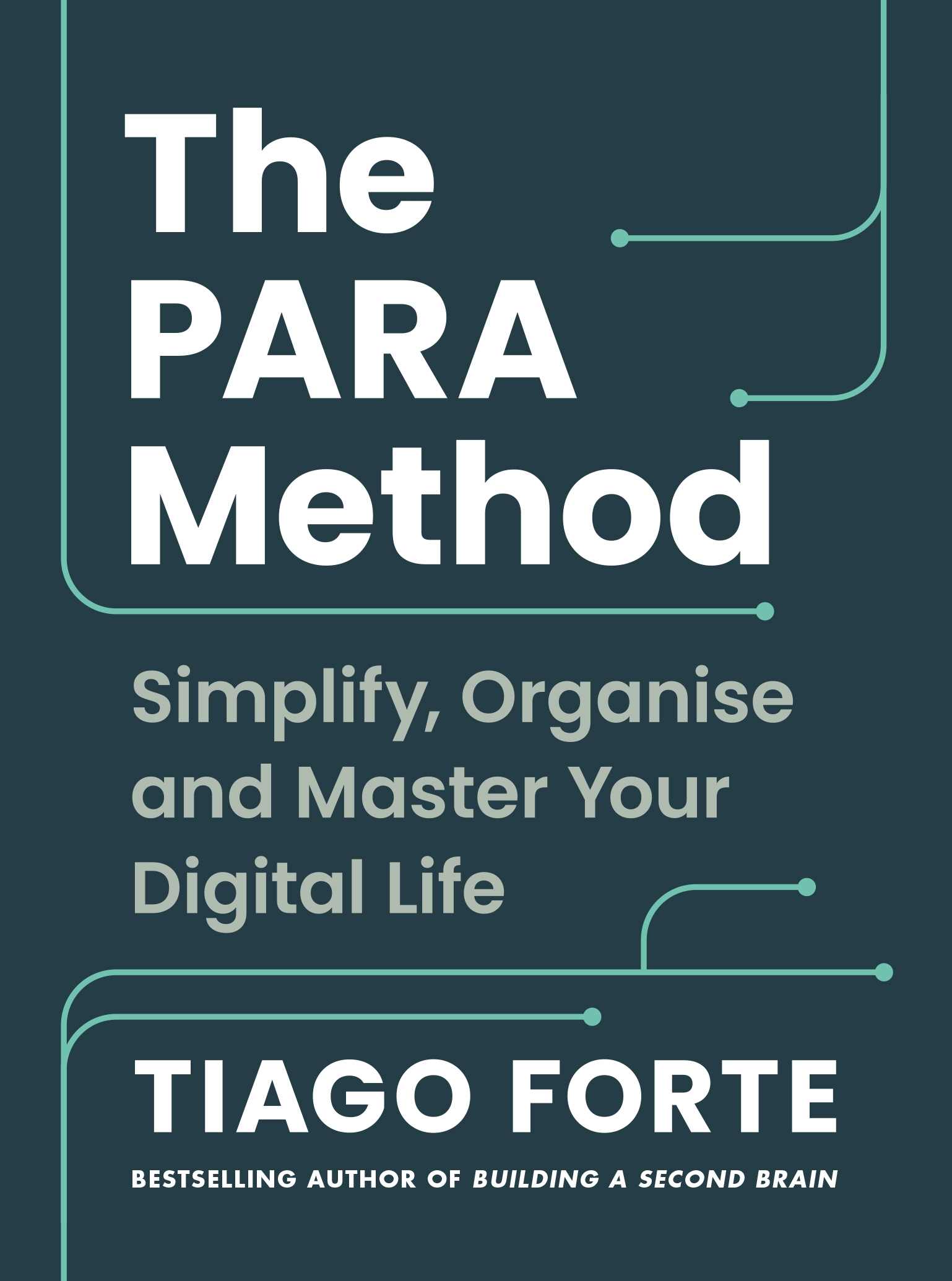
Forte's short book distills one organizing idea to its essence: sort all your digital information into just four top-level categories — Projects (active, with a deadline), Areas (ongoing responsibilities), Resources (topics of interest), Archives (everything inactive) — and sort by actionability, not by subject. It is the most widely adopted folder convention in the PKM world, and its popularity comes from an honest insight: most people's filing systems fail because they organize by topic, which answers "what is this about?" instead of the operative question, "when will I need to act on this?"
It is on the shelf as a curated four because it is the reference architecture I define my own system against. PARA is the minimal viable structure — deliberately small, deliberately universal, optimized for the person who has never had a system at all. My vault makes different bets: a calendar spine as the canonical home for anything dated, and a four-level lifecycle inside each domain (plan / active / history / insights) that is recognizably PARA's actionability gradient — but applied per-domain and enriched with decision records and preferences. You cannot articulate why you diverged from the standard without owning the standard.
For the Structure Beats Magic audience it is also the perfect teaching text: four folders, one sorting question, no software dependency. When I need to demonstrate that structure is a decision anyone can make in an afternoon — before showing what the same principle looks like at scale — PARA is the on-ramp.
Highlights
- Sort by actionability, not by topic — the operative filing question is when you will act on something, not what it is about; a genuine ontology insight, because most filing systems fail by answering the wrong question well.
- A small fixed decision space is the feature — four buckets means every filing decision resolves in seconds, and Forte is explicit that the system's power is its poverty: fewer categories, faster routing, higher compliance with your own rules.
- Projects end, areas never do — the load-bearing distinction of the method; conflating an unending responsibility with a completable project is a modeling error that produces both cluttered folders and personal overwhelm.
- The same schema across every tool — PARA's four folders replicate identically in notes, files, cloud drives, and task managers, making the structure independent of any platform; the PKM mirror of the MDDE claim that the model outlives the tools it is implemented in.
- Cheap archiving keeps the active set honest — guilt-free, reversible archival is the pressure valve that lets the working structure stay small enough to trust; retention design, not tidying.
- Where PARA strains — a single actionability axis assumes one canonical home per item, but at large scale dated content wants a time axis and reference content wants a domain axis; the method's limits are as instructive as its rules, and mapping them is how a bigger architecture earns its complexity.
My application
PARA sharpened my vault's design by contrast: I kept Forte's actionability gradient (my 1-plan / 2-active / 3-history split inside every domain is PARA's project-to-archive lifecycle) but rejected the flat four-bucket top level, because at my scale the time axis — the calendar spine — turned out to be the stronger canonical home for dated content than any actionability bucket. Writing down why PARA breaks at scale became part of my own architecture's rationale.
I also use PARA as the entry point in SBM content: it is the system I can hand a beginner without caveats, and the comparison "PARA is the starter home; here is what the same principle looks like as a full architecture" is a recurring narrative device in how I explain my vault.
_Draft — Jaco to refine with the specific project/insight._
Key ideas worth citing
- Organize by actionability, not by topic: the useful question is not "what is this about?" but "how soon will I act on it?"
- Four categories suffice for everything digital — Projects, Areas, Resources, Archives — and their power is the small, fixed decision space.
- Projects vs. Areas is the load-bearing distinction: a project ends, an area never does, and most personal overwhelm comes from treating areas as never-finishable projects.
- The Archive is a feature, not a graveyard: cheap, guilt-free archiving is what keeps the active structure small enough to trust.
- A system must be maintainable on your worst day — simplicity is chosen not for elegance but for survivability.
Related
- → concept: structure-beats-magic (PARA as the minimal proof that structure is a choice)
- → concept: 4-level-domain-structure (my per-domain lifecycle as a PARA descendant)
- → concept: calendar-as-spine (the divergence: time as canonical home, not actionability)
- → article: where PARA breaks — organizing at scale (candidate)
Highlights on this page are generated with the help of AI.