The same AI, two completely different outcomes
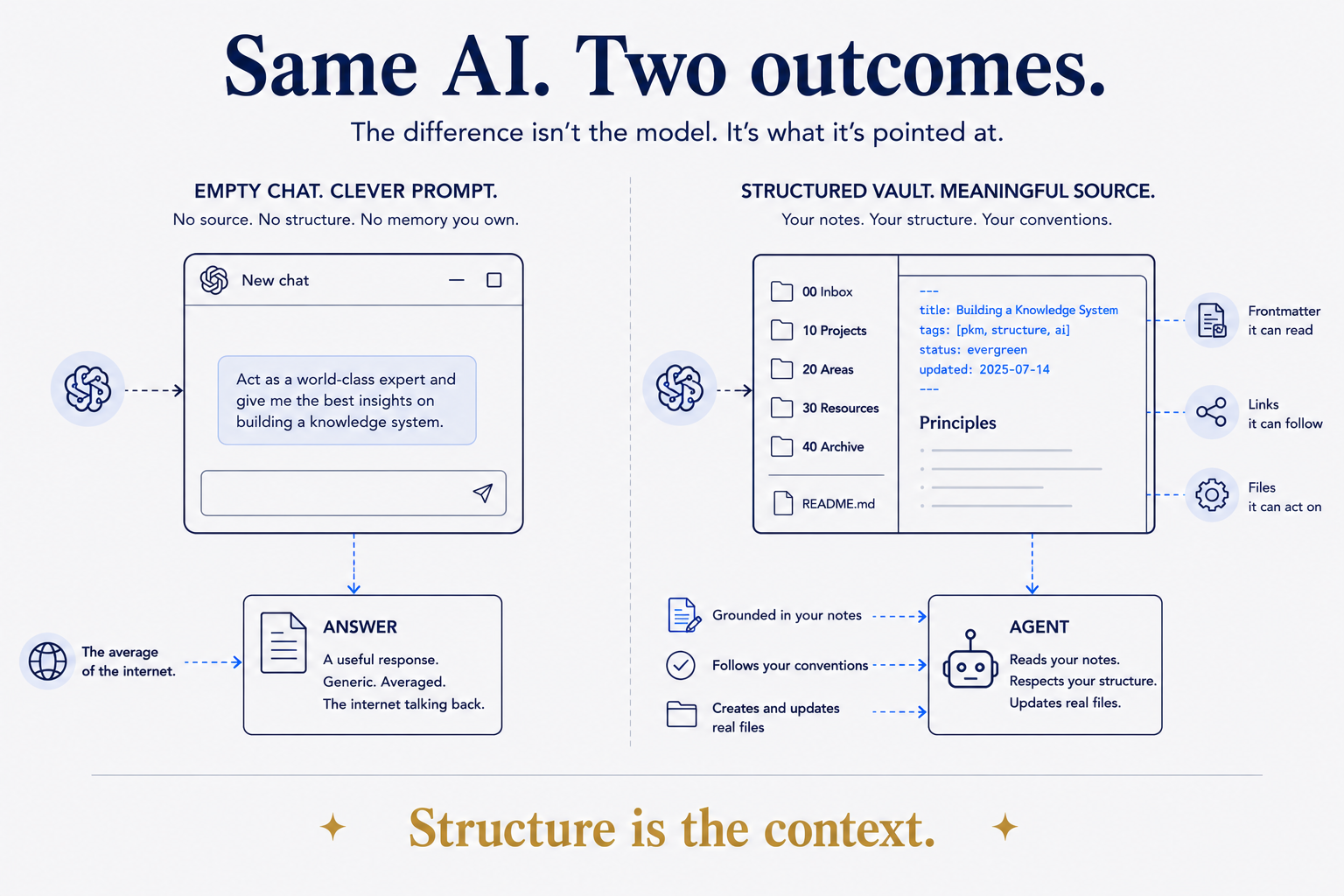
I have two ways of working with the same model. In one, I open a blank chat and type a clever, carefully-worded prompt. In the other, I point the model at a vault I've been shaping for over a decade — notes I started keeping in Evernote back in 2012, now a structured second brain with folders like finances/agreements/ and conventions the AI can read — and I ask it, in a plain sentence, to do something.
The first way gives me an answer: fluent, plausible, generic. The average of the internet, phrased for me.
The second gives me an agent: something that reads my actual notes, respects my actual conventions, updates my actual files, and hands back work that fits into a system instead of floating free in a chat window.
The difference between those two outcomes is not the model. It's the same model. The difference is entirely what I pointed it at. And that gap — between a well-phrased question and a well-structured source — is the whole game. Prompt engineering tunes the question. Context engineering builds the thing the question lands on. One is a sentence. The other is an asset that compounds.
Prompt libraries, prompt courses, prompt cheat-sheets: all of it sharpens the sentence. The thing that mattered was the source.
Context isn't what you paste. It's what you built.
Most people mean the shallow version: the stuff you paste into the chat, the files you attach, the system prompt you tweak. That's real, but it's the shallow end. It treats context as something you assemble on the way in, per conversation, by hand.
The deep version is different. Context is the standing structure of your knowledge — and if that structure is good, you barely have to assemble anything, because the AI can find what it needs. A messy pile of notes forces you to hand-feed the model every time, curating context by hand like a short-order cook. A structured base means the context is already there, in a shape the model can navigate on its own.
Which reframes the work. Building an AI-ready knowledge system is an engineering discipline you apply to the source — the same discipline that makes any system legible, applied to your own second brain. The payoff is that the better your structure, the less magic your prompts need to be. That's the trade: structure pays every query. A clever prompt pays once.
The four things that make a vault actable, not just searchable
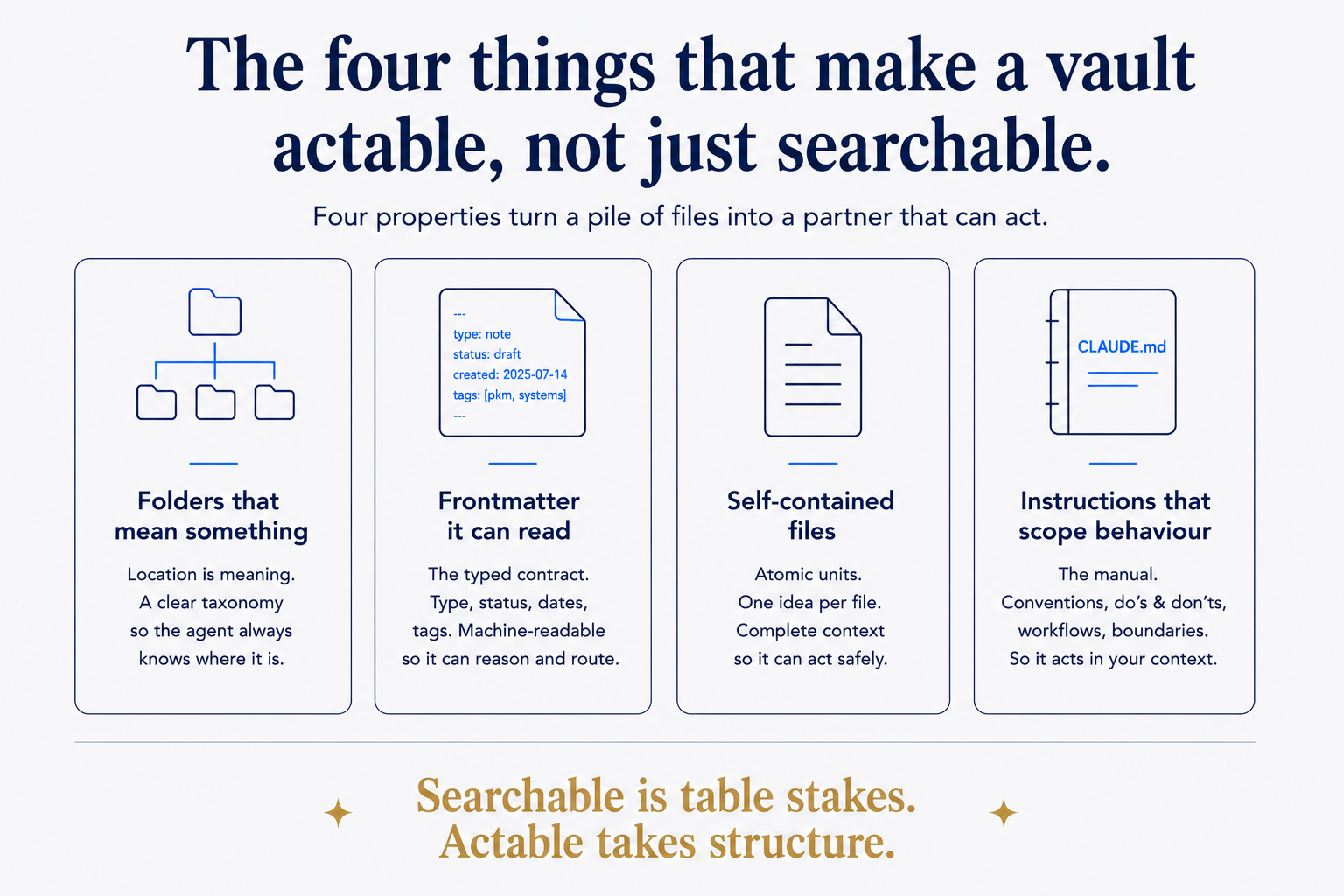
An AI can search almost any pile of text. Making it act — reliably, in your conventions, on the right files — takes four specific properties. None of them is exotic. All of them are structure.
Folders that mean something. A tag says a note is about a topic. A folder-path says where a note lives — and location carries meaning a flat tag never can. When your structure is finances/agreements/, an AI (and you) can reason about it: this is finance, it's active, it's an agreement. Tags are a substitute for structure; with real structure, you don't need the substitute. The AI walks the tree the way you would, and the tree tells it what things are.
Frontmatter it can read. Human prose is for humans. The machine-readable contract at the top of each file — type, status, dates, links — is the typed interface an AI can trust. "Which of my agreements expire this quarter?" is not a search problem; it's a query problem, and it only works if type: agreement and an expiry date are declared, not implied. Frontmatter is where your notes stop being text and start being data.
Files self-contained enough to act on. An atomic, self-describing unit — one note, one thing, with its own context and its own front door — is something an AI can pick up, reason about, and modify without needing the rest of the vault loaded in its head. A knowledge base of self-contained units is one an agent can work through file by file. A knowledge base of sprawling, interlinked, context-dependent documents is one it can only ever summarize.
Instructions that scope its behavior. The last piece isn't in the notes — it's the layered instruction files (the CLAUDE.md at the root, the domain-specific one deeper in) that tell the AI how this vault works: the conventions, the rules, the things it must never overwrite. This is context too — the most important kind. It's the difference between an assistant that guesses at your system and one that's been handed the manual.
Put those four together and you have crossed a line. The vault is no longer a place you retrieve from. It's a place an agent can operate in.
The proof is when you stop typing the context
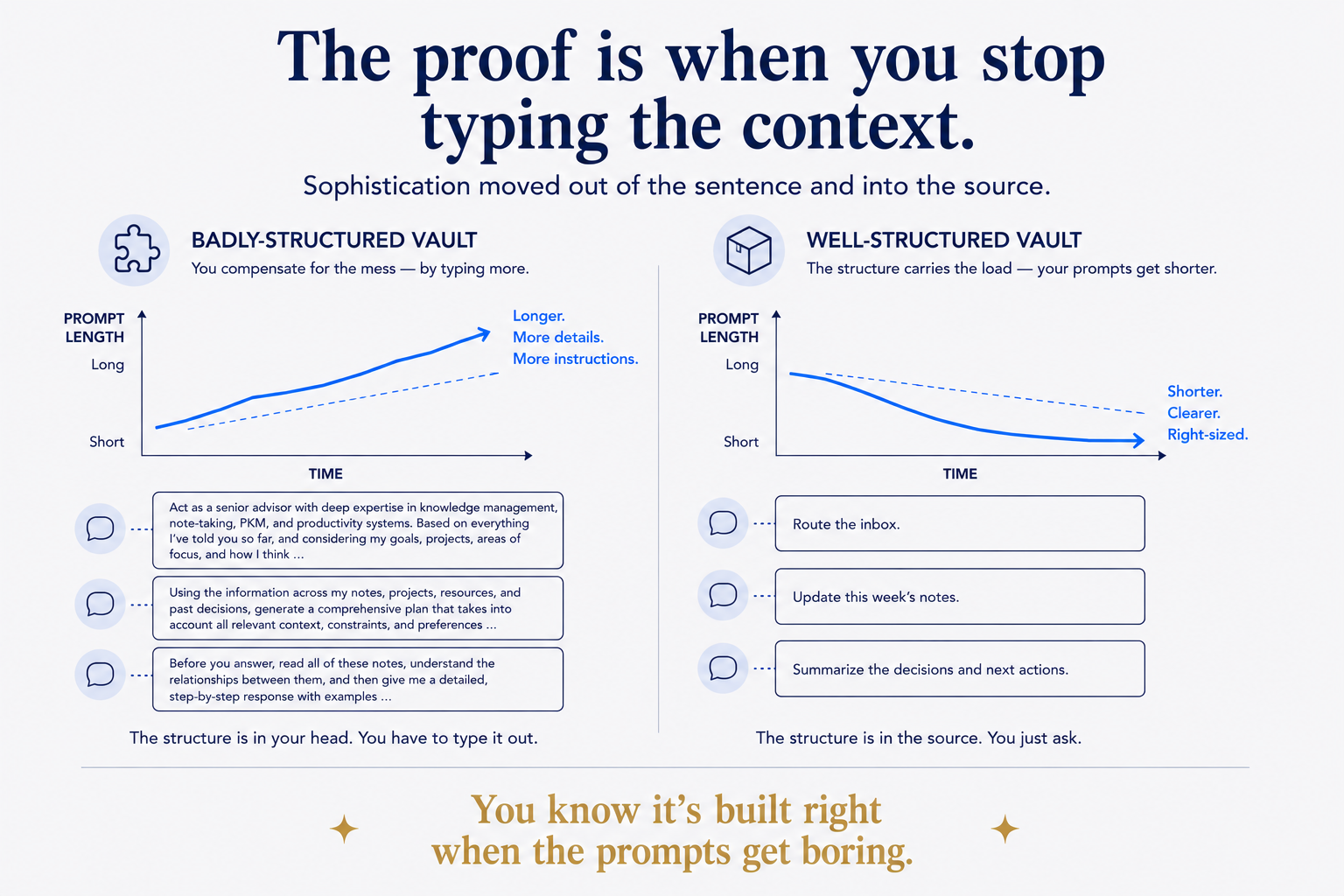
You know you've built it right when the prompts get boring.
Not "summarize this document I'm pasting." These are sentences I actually type, in Dutch, lowercase, with no context attached: "route de inbox." "verwerk de scans." "verwerk de nieuwe foto's." "verwerk de Samsung Health data." Route the inbox. Process the scans. Process the new photos. Process the Samsung Health data. Short, plain, almost lazy — and they work, because everything the AI needs to execute them is already in the structure. The conventions are in the instruction files. The data is in the frontmatter. The units are self-contained enough to act on. I stopped hand-feeding context because I built the context, once, into the shape of the vault itself.
That's the tell. In a badly-structured system, your prompts get longer and more elaborate over time as you compensate for the mess by hand. In a well-structured one, they get shorter, because the structure is carrying the load the prompt used to carry. The sophistication moved out of the sentence and into the source — which is exactly where it compounds instead of evaporating.
The obvious objection: "isn't this just good note-taking?"
Partly — and that's the point, not the weakness.
Good structure was always worth it. Folders that mean something, consistent metadata, atomic notes: I filed this way for years before an AI could read any of it, on the grounds that it helped me think and find. All of that is still true. What changed is that a second, much less patient reader arrived — one that can't intuit your sloppy conventions, can't guess what a cryptic filename meant, can't forgive the inconsistency a human eye glides over. The AI is the reader that punishes bad structure and rewards good structure, immediately and visibly.
So context engineering isn't a new discipline bolted onto note-taking. It's the old discipline, finally with a payoff you can see the same afternoon. You always suspected the structure was worth it. Now you point an AI at a well-built folder and it just works, point it at a mess and it flails — and the argument is over.
One caution: an actable vault is a vault that can be acted on wrongly
The flip side of building something an AI can operate in is that an AI can now operate in it — including in ways you didn't intend. The same structure that lets an agent update your notes lets it overwrite the wrong ones; the same access that lets it act lets it act badly. Context engineering earns a governance companion: what the AI may touch, what it must never edit, what needs your sign-off before it lands. Build the structure that lets the AI reach into your work, and build the rules that keep that reach pointed where you want it. (That's its own piece — but don't build the first half without the second.)
Stop polishing the prompt
The prompt-engineering era taught a real skill and oversold it. Yes, phrasing matters. But you can only phrase your way so far into a pile of unstructured mush, and no amount of clever wording turns a chatbot into an agent that acts on your life.
The thing that does is structure. Folders that mean something, frontmatter it can read, files it can act on, instructions that tell it how you work. That's context engineering — for one — and it's structure beats magic in its most personal form: the magic answer is a better prompt to a smarter model; the structural answer is a knowledge base worth pointing a model at. Build the second, and the first stops mattering.
Point your AI at a mess and you get a chatbot. Point it at a structure and you get an agent.
Part of the Structure Beats Magic series. The structural building blocks are in The Vault Is the Data Model and the frontmatter-as-contract piece; the governance half — what your AI may touch — is in Governing What Your AI Can Touch. The enterprise form of this argument is Model-Driven Data Engineering.