You wrote it down, so you think it's handled
"Always check the source before you trust it." "Never send without a review pass." "Always name files this way."
You wrote each of those once, in the file where standing instructions live, and then you stopped thinking about them. They're handled. They're documented.
They are not handled. They're being hoped into existence on every future run.
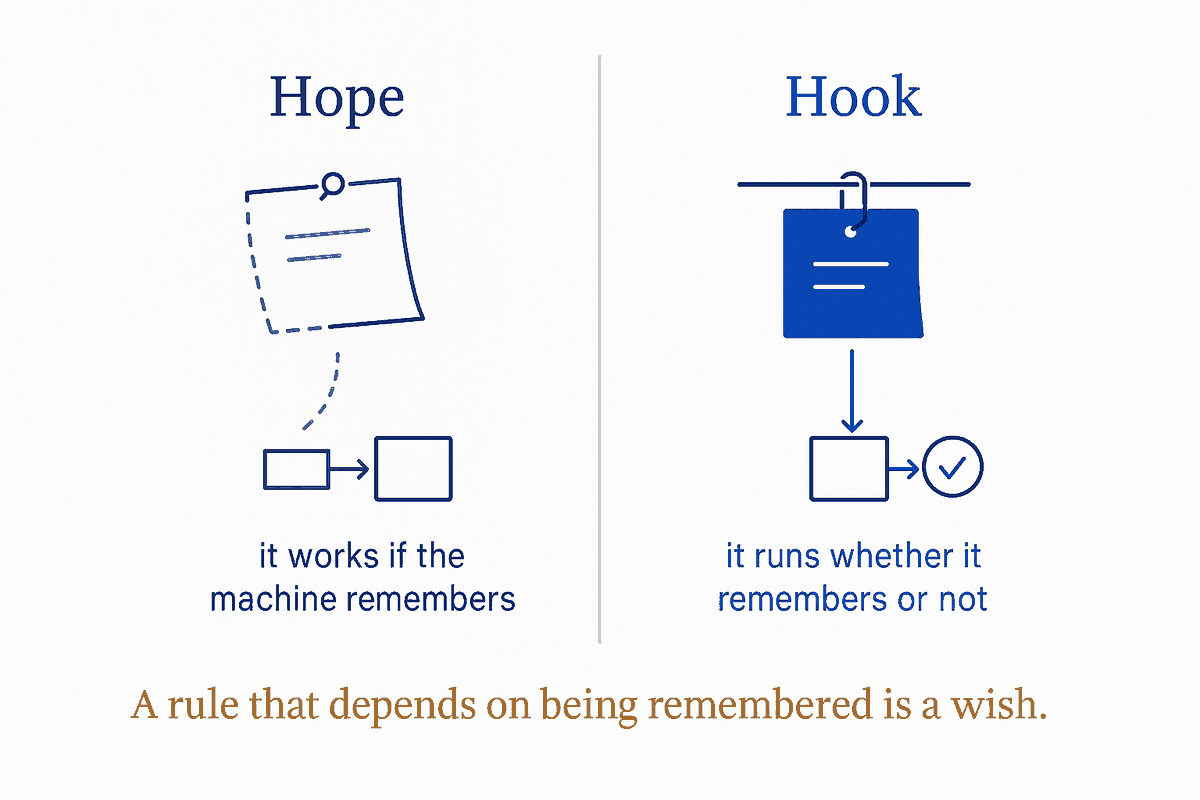
There are two species of rule, and almost nobody sorts their own. A hope is a rule you have expressed and are trusting to be honoured — a line in a document, an instruction in a prompt, a good intention held in your head. A hook is a rule attached to a moment: it runs at a fixed trigger, automatically, without anyone choosing to invoke it. The sentence can be word-for-word identical. The reliability is not remotely the same.
Every system you rely on is a mixture of the two. The interesting question is which of your rules are which — and whether the ones you cannot afford to lose are in the right column.
Hopes fail exactly when rules matter most
A hoped rule doesn't fail randomly. It fails under two specific conditions, and both are the conditions that make rules necessary in the first place.
Volume. The document grows. You add the fourth rule, the tenth, the twentieth. Adherence does not stay flat as that list lengthens — it decays, quietly, for humans and machines alike. The twentieth rule is honoured less reliably than the first, and nobody notices the crossover point where a standing-instructions file became a wish list.
Pressure. Tired, rushed, mid-crisis, three things overdue. This is precisely when the review pass gets skipped, the naming convention gets improvised, the source doesn't get checked. The rule was written for this moment and this is the moment it doesn't fire.
A rule that only holds when things are calm and the list is short isn't a rule. It's a preference. Preferences are fine — most of your rules can be preferences. The failure is not noticing which of them you've quietly filed as a preference while believing it's a guarantee.
You can only hook what you can check
There's a precondition, and skipping it is where most enforcement attempts die.
You cannot attach "be thorough" to a moment. Nothing can stand at a trigger point and decide whether thoroughness happened. The same goes for "write clearly," "use good judgment," "make it professional" — all real intentions, none of them enforceable, because no checkpoint can return pass or fail.
This is the argument in Rules You Can Verify, and it's the floor this article builds on: make the rule checkable first, then attach it to a moment. Verifiability is the floor. Enforcement is the wall. Build the wall on the floor, in that order, or you get a checkpoint that can't decide anything and quietly waves everything through — which is a hope wearing a hook's uniform.
What a hook looks like when there's no code involved
The word "hook" sounds technical. The pattern isn't, and you already live inside dozens of them.
A form that won't submit until the required field is filled. A door that locks behind you whether or not you remembered to. A pre-commit check that stops a broken file before it lands. Each one spans the range from the mundane to the technical, and none of them asks you to remember anything.
The pattern underneath all of them is the same: the rule is fastened to a point in the flow, so obeying it isn't a decision anyone makes — it's a gate the flow passes through.
Compare two versions of the same intention. "Remember to review before sending" is a hope: it depends on remembering, at the exact moment you're least likely to. "Nothing sends until a human clicks send" is a hook: the flow cannot complete without passing the gate. Identical intent. One of them survives a bad day.
The move: promote a few hopes, and only a few
Audit your standing rules — the file, the instructions, the conventions you'd claim you follow. Go through them one at a time and mark each one hope or hook. Not what you intend it to be; what it actually is right now. When I did this to my own setup, the split was stark: the rules I only wrote down are the ones I still break, and the ones that hold are the ones fastened to a trigger. Most of the list turned out to be hopes I'd have sworn were guaranteed.
Then resist the urge to promote all of them. This is not an argument for automating everything — a system with forty gates is its own kind of broken, and most rules genuinely can stay hopes. The discipline is triage. Look for the ones where forgetting is expensive or irreversible: the check that prevents sending something wrong to someone who matters, the step that prevents data loss, the validation that stops a bad record from entering the system and spreading before anyone notices.
Those few get a fixed trigger instead of a line in a document. The reminder needs you; the hook doesn't — and on the day you're not there, only one of them still fires.
Enforcement is the forgotten half of the forgotten pillar
Data and AI get the attention and the budget. Rules are the third pillar nobody funds — that's the argument in The Missing System, and it's why so much output is fluent and untrustworthy at the same time.
But there's a second omission inside the first one, and it's more common. Plenty of people do write rules. Very few attach them to anything. The rules exist, in a document, hoped-for. The systems that quietly work — the ones that behave the same on a Tuesday in a crisis as they did in the demo — are the ones that moved their load-bearing rules out of the document and into the machinery.
That's the point where Structure Beats Magic stops being a diagram on a slide and becomes something that actually holds weight. Structure that only describes intended behaviour is documentation. Structure that enforces behaviour at a trigger is architecture. Deterministic by Design is what you get when enough of the critical rules have made that move.
The good-day test
A system that works when you're paying attention isn't a system. It's a performance — and it falls apart the moment the performer isn't there.
So put every rule that matters through one question:
Does this still hold on the day I forget it exists?
If the answer depends on your memory, your attention, or your good intentions, it's a hope. That's fine for most of them. For the few where it isn't fine, stop hoping and fasten the rule to a moment — and let the machinery keep the promise you won't always remember to.