The difference is the contract: schema, ownership, SLAs, access policy, docs. Without those you shipped a file and called it a product.
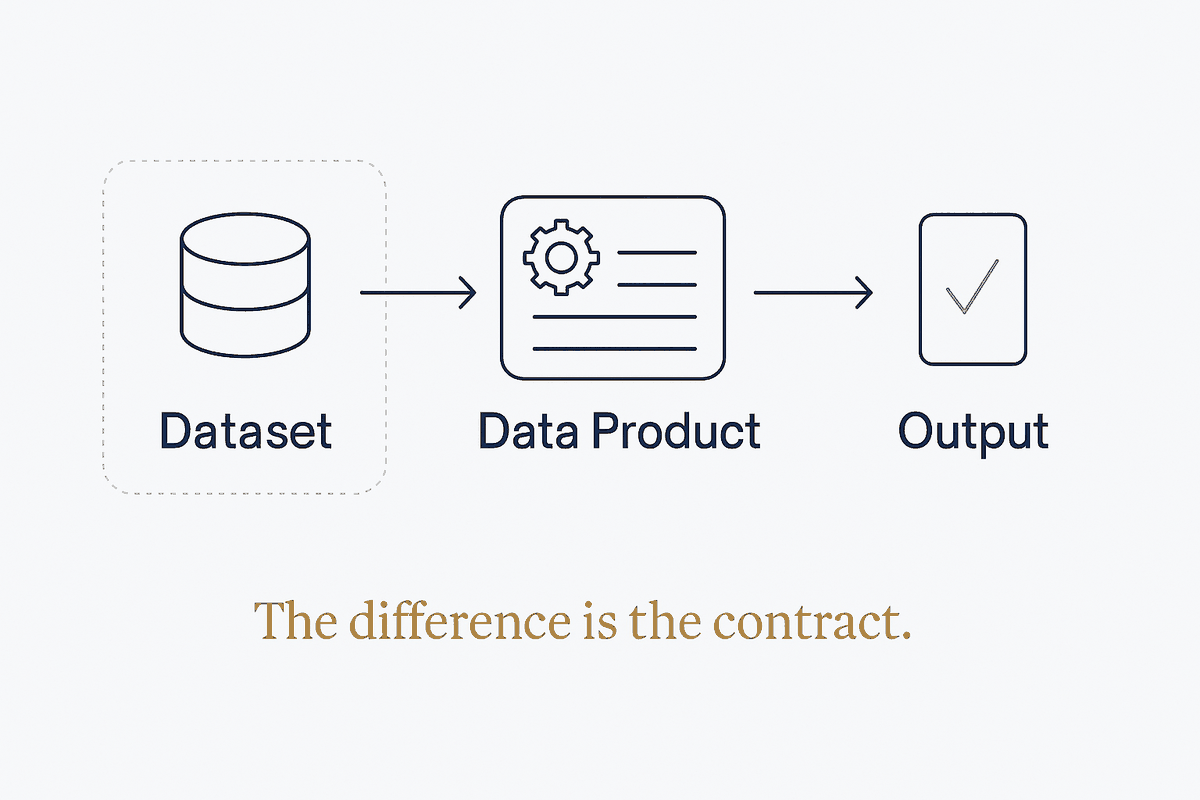
A dataset is data that exists. A data product is data plus the commitments that make it dependable: a declared schema, a named owner, a service level, an access policy, and documentation someone can act on. The distinction sounds bureaucratic until you consume one of each — the difference shows up the first time something changes upstream.
The contract is doing the real work, and every clause answers a question a consumer would otherwise have to answer by asking around. What shape is it, and will that shape change without warning? Who do I talk to when it breaks? How fresh is it meant to be, and how would I know if it stopped? Am I allowed to use this for that purpose? A dataset leaves each of these to tribal knowledge; a product answers them in a form that survives the author leaving.
This is why product thinking is a prerequisite for AI rather than an adjacent nicety. An agent consuming an unowned, undocumented, silently-drifting table cannot ask around. It will faithfully reason over whatever arrives and produce output whose quality tracks a schema change nobody announced. Reliability downstream is bounded by the contracts upstream, and no model improvement raises that bound.
There is a further step worth naming: usable is not the same as understandable. A well-governed table with clean data and a real owner is usable — a consumer can trust it. Understandable means the meaning travels too: the entities, the relationships, the rules. That is the point at which data stops being a dependable input and starts being something an agent can reason across rather than merely retrieve.