Defining what you are not interested in, so the system can filter to what matters — focus lives in the negative space.
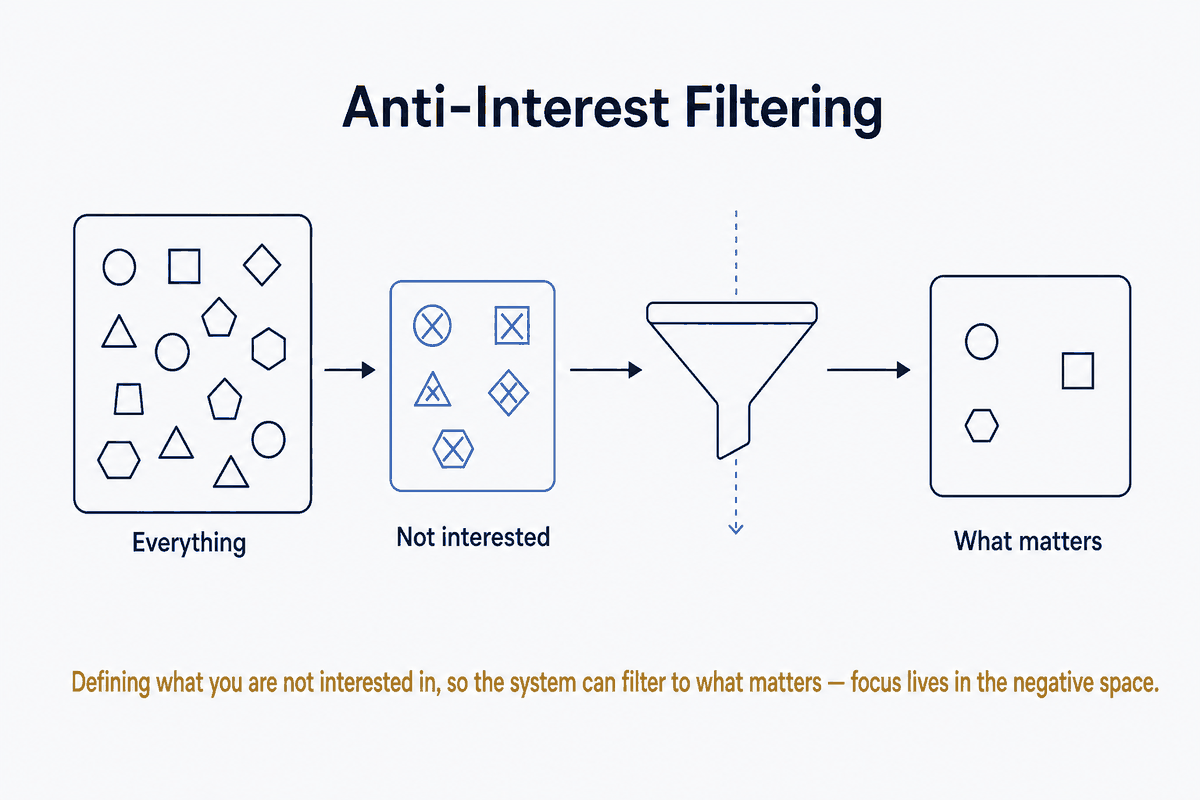
Explicitly recording what you do not want to see. The mirror image of preferences: not what draws you in, but what you actively keep out. In a personal recommendation system this is the brake beside the engine.
Why it is indispensable
A system that only knows what you like converges on an echo chamber. Similarity on similarity narrows by itself: every recommendation resembles the last, and the edge of what you encounter creeps inward until you only see more of the same. Recommendation (Affinity Matching) needs this brake to avoid dead-ending in its own success.
The commercial model deliberately omits the brake — narrowing toward what you will certainly click is a feature there, not a bug. Building one in anyway is one of the things that keeps your system healthy where the algorithm imitating it is not.
Two kinds of "no"
There is a difference between not interesting (noise — ignoring is enough) and actively unwanted (subjects, sources or tones you deliberately keep out of your attention). Only the second belongs in explicit anti-interest rules; recommendation itself resolves the first. The brake is for what you do not want to leave to chance.
What it yields
Anti-interests are not a negative list but a form of curation. They define the outer edge of your attention space just as your interests define its centre. Together — engine and brake — they give a system that widens without wandering and deepens without narrowing.