The number of people who'd have to disappear before your system becomes unmaintainable — and for most personal systems that number is one.
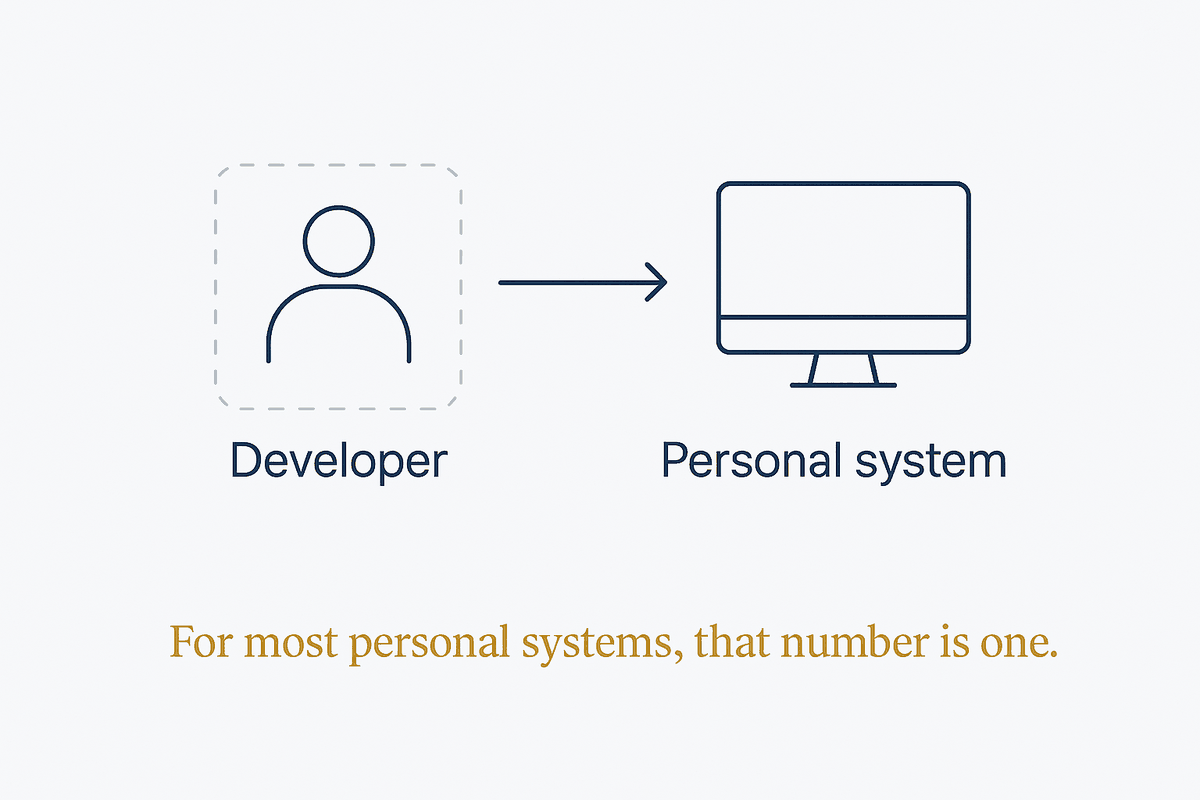
How many people would have to disappear before this becomes unmaintainable? If the answer is one, you have not built a system — you have built a dependency on yourself.
Borrowed from engineering ("bus factor", or "truck factor"), and worth keeping because it is blunt. In management language the same idea is key person risk; in a steering committee that phrasing travels further. The engineering version is better for personal systems because it refuses to be polite about it.
Why it matters for a second brain
A personal knowledge system looks like the one place this cannot bite you — it is yours, you are the only user, so who cares? Two answers.
The bus is usually not a bus. It is six months away from a project, a sabbatical, a new job, or simply forgetting. Future-you is a different person with none of the context. Every system with a bus factor of one is already failing for its most frequent visitor: the version of you who has moved on.
AI made the second reader real. A structure only you can navigate is a structure an agent cannot navigate either. The moment you want a model to reason over your work, "it is all in my head" stops being a quirk and becomes the binding constraint. Externalising is no longer about succession planning; it is about whether the system can be used at all.
The test
Point at any part of the system and ask: if I stopped explaining it, would it still be understandable? Not "is it documented" — documentation rots — but can this artifact tell you what it is. That is Maps Everywhere stated as a risk rather than a practice: every layer without a map is a bus factor of one, locally.
What it is not
Not an argument for writing everything down. Exhaustive documentation is its own failure — nobody reads it, so it goes stale, so nobody trusts it, so nobody reads it. The target is navigability, not completeness: enough structure that a stranger (or an agent, or future-you) can orient without a guide.
Related concepts
- concept-maps-everywhere
- Tribal Knowledge
- Write-Only Knowledge