The org-scale second brain: shared, structured, permission-aware knowledge AI can rely on. Wiring tools together isn't it — access is not memory.
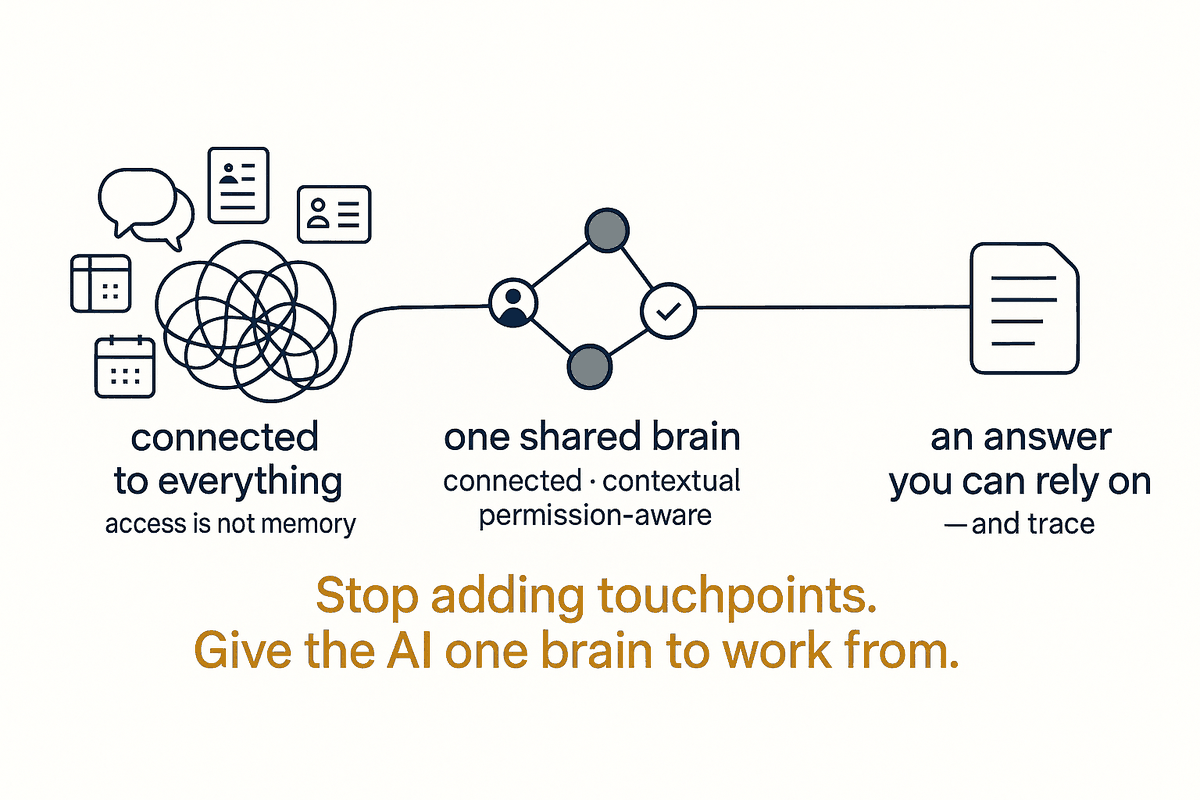
A company brain is the organisation-scale version of a personal second brain: one living, structured, permission-aware knowledge layer that both humans and AI can rely on — connected, contextual, continuously updated. It is what almost every "AI-enabled" company is missing, because most teams are doing something that looks similar and isn't: wiring AI into tool after tool and hoping scattered documents start behaving like a system.
The trap has a name: access is not memory. Connecting an agent to twenty systems through MCP gives it reach, not understanding. It can now fetch from everywhere — but nothing tells it how a decision relates to a project, which document supersedes which, whose customer this is, or what the acronym meant last quarter. A pile of connections is plumbing. A brain is what the plumbing was supposed to feed: a knowledge graph where people, projects, decisions and customers are linked, so the AI reasons over structure instead of searching through text.
Everything a personal vault proves at individual scale is what a company brain needs at organisational scale — the same blocks, bigger board. Curated sources instead of ingesting everything; a structured, connected core instead of folders of prose; explicit rules and validation so the system can check itself; one authoritative place that publishes outward rather than syncing everywhere. The additions at company scale are the hard ones: permissions (who may see what must be structural, not hoped-for) and shared semantics (the vocabulary itself has to be governed, because company language is messy, acronym-heavy and always drifting).
This is the difference between AI that sounds smart and AI that is useful at work. An assistant with access answers fluently from whatever it happened to retrieve; an assistant with a brain answers from the organisation's actual, current, connected knowledge — and can say where it came from. Teams don't win by adding more AI touchpoints. They win by giving all of them one structured brain to work from.