Three practices — personal knowledge, data modelling, and the thinking itself — that stay separate but keep feeding each other. The convergence is the result; the pollination is the mechanism.
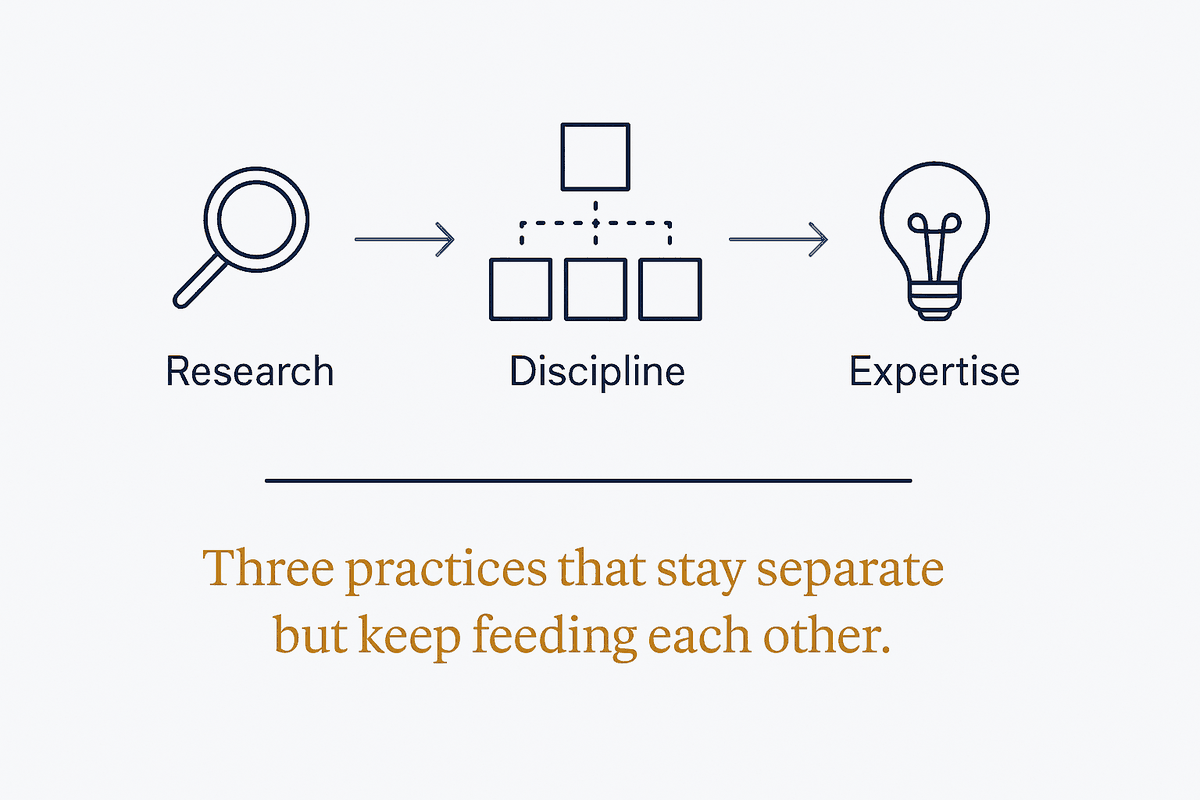
Three practices run in parallel — organising your own knowledge, modelling data for organisations, and the thinking that sits above both. They are not one discipline and should not be merged. But each keeps producing things the others turn out to need, and that traffic is worth more than any of the three on its own.
The three, named plainly: PKM — the personal vault, the capture habits, the decision records. MDDE — model-driven data engineering, the client-facing craft. Mind — the attitude layer: how you decide, what you refuse to automate, which effort you keep because it is doing work on you.
The temptation is to call this convergence and be done. Convergence says separate things became one thing, and it is the wrong word here, because nothing merged. The vault did not become a data model; the client work did not become journalling. What actually happens is smaller and more useful: a technique invented on one side turns out to solve a problem on another, and it crosses over.
The traffic runs in every direction, which is how you know it is not just one field borrowing from another. Decision records were a governance habit from enterprise architecture; applied to a personal life they produced 250 IDRs, PDRs and BDRs, and the discipline of writing down the options you rejected turned out to matter more privately than professionally. It then crossed back: a client asking why a model looks the way it does is asking exactly that question. Metadata-driven generation was built for data platforms; pointed at a personal vault it produced sites, indexes and maps that no one hand-maintains. Publish-by-default came from the writing practice and now governs how concept libraries route themselves.
⭐ The test is that it survives the transfer. A method that only works where it was invented is a local trick, and the honest way to find out is to run it somewhere it was not designed for. That is the whole reason the personal vault matters to the professional argument — not as a portfolio piece, but as the place where a method either generalises or is quietly exposed. Applying structure to travel is not a hobby project; it is the falsification test.
The failure mode is the opposite of the promise, and it is worth naming. Cross-pollination becomes an excuse when everything is declared connected to everything, because at that point the word stops distinguishing anything. The claim is only interesting when you can name the specific technique, where it came from, and what it fixed on arrival. If you cannot trace the crossing, nothing crossed.
Convergence does eventually show up, but as a symptom rather than a goal. When enough techniques have crossed in enough directions, the three practices start to look like one system from a distance — the same structural instinct applied at three scales. That feeling is real and it is the payoff. It is just not something you can aim at directly: you get it by keeping the practices distinct enough that they still have something to teach each other.
Related concepts
- A Compounding Asset
- concept-maps-everywhere
- A Modeled Self