Use your own tool/method on your own real work before and while you ask anyone else to — dogfooding surfaces the flaws a demo hides.
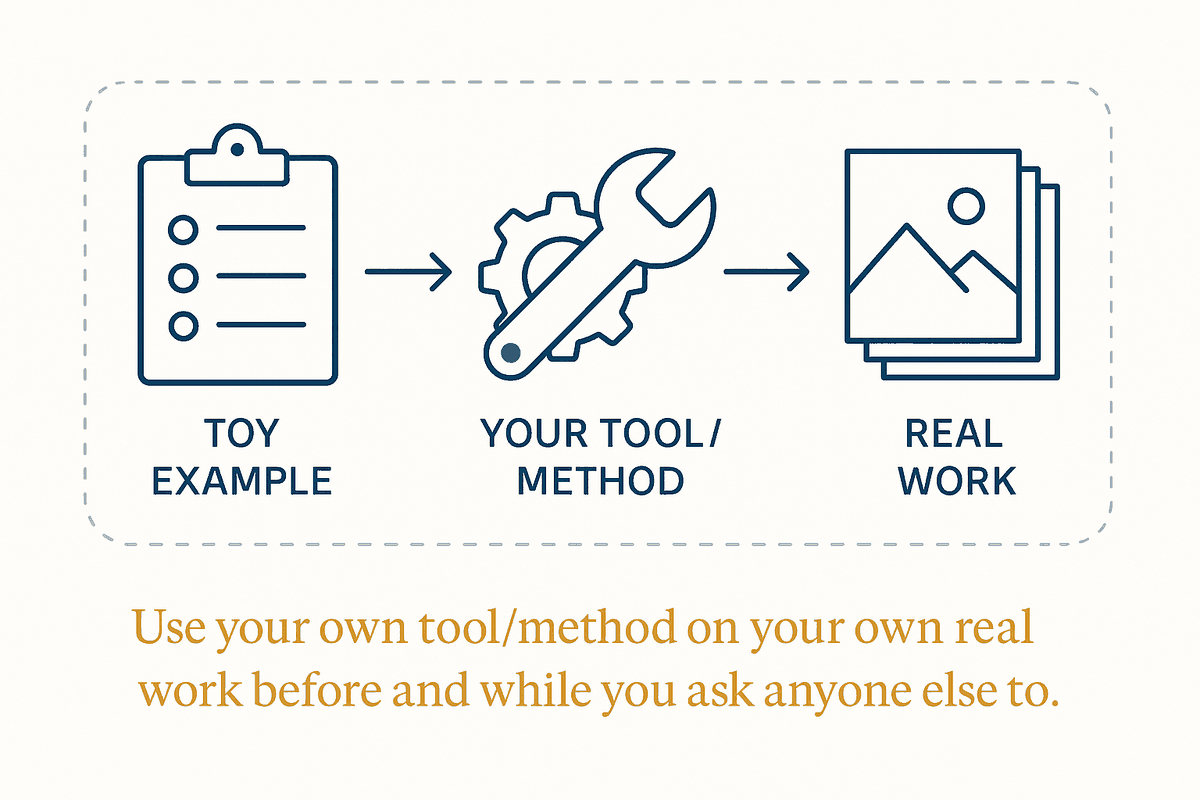
Use your own tool/method on your own real work before and while you ask anyone else to — dogfooding surfaces the flaws a demo hides.
Dogfooding is the engineering discipline of running your own product on your own real problem — not a toy example, the actual thing. If the metadata-driven pipeline is any good, it should be good enough to run on your own 700 articles, not just on a client's data warehouse. The test isn't "does the demo work"; it's "would I bet my own daily work on it." That question kills vapourware, because you can't hand-wave a step you have to actually run every day.
It sits next to Practice What You Evangelize, and the difference is worth keeping. Practice-what-you-evangelize is the broader stance — your whole operation is built on the method you teach, so the foundation is the proof. Eat-your-own-dogfood is the narrower, concrete engineering practice underneath it: use the tool on your own work, find the flaws before a client does, and let the fact that you rely on it be the credential. One is the philosophy; the other is the Tuesday-morning habit that makes the philosophy true. The MDDE-on-my-own-content work is dogfooding in the literal sense — the same metadata-driven pipeline preached for data warehouses, run on the article corpus. (English keeps two idioms for this — "eat your own dogfood" for the product-usage version, "practice what you preach" for the older moral version; the technical world adopted the first because it adds the sharp test: not just believe it, use it.)
Related: Practice what you evangelize · Proof not slides · Show the machinery · Structure beats magic.