Let two different AI models answer independently, break both answers into claims, and use their disagreements and unique finds to decide what to check — then let one authoritative source decide. The audit's four-eyes principle, applied to machines.
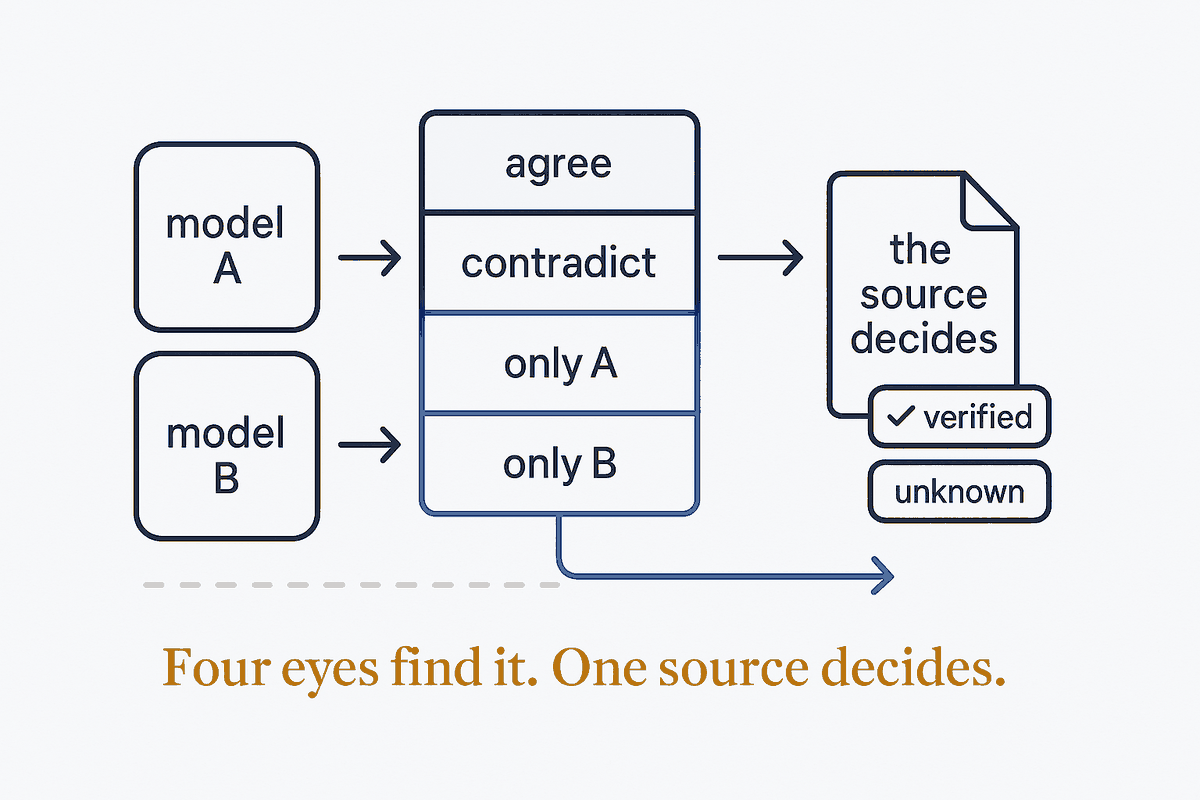
The four-eyes principle comes from audit and banking: nothing important is done on one person's judgment. Applied to AI it is tempting and half right. A second model from another provider does catch things the first missed — on our USA road trip, Claude and ChatGPT sometimes contradicted each other, and sometimes one found a closure or an opening-time change the other never mentioned. But two models agreeing proves little (see One Witness, Not Two).
So the pattern has two halves. Four eyes to find what to check; one source to decide.
1. Ask independently. Both models get the same question, never each other's drafts. 2. Break answers into claims. "The visitor centre is open 9–5 on Monday" is one claim, with a place, an attribute, a value and a date. 3. Resolve the entity first. Bind every claim to one real place — a map ID, a park code, a trail with coordinates. A trail with the same name 148 km away is a different trail (Resolve the Entity First). 4. Sort the claims. Agree · contradict · only in A · only in B. The contradictions and the unique finds are the valuable part — they are where one model saw something the other didn't. 5. Check every claim against a source, agreements included, using a fixed source hierarchy (Consensus Is Not a Source). 6. Give every claim a status: verified (with source and time), contradicted, unknown, or stale. High-impact unknowns go to a person.
Compared with a model council — answers, peer ranking, a chairman's synthesis, as in Karpathy's llm-council — the difference is step 5: the council settles disagreement among the models, this pattern settles it outside them, claim by claim.
The models are good at finding candidate facts and bad at being the authority on them. This pattern uses each for what it is good at. It is Never Marks Its Own Homework taken one step further: the judge is neither of the builders, and not another model either — it is the source.