No complaints does not mean no problems. It usually means people adapted to the errors and stopped mentioning them.
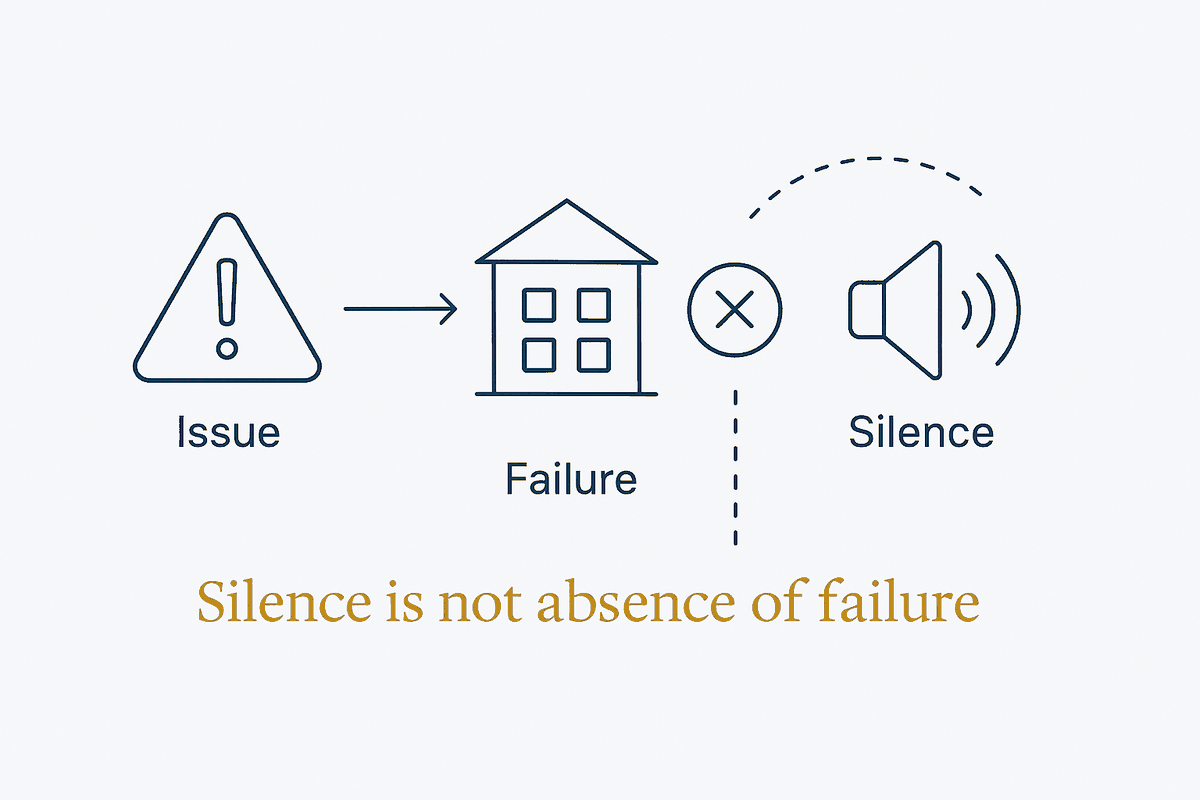
The most reassuring signal in any system is the absence of complaints, and it is the least trustworthy. People are extraordinarily good at routing around broken things: the analyst who keeps a private corrected spreadsheet, the team that knows to ignore column four, the workaround so old nobody remembers it is one. None of that generates a ticket. All of it is failure, absorbed.
This produces a specific kind of blindness. Reported problems are a sample biased toward the loud, the recent and the unavoidable; everything quietly compensated for is invisible by construction. So a system judged by its complaint volume is being judged on how tolerant its users are, which is a fact about the users. The absence of evidence has been read as evidence of absence, and the longer it holds the more confident the wrong conclusion becomes.
The correction is to go and look rather than wait to be told. Sample outputs against reality on a schedule. Check whether the thing that should have arrived actually arrived, not whether the job reported success. Ask people what they work around instead of what is broken — the phrasing matters, because "what's broken" invites the answer "nothing, really" while "what do you fix by hand" produces a list.
The same discipline explains why an unmonitored automation is not a solved problem but a deferred one. It ran, therefore it worked, therefore nobody looked — and the gap between those steps is where months of silent divergence accumulate. Proactive verification is not distrust of the system; it is the recognition that a healthy system and an ignored one emit exactly the same signal.