Every piece of work feeds back in, so the system is smarter next time than last.
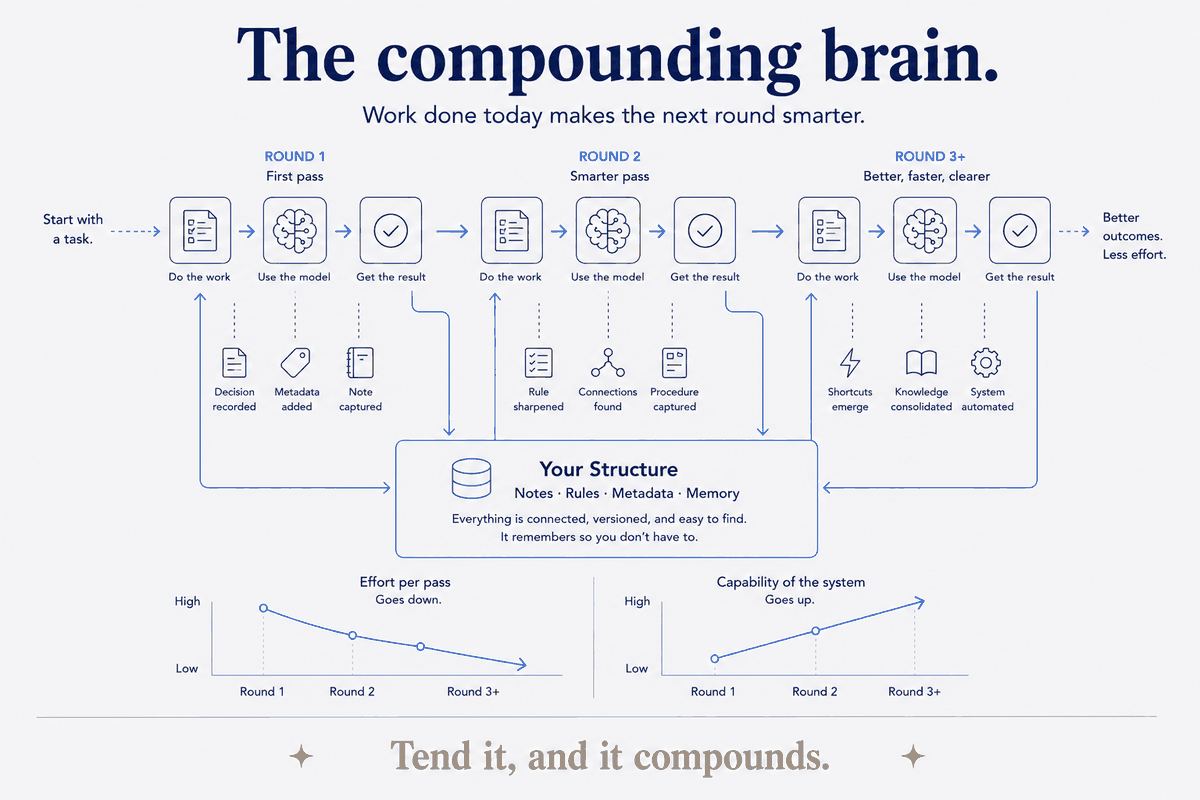
A brain rewires itself with use; a good system should too. Every decision, procedure and lesson feeds back into the structure — tend it, and it compounds.
Most knowledge work is quietly lossy. You solve something hard on a Tuesday, and by the following month the reasoning is gone — so you solve it again, slightly worse, from memory. The work happened; the learning evaporated. A compounding brain is simply the refusal to keep paying that tax: the decision gets recorded, the rule gets sharpened, the procedure gets captured, and the next round starts from there instead of from scratch.
Watch what that does to the two curves that matter. Effort per pass goes down — the second time is faster than the first, the fifth barely costs anything. Capability goes up — the system knows more than it did, so it can attempt more than it could. Those curves crossing is the whole promise. Nothing here is a productivity hack; it's just interest, paid on work you already did.
The catch is in the word tend. Compounding is not automatic — a structure only feeds back if you actually close the loop, and a system nobody tends decays exactly as fast as one nobody built. Small, boring, consistent deposits. That's the mechanism.
Related concepts
- Compile, Don't Retrieve
- Reading Intelligence
- Reinforcing Loop
- concept-self-destructive-spiral
- The Mistakes File
- Zettelkasten
- A Compounding Asset
- Retrieval Is Not Memory
- Facts Expire