The whole architecture reads as a brain — atomic documents are neurons, frontmatter links are synapses, the vault is the brain, federation is brains talking, and each cell holds a memory.
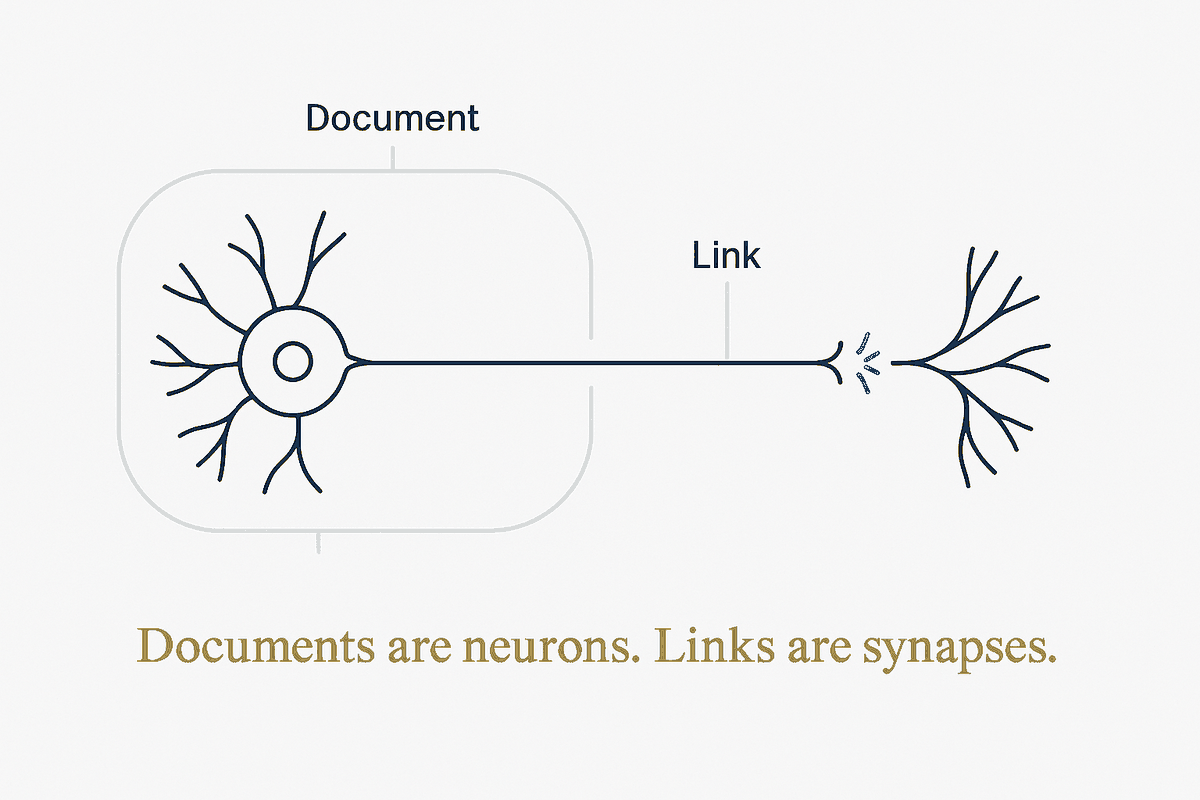
The architecture isn't a database — it's a brain. Documents are cells; links are synapses.
The reason the whole family of concepts is named for a brain and not a database: the structure genuinely maps to how a brain is built. A database stores rows; a brain remembers, connects, and grows. Same underlying structure — a picture that stays.
| Brain | Structure Beats Magic | |---|---| | Neuron (one cell, one memory) | Atomic Document — one thing, indivisible, holding a memory | | Synapse (the wiring between cells) | Loosely-coupled frontmatter links — Links, owner, IDs | | The brain (all the cells together) | The vault — the sovereign node | | Two brains talking | Federated Brains — synapses at the boundary, validated | | Memory (what a cell holds + how it strengthens) | the content of a document + its change-log; the system compounds with use | | Learning / rewiring | new links, new rules, roll-ups — the brain rewires itself as you work |
Why it matters (not just pretty): the metaphor is a design compass. It tells you what good looks like — cells should be small and single-purpose (atomic), value lives in the connections not the pile (synapses over copies), and a brain that isn't used atrophies (a vault you don't tend stops compounding). It also makes the thesis land for a non-technical listener in one sentence: "I'm building a second brain — literally: cells, wiring, memory — and teaching two of them to talk." That's Structure beats magic you can picture.
Article potential
- B2C (SBM): "Your Notes Are Brain Cells" — the metaphor as the through-line; atomic docs = neurons, links = synapses, the vault learns. Warm, memorable, thesis-level.
- B2C/method: "A Brain That Talks to Another Brain" — the neural metaphor extended to Federated brains (the Annemarie story underneath).
- B2B (jacovanderlaan/MDDE): the same mapping for enterprise — atomic data products, metadata links, validated exchange = a nervous system for a data platform.