A boundary that exists only as a rule people must remember. It holds until someone is busy — then it leaks. Policy describes the boundary; only structure enforces it.
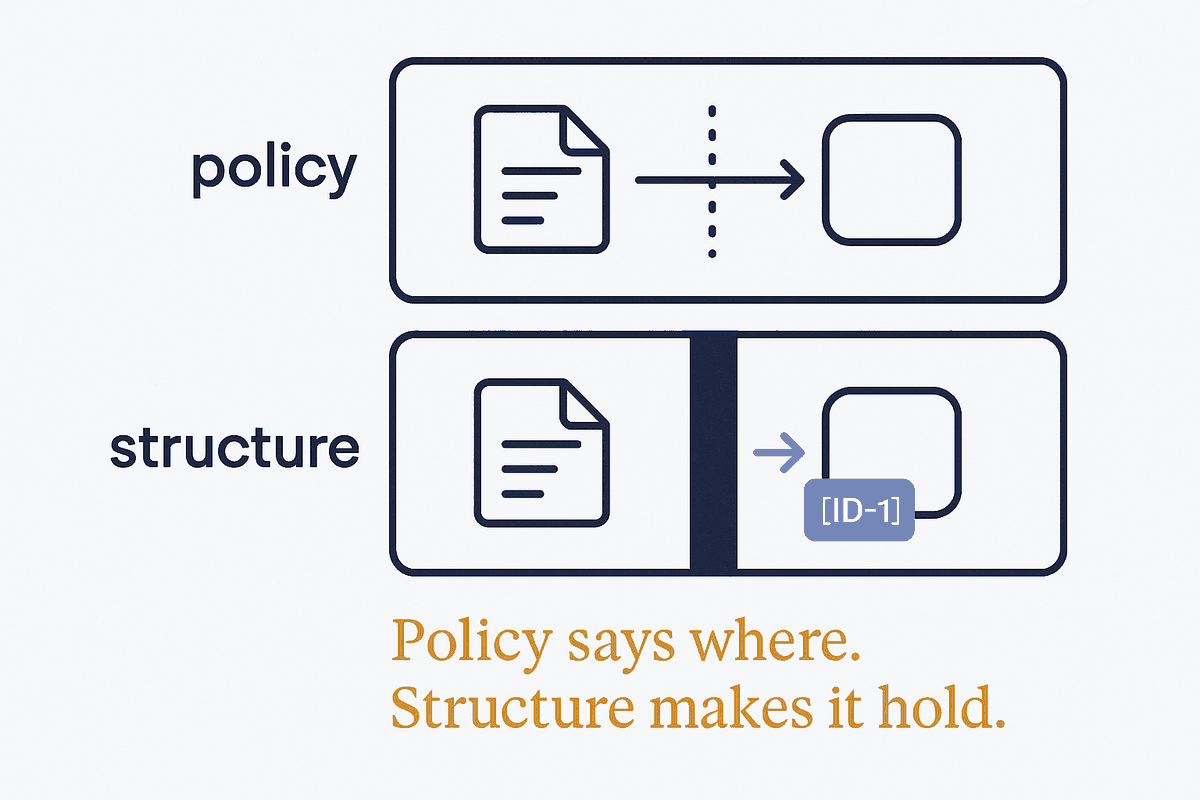
A policy wall is a boundary that lives in a document instead of in the system. "Never paste client data into a public chatbot." "Don't share the sales numbers with the other team." It is written down, signed off, explained in a training — and it holds exactly as long as every person remembers it, every time, under pressure.
That is not a boundary; it is a hope with a signature. The evidence is public. The Dutch data protection authority received dozens of breach reports in 2024 and 2025 from organisations whose staff pasted CVs, youth-care files, patient data and customer addresses into AI chatbots — in organisations that had a policy against it. Banks keep paying fines for the same reason: the Chinese wall was on paper, and people walked through it.
The fix is not a stricter policy. It is to make the wrong move hard and the right move easy: a business AI account with no training on the data, an airlock in front of the model, data the model can only see through a schema, contexts separated by an information barrier built into files and keys. Policy still matters — it says where the boundary is. Structure is what makes it hold. That is structure beats magic, applied to compliance.
The test: if the boundary would fail the day one tired person ignores it, it is a policy wall.