Listen for the missing word
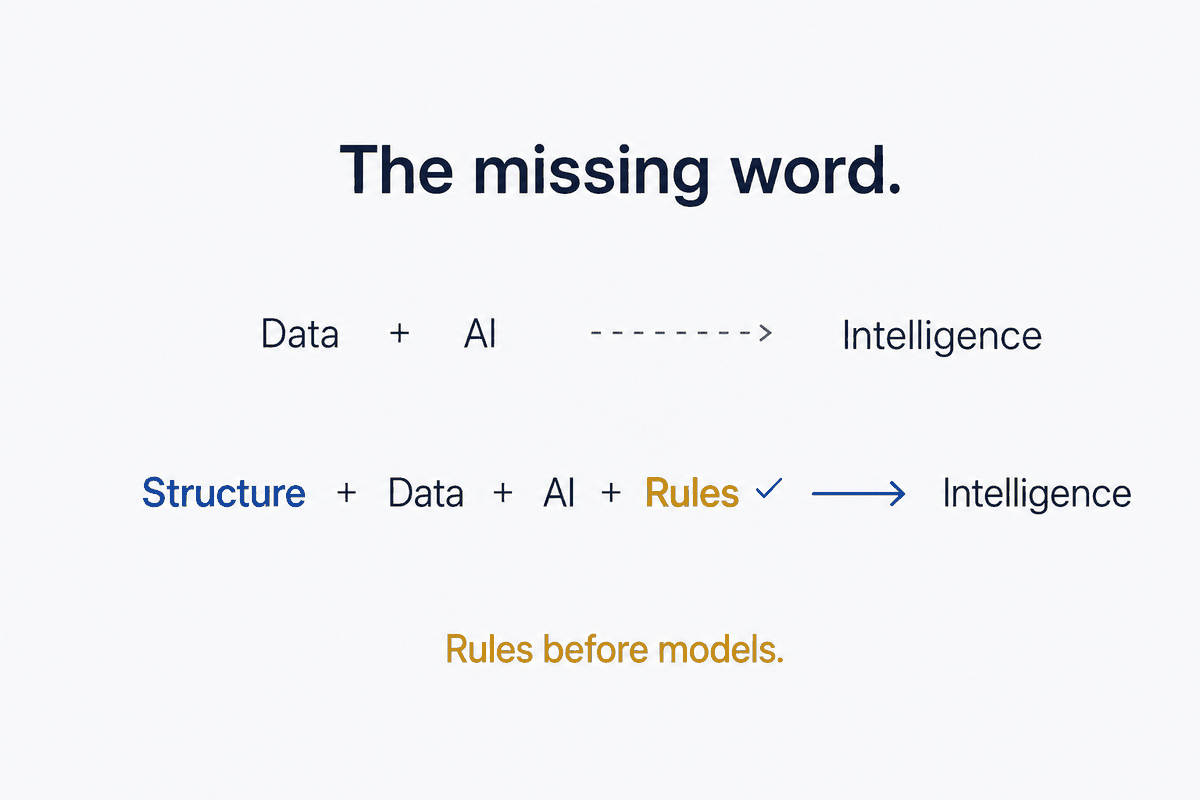
Sit through any pitch about the future — of work, of knowledge, of your company — and you'll hear the same two words, welded together like they've always belonged: data and AI. Feed the AI your data, the story goes, and intelligence falls out. It's on every slide, in every keynote, at the top of every strategy deck. Data plus AI equals magic.
Listen for what's not said. Nobody names the thing that decides whether that equation produces intelligence or produces confident nonsense. Nobody says the word that separates a system you can trust from a system that's merely fluent. The word is rules — and its absence isn't an oversight. It's the whole reason so many "data + AI" projects feel impressive in the demo and hollow in production.
Data + AI is an unstable pair. It needs a third term to hold. That term is rules, and this is the argument for putting it back.
What each of the popular two actually gives you — and doesn't
Data gives you material. It does not give you meaning. A pile of data — your notes, your transactions, your documents — is raw and mute. It sits there. The pitch treats "having the data" as the hard part, but having it was never the problem. Making it mean something reliably is.
AI gives you fluency. It does not give you truth. A model will read your data and produce something articulate about it, instantly, on demand. What it will not do — cannot do, by construction — is guarantee that the articulate thing is correct. It generates the plausible. Plausible and true overlap often enough to be seductive and diverge often enough to be dangerous. The fluency is real. The reliability is borrowed, and the AI can't post the collateral.
So the honest version of the equation is: material you can't trust to mean the same thing twice, plus fluency you can't trust to be right. Put those together with nothing in between and you get a system that is convincing — which, for anything that matters, is worse than a system that's merely useful. A convincing wrong answer costs more than an obvious one.
That gap — between material-without-meaning and fluency-without-truth — is exactly the shape of the missing word.
Rules are how meaning stops being a matter of hope
A rule is a piece of your judgment, written down once, in a form that can be checked — automatically, every time, without you in the room.
That's it. Not a mystical governance framework. A written-down, executable expression of something you know to be true: an agreement has an end date. This claim contradicts one I already accepted. A revenue number computed this way must tie to that source. This "highlight" is a near-duplicate of one I saved last month. Small, specific, checkable statements — the accumulated judgment of a person or a team, made mechanical so it holds even when nobody's paying attention.
Put a layer of those between the data and the AI, and both unstable terms get stabilized at once. The AI can propose freely — a link, a summary, a change, a conclusion — because its output isn't trusted on its fluency alone. It's checked against the rules first. Does this contradict what's known? Does it duplicate what exists? Does it violate something you've declared? On a mismatch, the system does the one thing a raw model never does: it flags, it doesn't guess. It surfaces the problem instead of confidently papering over it.
Now the material has enforced meaning, because the rules define what the data is allowed to say. And the fluency has a leash, because nothing the AI produces is treated as true until it survives the checks. The two unstable terms hold each other up — through the term nobody named.
The formula, with the missing terms restored
The popular equation is missing two words, not one. Written out fully:
Structure + Data + AI + Rules → Intelligence.
Structure comes first because rules need something to attach to — you can't check "an agreement has an end date" against a mush with no notion of an agreement. Structure is what makes data legible enough to govern. Data is the material. AI is the fluency and the labor. And Rules is the verification layer that turns the whole thing from impressive into trustworthy — the difference between a system that sounds intelligent and one that behaves intelligently.
Drop any term and it degrades in a recognizable way. No structure, and the rules have nothing to grab. No rules, and you're back to data + AI: fluent, fast, and quietly unreliable. The reason the popular version keeps producing demos that don't survive contact with reality is that it's running two terms short and calling the remainder magic.
This is scale-free — the same word is missing everywhere
The tell that this is a real principle and not a personal quirk: the missing word is missing at every scale.
At the scale of one person and a knowledge vault, the pitch is "point AI at your notes and get a second brain." What's missing is the rules that keep the AI from filling your brain with plausible connections you never actually thought — the validation pass that flags a contradiction instead of silently absorbing it.
At the scale of a company and a data platform, the pitch is "point AI at your warehouse and get insights." What's missing is exactly the same thing, wearing a suit: the checks that verify a generated query means what the old one meant, that a proposed change doesn't break a contract, that an AI's confident claim actually traces to the data instead of being generated whole.
Same equation. Same missing term. Same failure when it's absent, and the same fix when it's restored. A principle that holds identically from one person's notes to an enterprise's warehouse isn't a preference. It's structural.
The objection: "won't rules just slow the AI down?"
Backwards. Rules are what let you unleash it.
Without a verification layer, you're forced to keep the AI cautious — advisory, second-guessed, kept on a short leash — because anything it produces might be wrong and there's nothing between its output and your trust. That caution is the real tax. It's slow because you're the checking layer, doing by hand and by eye what a rule could do by machine.
With the rules layer, you can let the AI run fast and loose generating candidates — proposing, drafting, linking, rewriting at full speed — precisely because a mechanical check and a human decision stand between its output and anything that lands. Speed and trust stop being a tradeoff the moment something reliable sits in the middle. The rules don't slow the AI. They're what make it safe to let the AI go fast.
Put the word back
The next time you hear data and AI offered as the whole recipe, notice the silence where the third word should be. The pair is genuinely powerful and genuinely incomplete: material without guaranteed meaning, fluency without guaranteed truth. What makes it hold — at your desk or across a company — is the layer of written-down, checkable judgment that everyone assumes and nobody names.
This is structure beats magic stated as plainly as it goes. The magic story is data plus AI equals intelligence. The structural story adds the two words the magic story drops — structure to make the data legible, and rules to make the AI trustworthy — and only then does intelligence actually fall out. Rules before models. Say the missing word, and build the layer it names.
Part of the Structure Beats Magic series. This is the doctrine; the same argument told through the two biggest names in PKM is in The PKM-and-AI Dividing Line, and the practical governance half — what your AI may actually touch — is in Governing What Your AI Can Touch. Rules as a focus filter shows up in Important Is Not Interesting.