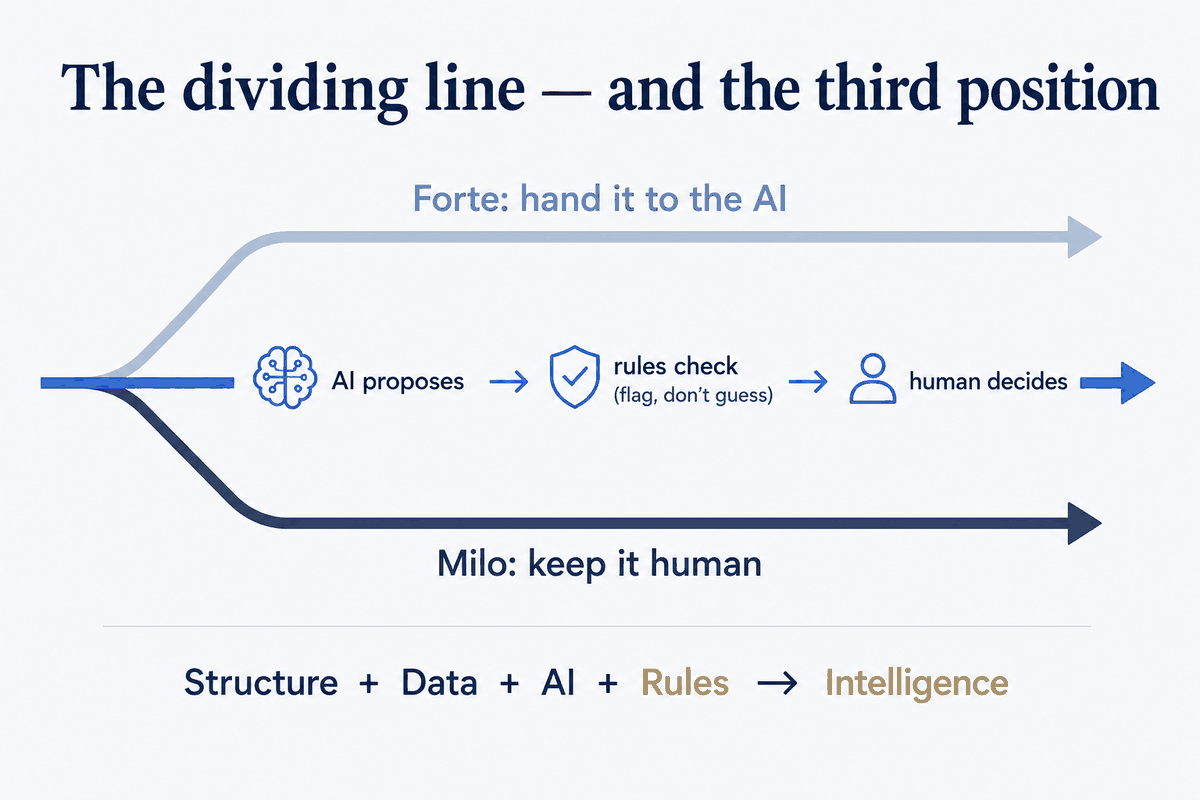
In 2026 the two most influential people in personal knowledge management both reorganized their life's work around AI — and they pointed in opposite directions. Watching them split is the clearest map we have of the choice every knowledge worker now faces. It's also, I think, a false binary. There's a third position, and it's the one I build on.
Here's the split.
Forte: hand the center of gravity to the AI
Tiago Forte — Building a Second Brain, PARA, ~400,000 books sold — did something startling: he declared the discipline that made him famous obsolete. His framing for 2026:
"Personal Context Management is replacing Personal Knowledge Management."
The argument is sharp. If an AI can read, summarize, and retrieve for you, then organizing notes for your own future retrieval is yesterday's problem. The new job is curating context for the AI — closing the "context gap" so it stops sounding like the average of the internet. He stopped teaching his flagship cohort in 2023 because of ChatGPT, and rebuilt it as "The AI Second Brain," taught on Claude. The center of gravity moves to the machine; your knowledge base becomes its feedstock.
Milo: never let the AI do the thinking
Nick Milo — Linking Your Thinking, the originator of Maps of Content — drew the opposite line, and drew it hard:
"If you want AI to think for you, you're in the wrong spot."
"Your words over their words."
His position: the act of linking one idea to another is the thinking. The moment you let an AI generate those connections, you've outsourced the one thing that was making you smarter. His 2026 course teaches a personal "AI operating system" — but the human stays, emphatically, in the driver's seat. The center of gravity stays in you; the AI is a power tool kept on a short leash.
Both teach on Claude. Both are friends, not enemies. And both, I'd argue, are half right — which is exactly why the split is so clarifying.
Why each is half right
Forte is right that context is the game. The difference between an AI that's useful and one that's generic is entirely the quality of what you feed it. That's not a small insight; it's the whole ballgame. But "context management replaces knowledge management" smuggles in a sleight of hand. Context doesn't come from nowhere. A knowledge base is the source of good context. Retire the discipline of building one and you've kicked away the ladder you're standing on. PKM doesn't die in the AI age — it becomes the supply chain for context.
Milo is right that judgment is irreducible. A second brain full of AI-generated links is a hall of mirrors — plausible connections nobody actually thought. The rating, the "does this matter," the leap from what they said to what I now believe — those can't be delegated without the whole thing becoming hollow. But "never let AI create your links" throws away real leverage. The AI is genuinely good at proposing connections and at surfacing contradictions across a corpus far too large to hold in your head. Refusing that help isn't sovereignty — it's confusing the deciding with the fetching, and insisting on doing both by hand.
The third position: AI proposes, rules check, the human decides
So here's where I land — between them, and past both.
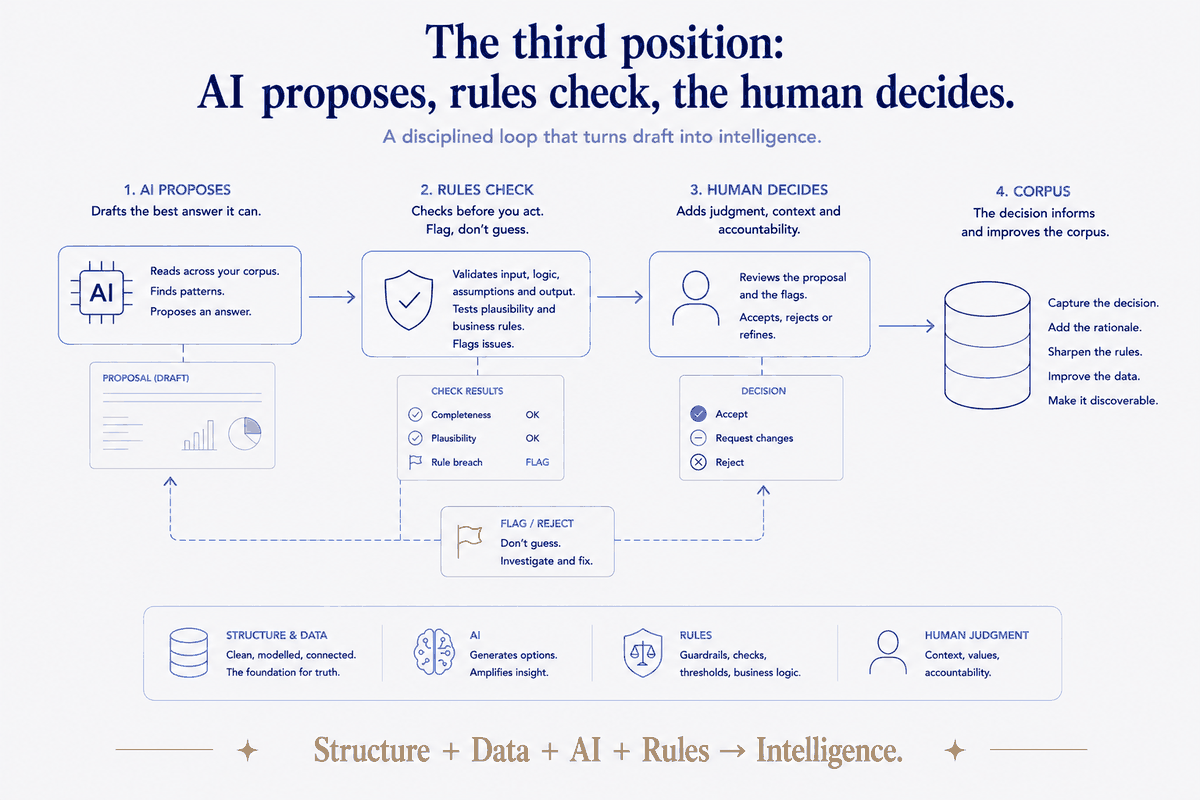
Let the AI do the labor. Extraction, linking, contradiction-hunting, rolling up the maps — all the work that made manual knowledge systems collapse under their own weight. This is Forte's leverage, taken seriously.
Keep the judgment human. Nothing the AI proposes is true until I've rated it, approved it, and added my angle. This is Milo's sovereignty, taken seriously.
And put rules between them. This is the part both leave implicit, and it's the part I've spent twenty-five years building in data warehouses: a validation layer. The AI proposes a link or surfaces a claim; rules check it against everything already in the corpus — is this a duplicate, does it contradict something I've already accepted, is it plausible? On a mismatch, the system flags; it doesn't guess. A human resolves the flag. And the rules themselves get reviewed and improved. It's a double loop, and it's the same discipline that keeps a production data system honest.
The shape of it:
  AI proposes  →  rules check (flag, don't guess)  →  human decides  →  corpus
   (labor)          (validation / plausibility)        (judgment)        (compounds)
Forte gives you the first arrow. Milo guards the third. The middle arrow is the missing one — and it's the same word missing from every "data + AI" pitch you've ever heard. Everyone says data and AI. Almost nobody says rules. Structure + Data + AI + Rules → Intelligence.
Why the middle arrow is the whole point
Without the rules layer, you're forced to choose between Forte's speed and Milo's safety. With it, you don't have to. The AI can run fast and loose generating candidates, because a validation pass and a human gate stand between its output and anything you'd act on. Speed and trust stop being a tradeoff.
I built this as a working system — a knowledge corpus where AI extracts "highlights" from curated sources, a focus-filter decides what's even worth keeping, a validation pass flags overlaps and contradictions, and nothing reaches a draft until I've rated it. The two ideas at the top of this article — Forte's and Milo's — are in that corpus, logged as a contradiction, kept not as an error to resolve but as the productive tension that this very article is built from. The system that holds the dividing line is the system that wrote about it.
That's the tell, I think. The argument about AI and knowledge isn't really about capability — it's about where you put the guardrails. Forte removes them and trusts the machine. Milo keeps them all and trusts only himself. The third position keeps them, automates everything they don't need to guard, and spends your scarce judgment only where it actually counts.
Keep the judgment. Give away the labor. Put rules in the middle.
Built from the Content-Intelligence corpus described in Zettelkasten 2.0; the governance half is in Governing What Your AI Can Touch.