The mess this replaced
Before the principle, my content lived the way most people's does. Articles were markdown files in one directory. Their images went into a shared attachments/ pile, named whatever the export tool named them. Review notes, if they existed, were scattered — some inline, some in a separate doc, some in my head. The database, when I finally built one to make sense of it all, was where I edited things, because that's where the data felt real.
Everything about that arrangement fought me. To move an article, I had to hunt down its images in the shared pile and hope I got all of them. To reason about the corpus — what's missing, what's stale, what's ready — I queried a database that had quietly drifted from the files. To reuse a good paragraph, I had to remember which three-thousand-word document it was buried in. Nothing was a thing I could pick up. Everything was a relationship I had to reconstruct.
Then I rebuilt the whole corpus around one rule, and the friction didn't reduce — it disappeared. The rule is almost embarrassingly simple, and it's the subject of this piece.
The one-sentence thesis
Every unit of knowledge — an article, an image, a concept, a series, even a review — is a self-contained, atomic folder that carries everything about itself. And a database sits alongside as a queryable view of the files, never as the master.
Two ideas, welded together. First: the unit of everything is a folder, and that folder holds the unit and everything belonging to it, with nothing loose and nothing scattered. Second: the database that makes the whole thing queryable is a projection of those folders, not a second home for the truth. The rest of this article is those two ideas, made concrete.
Atomic and self-contained, at every level
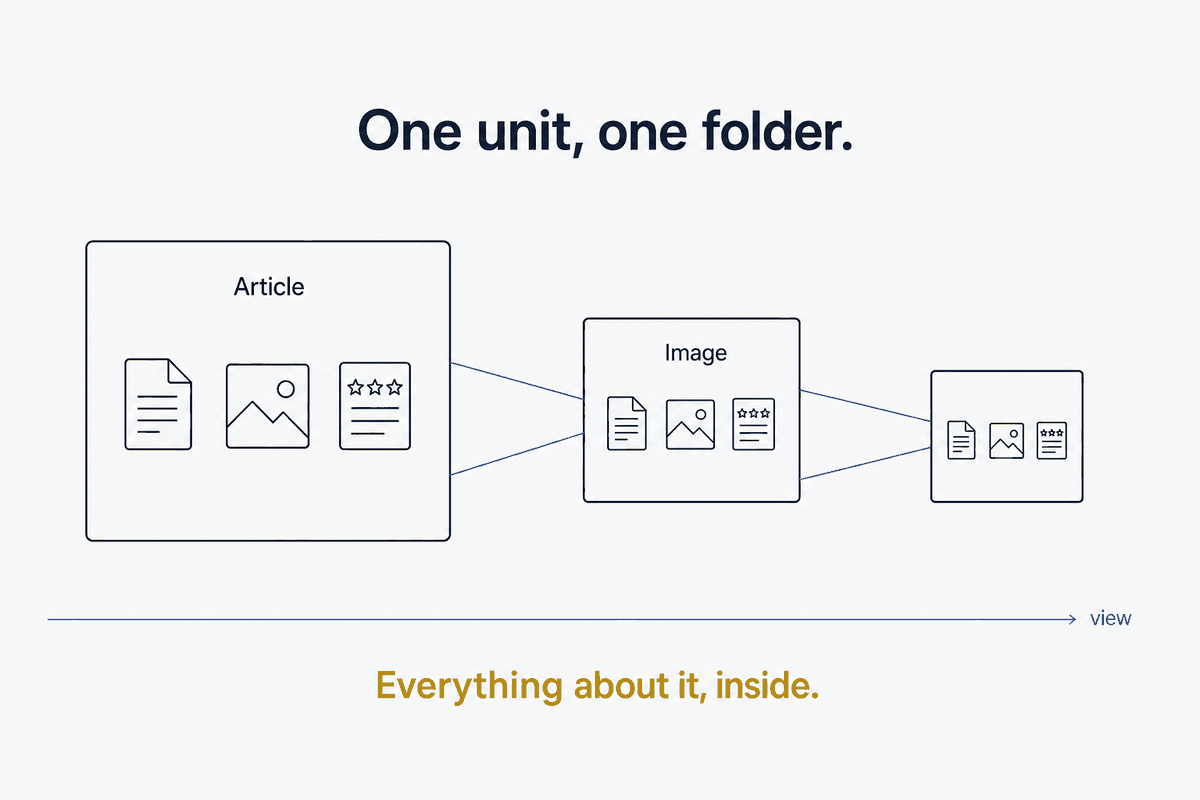
Here's the shape. An article is not a file — it's a folder: the markdown that is the article (a same-named folder-note), its assets/ of images, its review/ notes. Everything the article needs to exist lives inside the article's folder.
Now zoom in, because the principle is fractal. Each image isn't just a loose PNG in the assets pile — it's also a folder, holding the image file, a properties note describing it, and its own regeneration brief. Zoom out, and a concept is a folder, a series is a folder, a review is a folder. The same shape — one unit, one folder, everything about it inside — repeats at every level of the system. It's the Zettelkasten idea of the atomic note, taken seriously and applied to every content type, not just prose notes. The atom isn't the sentence or the file. It's the self-contained folder, wherever you look.
Why atomicity is the thing that makes reuse and automation safe
This isn't tidiness for its own sake. A self-contained unit has a property that a scattered one can never have: it can be picked up whole, and everything comes with it.
Move the folder, and the article moves with its images and its review notes — no dangling references, no orphaned attachments, no "wait, where did that diagram go." Publish the folder, and the build script finds everything it needs in one place. Hand the folder to a colleague — or point an AI at it — and it has the entire story, no external context required, because the context is inside the unit. That last part is why this matters more in 2026 than it did before: an AI agent working through your corpus can reason about a self-contained folder because the folder is complete. It can't reason about a file whose meaning is scattered across three other directories it would have to go find.
Atomicity is what makes reuse safe (you reuse a whole, coherent unit, not a fragment ripped from context) and automation safe (a script or an agent operates on a bounded thing, not a web of assumed relationships). Get the boundary of the unit right, make every unit carry itself, and everything downstream — moving, publishing, reasoning, reusing — becomes trivial instead of treacherous.
The database is a view, not the master
The second half of the thesis is where people's instincts betray them. Once you have hundreds of these folders, you want to query across them — what's missing a concept tag, which images need regenerating, what's the review status across six hundred articles? A folder tree can't answer that. A database can.
So you build one — and the temptation, immediately, is to treat it as the real data and start editing it directly. Don't. All truth lives in the files — the markdown bodies and their YAML frontmatter. The database is a derived, queryable representation of that YAML, rebuilt from the files on every run. It exists to answer the cross-cutting questions the folders can't, without ever becoming a second place the truth lives. Edit the frontmatter, re-run, and the view updates. Never edit the view.
Because it's a view, the discipline that keeps it honest is: after any change, you rebuild it — seconds, not minutes. That single habit — files are truth, the database is a fast disposable projection you regenerate on demand — is what lets the system be both fully human-editable (they're just folders and text) and fully machine-queryable (there's a SQL layer over them) at the same time, without the two ever disagreeing. (This is important enough to stand on its own — the rebuild discipline and its failure modes are Your Database Is a View; here it's one half of the atomic-unit principle.)
Why this beats every alternative I tried
Set the atomic-folder-plus-view design against the three things people actually do instead, and each alternative fails at a specific, predictable joint.
Versus a big database as the master: the database drifts from reality, because it's edited independently, and one day you can't tell which is right — the file or the row. The files, by contrast, are the reality; they can't drift from themselves. And files survive a tool change — open them in any editor, forever — while a proprietary database schema is a bet on one tool outliving your data. Truth in files, queries in a rebuildable view: you get the database's power without staking your data on it.
Versus loose files plus search: search is excellent at finding, and useless at everything else. It can't move a unit, publish one, back one up, or reason about one as a whole, because search returns matching lines, not bounded things. Atomic folders can be all of those, because a folder is a bounded thing. (This is the deeper reason folders still beat tags — the atomic folder is why the folder wins.)
Versus one giant document: you cannot reuse a paragraph buried in a three-thousand-word file — to reuse it, you'd have to extract it, and now you've got two copies drifting apart. You can reuse an atomic unit, because it was already a self-contained thing with its own boundary. Reuse requires atomicity; a monolith forbids it.
The intelligence falls out of the structure
Here's the payoff, and it's the whole "structure beats magic" argument in miniature. My content system does things that look intelligent — it finds gaps (which articles imply a piece that doesn't exist yet), spots duplicates, tracks review status across the whole corpus, plans what to publish next. None of that is magic, and none of it required a clever algorithm. It's simply what the atomic structure plus the YAML-as-data make computable.
Because every unit is a self-contained folder, a script can walk them. Because every unit carries its own frontmatter, that walk produces data. Because the database is a rebuilt view of that data, the cross-cutting questions become SQL. The "intelligence" of the system is a consequence of the structure, not an addition to it. You don't build a smart system on top of a messy one. You get the unit boundary right, make every unit carry itself, keep the database as a view — and the smart behavior falls out for free.
Get the boundary right, and everything follows
The mess I started with wasn't a discipline problem or a tooling problem. It was a boundary problem: nothing was a self-contained thing, so nothing could be picked up, reused, reasoned about, or trusted. The fix wasn't a better app. It was one principle, applied ruthlessly at every level: one unit, one folder, everything about it inside — and a database that's only ever a view of the files.
This is structure beats magic at the most foundational level of a knowledge system — the level that decides whether everything above it is computable or just searchable. The magic answer is an all-knowing app that organizes your mess for you. The structural answer is to not have a mess: make every unit atomic and self-contained, keep the truth in files and the queries in a rebuildable view, and watch the system's intelligence emerge from its shape rather than from a promise. Get the atom right, and the whole falls out for free.
Part of the Structure Beats Magic series — the layer beneath Folders Still Beat Tags (why folder-per-unit works) and the sibling of Your Database Is a View (the rebuild discipline). Pointing an AI at these self-contained units is Context Engineering for One. Born from the content-backbone rebuild.