Models are swappable commodities; your structure is the durable asset.
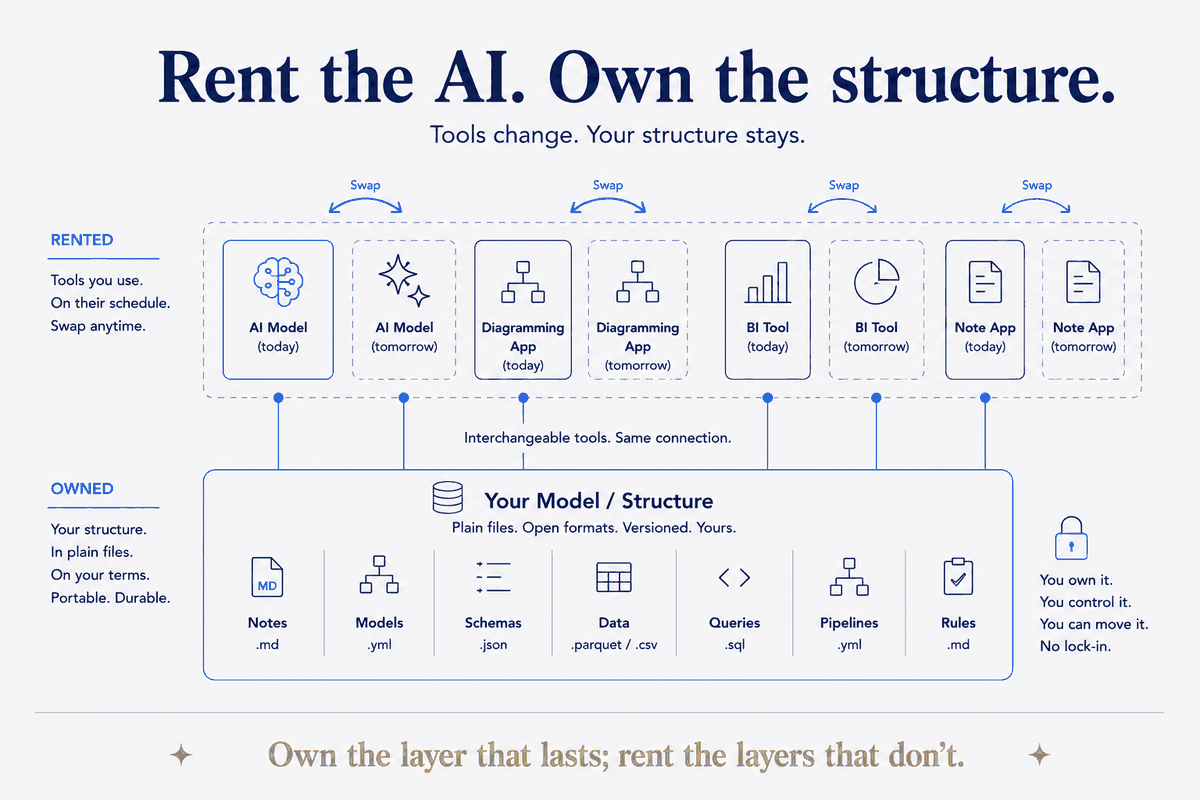
Models come and go and are rented from vendors; the structure you build is the durable asset you own — so invest there. And this isn't only about the AI model: your model outlives the tool. The data model, the conceptual diagram, the structure of your vault survives every tool that renders it — the diagramming app (Visio, yEd, draw.io), the BI tool, the note-taking app, and the AI itself. Tools are rented and replaced on someone else's schedule; the model is yours and persists across all of them. Own the layer that lasts, rent the layers that don't.
The serious counter-position: put the knowledge in the model
The sharpest challenge to this stance is not the usual one ("but the model is so capable"). It is the argument that the split between model and structure is itself the mistake.
LARQL (Lazarus Query Language, 2026) makes that case concretely. It decompiles a transformer's weights into a queryable graph, gives you a SQL-like language over it, and — the striking part — lets you write facts back into the weight space directly. No fine-tuning, no retrieval at inference time. The model is the database. Its author calls it "a real alternative to RAG for grounding": instead of fetching context from outside, you edit the model's internal graph.
It is an elegant idea, and it is the exact inverse of this concept.
Why the stance holds anyway. Those fact-patches are written against one model version, one architecture, one layer layout (probe, L27). When the successor ships — on the vendor's schedule, as always — the patches do not port. You would have invested in structure that cannot outlive the thing it was carved into. That is the failure mode this concept exists to name: not that the knowledge was unversioned, but that it was unportable.
Note what RAG, for all its clumsiness, gets right by accident: the source stays outside the model, readable, and yours. Retrieval is the architecture that survives a model swap.
⚠️ The honest concession. Grounding by retrieval is genuinely awkward — latency, chunking, relevance — and "put the facts where the reasoning happens" answers a real problem. The counter-position is not silly; it is the strongest form of the argument against us. What it trades away is portability, and that is the trade this concept refuses. Anything you cannot carry to the next model is rented, however well you version it (Gated Knowledge in a new costume).
The test: can this survive the model being replaced tomorrow? If not, you are renting it — no matter how much structure it has.
Related concepts
- A Toy vs an Instrument
- AI ROI
- Structure Lets a Cheaper Model Win
- Give the Recipe, Sell the Kitchen
- The Model Is the Easy Part
- Own the Layer or Rent the Feature