The same structured knowledge feeds every output — an article, a workshop, a course, a talk — because it's stored as reusable units, not one-off documents.
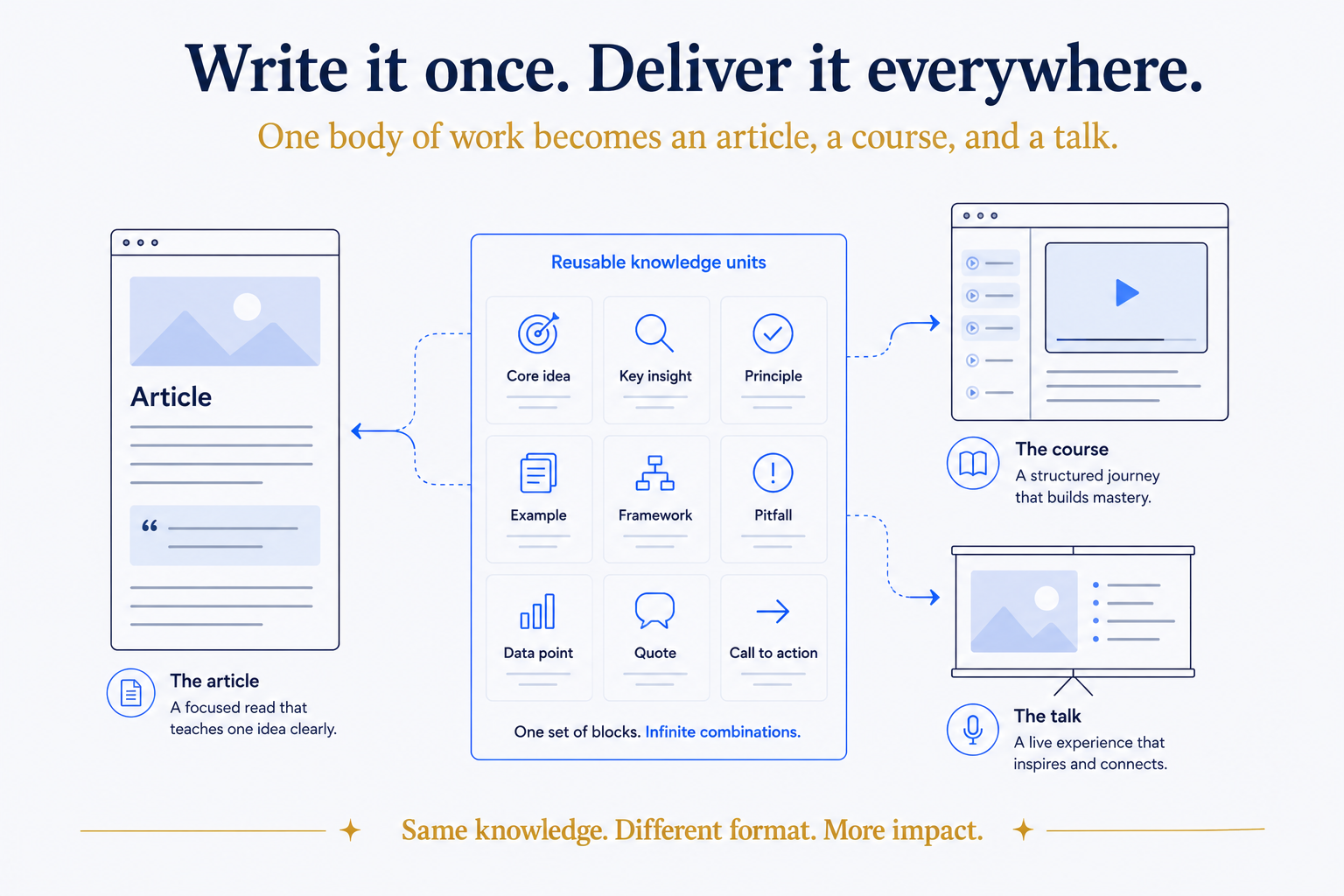
The same structured knowledge feeds every output — an article, a workshop, a course, a talk — because it's stored as reusable units, not one-off documents.
Most people write an article, then start a training from scratch, then rebuild the same idea again for a talk. The knowledge is the same each time; only the format differs — but because it was captured as a finished document rather than as structured units, none of it composes. Content-to-training is the opposite: capture knowledge once as small, atomic, tagged units (blocks, concepts, code snippets, images), and let every format be composed from those units. An article is a sequence of blocks. A workshop is a curated, reordered set of the same blocks plus exercises. A course adds progression and assessment. A talk is the essence of a few blocks. One source, many monetized outputs — free content at the top, group classes in the middle, high-rate consultancy at the point.
This is the pipeline that turns a body of writing into a training business without redoing the work: the article corpus is the curriculum's raw material, the concept library is the skills framework, the reusable blocks are the lesson content. AI does the leverage — recomposing units into a new format on demand — so the marginal cost of a new class or talk drops toward the cost of curation, not creation. It's Structure Beats Magic applied to your own output: the value isn't producing more, it's structuring what you have so it can be reused deliberately.
This is Zettelkasten, arrived at its conclusion. Luhmann's slip-box was the original version of the idea — atomic notes, one thought each, densely linked, so knowledge compounds through connection rather than accumulation, and the box eventually "writes with you." Content-to-training is that same principle in 2026, with three upgrades that change what the box can do: the atomic notes become composable outputs (a block feeds an article AND a course AND a talk, not just the next paper); the link layer becomes queryable (a database view over the concept graph, so you can ask the box what it holds and where the gaps are); and AI does the linking and the composition that Luhmann did by hand for decades. The slip-box that once fed one scholar's writing now feeds a whole knowledge-to-consultancy engine — and it writes back.
Related: Atomic documents · A compounding asset · The compounding brain · Deliberate by design · Practice what you evangelize.