Standing outward search through your own filters — the system keeps looking when you aren't, and reports back.
Standing outward search through your own filters — the system keeps looking when you aren't, and reports back.
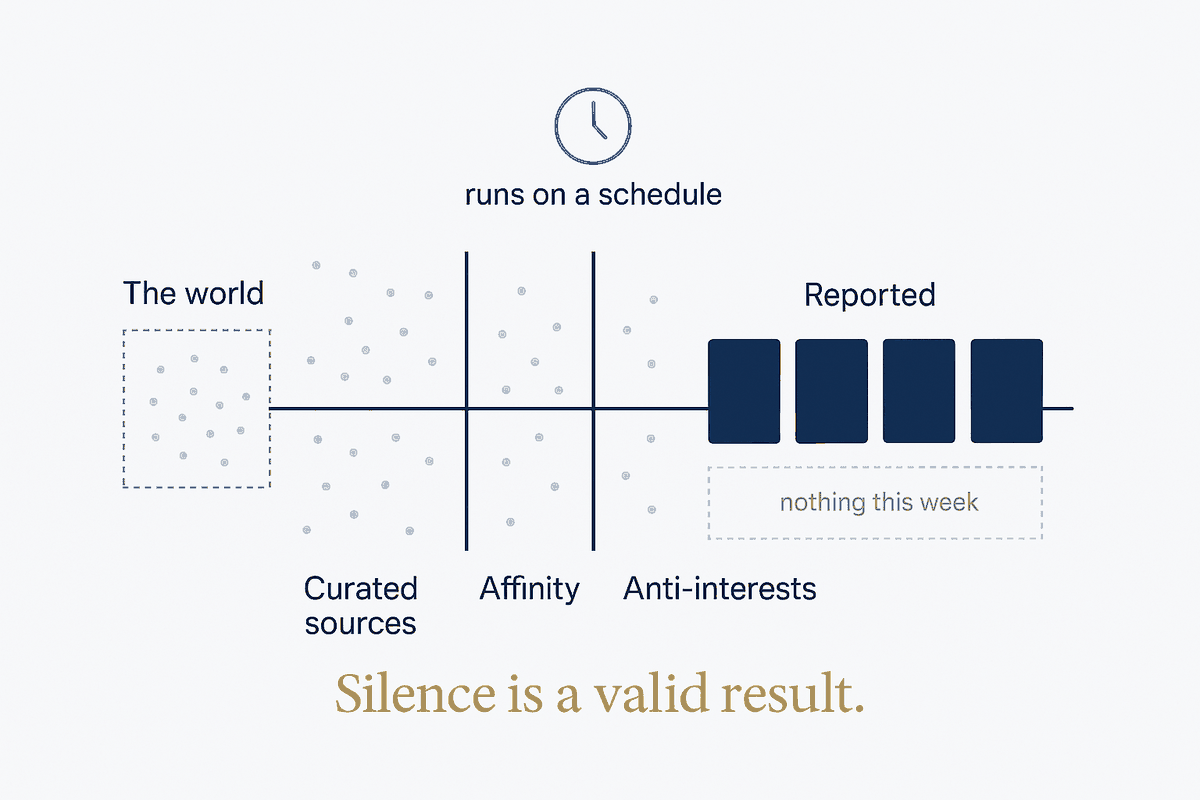
Exploration is the outward-facing half of a personal intelligence system: agents that scan the world along search paths you defined, score what they find against your affinities, drop what your vetoes exclude, and surface the remainder. It runs on a schedule rather than on an impulse, which is the entire point — the discovery keeps happening on the weeks you forget to go looking.
The search paths come from curated sources: the people, publications and makers you've already judged worth trusting. The scoring comes from affinity matching. The exclusions come from anti-interests. Exploration is what those three do when pointed outward and left running.
Not a feed
The obvious comparison is a recommendation feed, and the distinction is worth being precise about because they look similar from the outside.
A feed decides what you see, using signals it owns, optimising for a metric you don't control — usually time spent. Its success condition is that you keep scrolling. Continuous exploration has no such metric. It runs your filters and reports what passed; if nothing passed this week, it says nothing. There is no floor of content it must produce to justify itself.
That inverts the failure mode. A feed's failure is that it works too well and you lose an hour. Exploration's failure is silence — which is honest, and which you notice.
Not the same as experimenting
It sits next to the experiment loop and does a different job. The experiment loop tests a hypothesis you already hold: hypothesize, try, learn, decide. Exploration finds the candidates you didn't know to hypothesize about. One converges on an answer; the other widens the field of questions.
They chain naturally — exploration surfaces something, the experiment loop decides whether it's real — but conflating them loses the reason exploration exists. If you only ever test what you already thought of, the system can't tell you anything you didn't already suspect.
The inward twin
Exploration broadens: new sources, new candidates, new territory. The inward-facing counterpart deepens instead — resurfacing what's already in your own system so it compounds rather than silently expiring.
Same infrastructure, opposite direction. Both are needed, and the failure of most personal systems is running only the first: a growing pile of discovered material that nothing ever brings back. Discovery without return is collecting.
Related: Curated sources · Recommendation affinity matching · Anti interests · Intelligence systems · Collecting is not capability