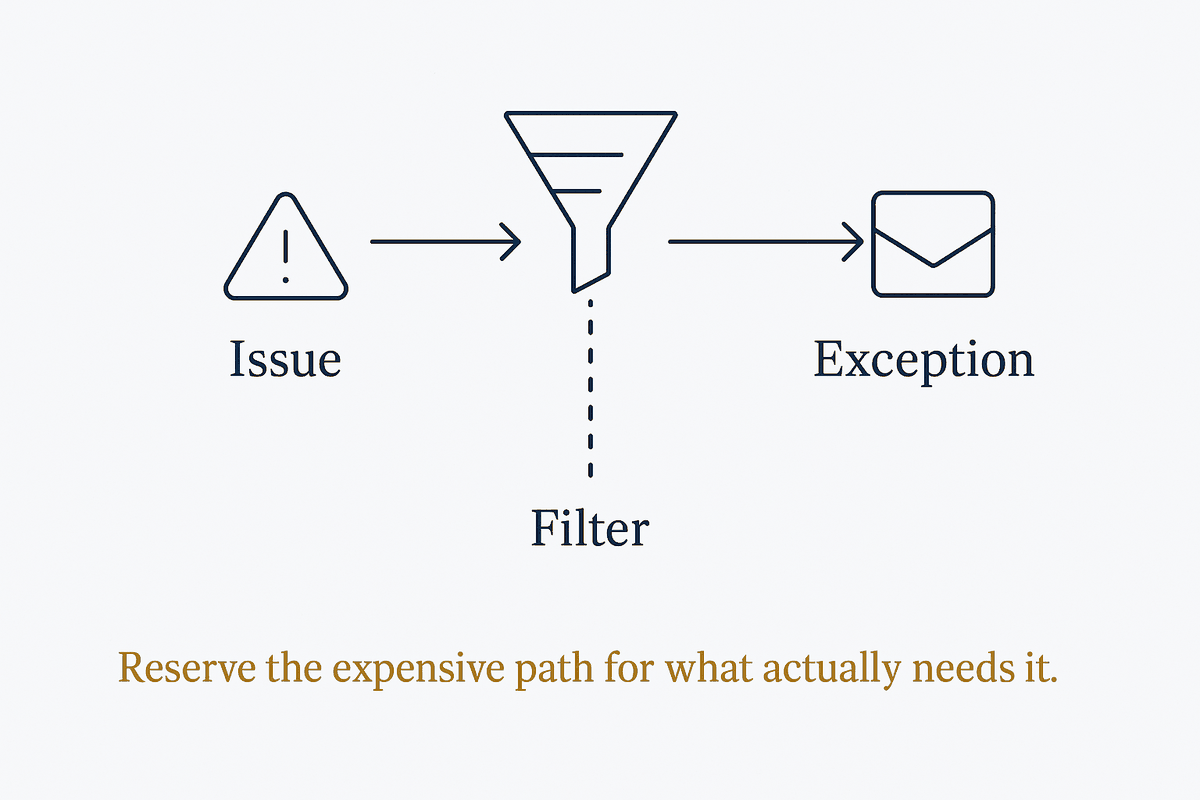
Route the easy work to the cheap path and reserve the expensive one for what actually needs it. Power by exception, not by default.
The default posture with capable models is to send everything to the best one. It is the most expensive habit in applied AI, and the least examined — because it never produces a visible failure, only a bill. Most requests are routine: a reformat, a lookup, a summary of something short. They do not need frontier reasoning, and giving it to them buys nothing measurable.
The alternative is a routing decision made before the model is called: classify the task, send the ordinary case down the cheap path, and escalate only when the work genuinely demands it. The classification does not need to be clever — a plain rule usually beats asking a model to judge its own difficulty, and it costs nothing to run. What matters is that the decision exists at all, because "always use the strongest" is itself a routing policy, just an unexamined one.
The same shape appears wherever a system meets a human. A confidence threshold that sends only uncertain cases to review, a guardrail that interrupts on anomaly rather than on every action, an approval gate that triggers on the irreversible step and stays out of the way otherwise. In each case the scarce, expensive resource — a person's attention, a frontier model, a hard check — is spent on the exceptions, and the routine flows through untouched.
This is why the biggest cost reductions in production AI come from architecture rather than from cheaper tokens. Reused context beats rebuilt context; a small model on a well-scoped task beats a large one on a vague task; a rule beats a model call when a rule suffices. Structure is what makes the cheap path viable — without it, every request looks equally hard and everything escalates by default.