The third level of getting real work from AI — building the system around the model (tools, checks, memory, retries, escalation) so it can finish long tasks, not just answer.
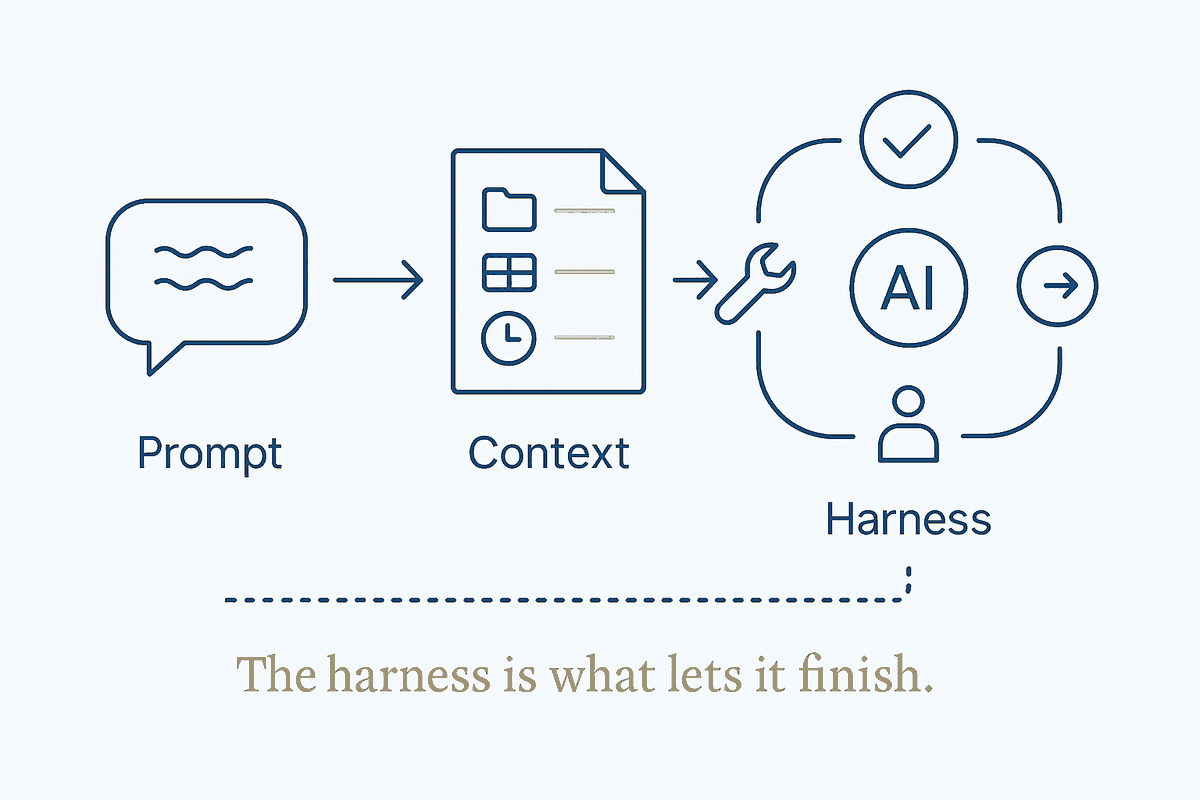
⚠️ Attribution. "Harness engineering" is Clare Kitching's term (LinkedIn, 2026), as the third of three levels: prompt engineering → context engineering → harness engineering. The contribution here is not the term but the worked examples — what the harness looks like when you actually build one. Cite her when writing about it. (Consistent with the tool-extender-not-framework-owner positioning.)
The three levels
| level | question it answers | |---|---| | Prompt engineering | What should the AI do? — the instruction | | Context engineering | What does it need to know? — the briefing pack | | Harness engineering | What does it need around it to finish the job? — the working environment |
The first two are covered in Stop Prompting, Start Directing and The Context Graph. Harness engineering is the layer those two stop short of.
What it is
Building the system that lets a model finish real work: tools, workflow, permissions, checks, memory, retries, and escalation around the AI. Not the words you send and not the documents you attach — the machinery that turns an answer into a completed task.
Why it matters
Without a harness, even frontier models fail long tasks: they do too much at once, or declare victory early. The harness is what catches the failure the model can't see itself — a check that flags a wrong result, a retry that survives a dropped connection, an escalation that sends the uncertain case to a human.
⭐ This is the same claim as "structure beats magic," one level up. The result comes from the structure around the model, not from the model.
What it looks like — worked examples
A week of building a personal system produced five concrete harnesses, each now its own article:
- A test that runs the real thing, not one that only checks the code parses — because "it compiles" is not "it works." → The Test That Says It Parses Says Nothing
- A backup you've actually restored from, because an untested backup is an assumption. → Your Backup Is an Assumption Until You Restore It
- A check that measures the outcome, not the operation — count what should be true at the end, not what the process claims it did. → Nothing Was Broken, So Nobody Told Me
- Meaning in metadata, not in folder names, so the harness survives a rename. → The Folder Is an Address, Not a Meaning
- One shared component every screen inherits, instead of a contract honoured by hand thirty times. → You Copied the Row, Not the Toolbar
⭐ Each is a small harness: the thing around the work that makes the work trustworthy.
The bridge to data work
Harness engineering for data is close to what model-driven data engineering already is — the harness around the modelling: generated transformations, validation, lineage, the checks that make a pipeline trustworthy rather than merely running. That connection is worth developing separately (candidate frame for the breakthrough-modeling article).