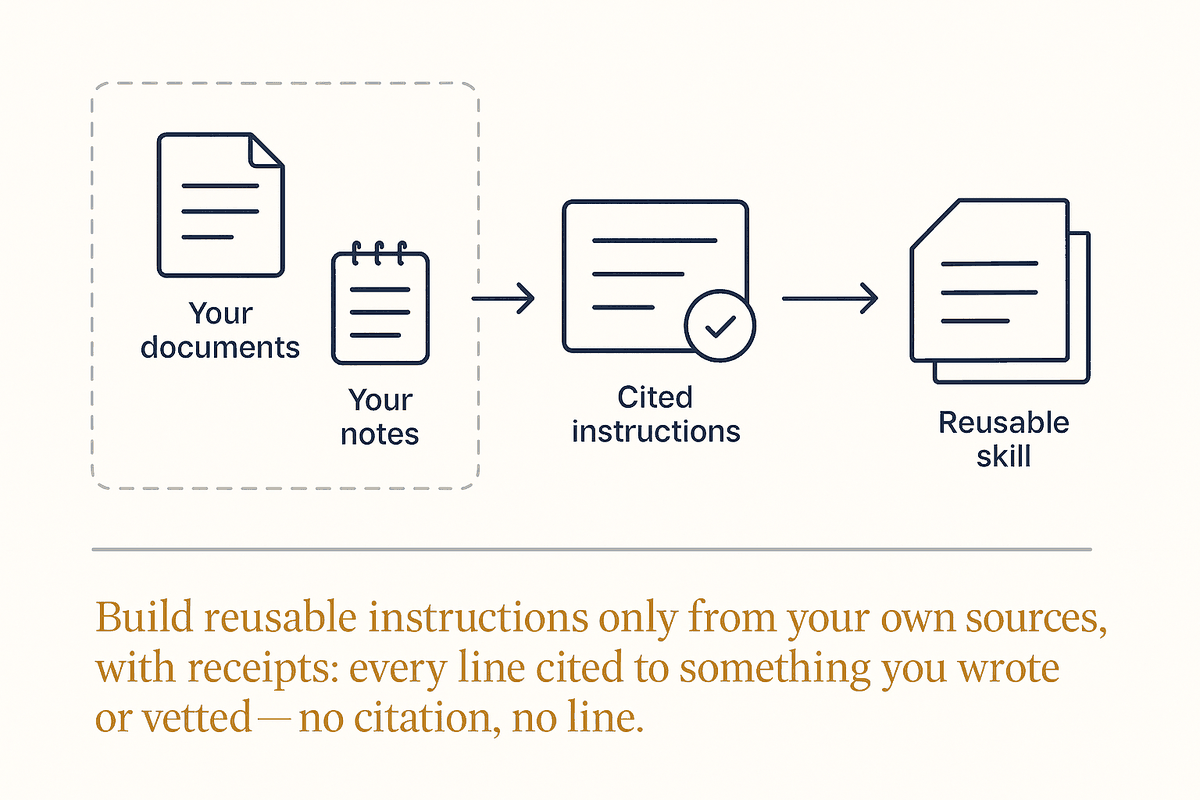
Build reusable instructions only from your own sources, with receipts: every line cited to something you wrote or vetted — no citation, no line.
A skill is a document the AI will obey hundreds of times — which makes an invented line in a skill categorically worse than an invented line in a chat. The chat hallucination misleads once and dies with the session; the skill hallucination is codified, trusted, and executed on schedule. A fabrication in a standing instruction is a hallucination with a cron job.
The build discipline that prevents it: generate the skill from your own corpus — your articles, your sent work, your actual standards — and require a receipt per line. Every instruction in the skill must point to something you wrote, did, or explicitly vetted; any line that can't produce its citation gets cut, however sensible it sounds. "Sounds right" is exactly the quality hallucinations have. The rule is mechanical on purpose: no citation, no line.
The discipline does two jobs at once. It blocks fabrication at the moment of codification — the only moment cheap enough to catch it, before the line has been obeyed a hundred times. And it keeps the skill in your voice and your method rather than the model's average: a skill distilled from your corpus encodes how you actually work; a skill written from the model's priors encodes how everyone works, which is to say no one.
This is provenance thinking applied to instructions — the same lineage reflex data engineers apply to pipelines, pointed at the one artifact most people write from vibes. Nobody serious runs a data platform where numbers can't say where they came from; a standing instruction the AI executes daily deserves the same standard. If a line in the skill were challenged, could it produce its source? If not, it was never yours to begin with.