Make AI write like you, not like AI — a standing voice corpus mined from your unpolished sources.
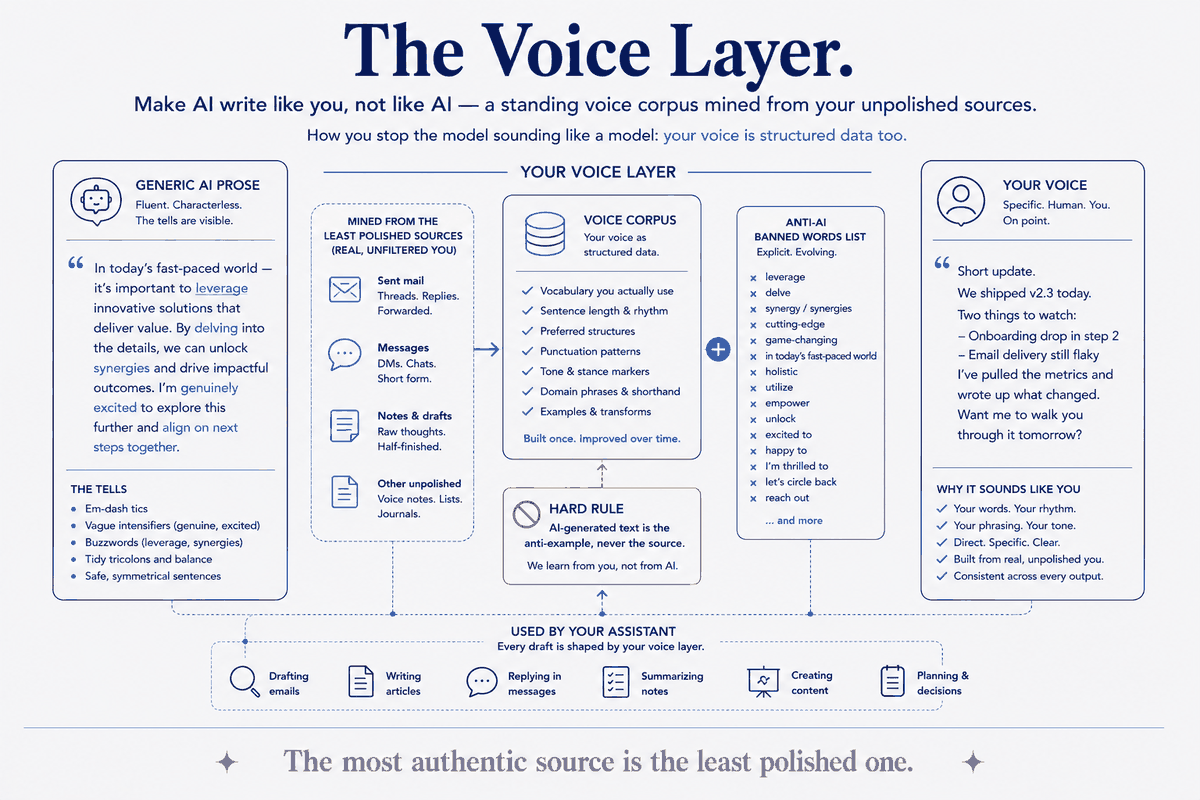
How you stop the model sounding like a model: a standing voice corpus distilled from real, unpolished sources (sent mail, messages) plus an explicit anti-AI banned-words list. The key rule — AI-generated text is the anti-example, never the source. Your voice is structured data too, and the most authentic source is the least polished one.
The counter-intuitive part is where the corpus comes from. The instinct is to feed the model your best writing — the published pieces, the polished essays. That's exactly wrong: polished prose has had the voice edited out of it. Your sent mail and your messages are where you actually sound like you, because nobody performs in a reply.
The banned-words list does work the positive instruction can't. "Write like me" is a wish; never write "delve", "leverage", "genuinely excited", "in today's fast-paced world" is a rule. Removing the tells is more reliable than describing the target, because the tells are finite and specific while "my voice" is neither.
And the hard rule is load-bearing: AI text is the anti-example, never the source. Let generated prose back into the corpus and the system starts learning from its own output — voice-flavoured sludge, converging on the average it was supposed to escape. The corpus only stays yours if everything in it was written by you.