Once a thing has a name, it keeps that name — in the model, in the procedure, and in what the AI writes. Aviation fixed this in the 1970s (ASD-STE100); AI output reintroduced the problem by loving synonyms.
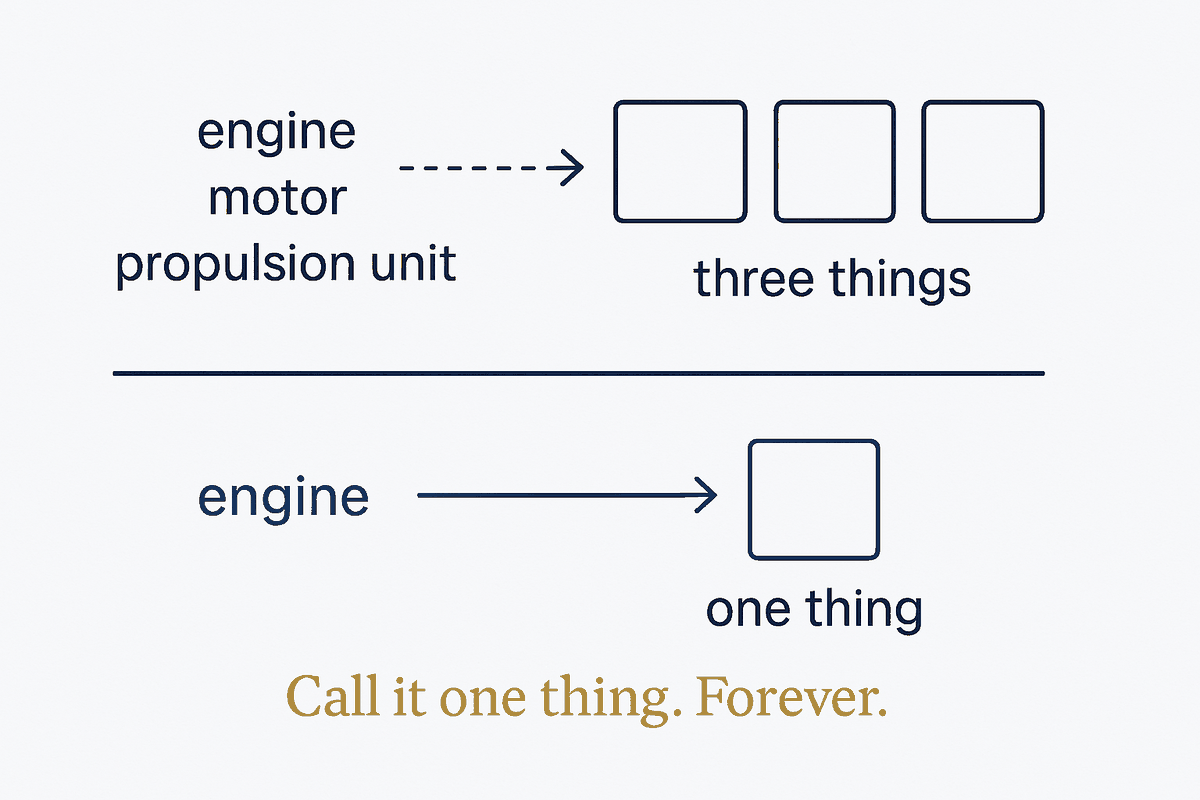
Language models are trained to sound fluent, and fluent writing avoids repetition. So a model calls a component an engine in one paragraph, a motor in the next and a propulsion unit in the third. For a reader that is variety. For a data model it is three entities, for a procedure it is three parts, and for a decision it is a misunderstanding waiting to happen.
Aviation solved this half a century ago. European aerospace manufacturers created Simplified Technical English (today ASD-STE100) for maintenance manuals: short procedural sentences, one action per instruction, a controlled vocabulary, and never a synonym for the sake of variety — if it is a bolt, it is a bolt forever. A mechanic who reads "fastener" where yesterday it said "bolt" has to stop and wonder whether it is the same part.
The rule is the same one behind every business glossary and every data model: decisions fail when nobody agreed what the words meant, and an ontology is a contract about exactly that. What is new is the source of the drift. It used to be people; now it is also the AI writing the summaries, the specs and the answers.
So put the vocabulary in the structure, and hold the AI to it: give it the glossary, tell it to answer in the spirit of ASD-STE100 for anything someone will act on, and check its output for one concept carrying two names. A side effect is that structured, fixed-term answers are also easier to split into claims and verify (see Four Eyes, One Source).
Boundary: this governs terms, not tone. Personal prose can vary its wording; a defined term never changes its name.