How a system, team or business actually runs day to day — the concrete machinery underneath the strategy, not the org chart or the vision slide.
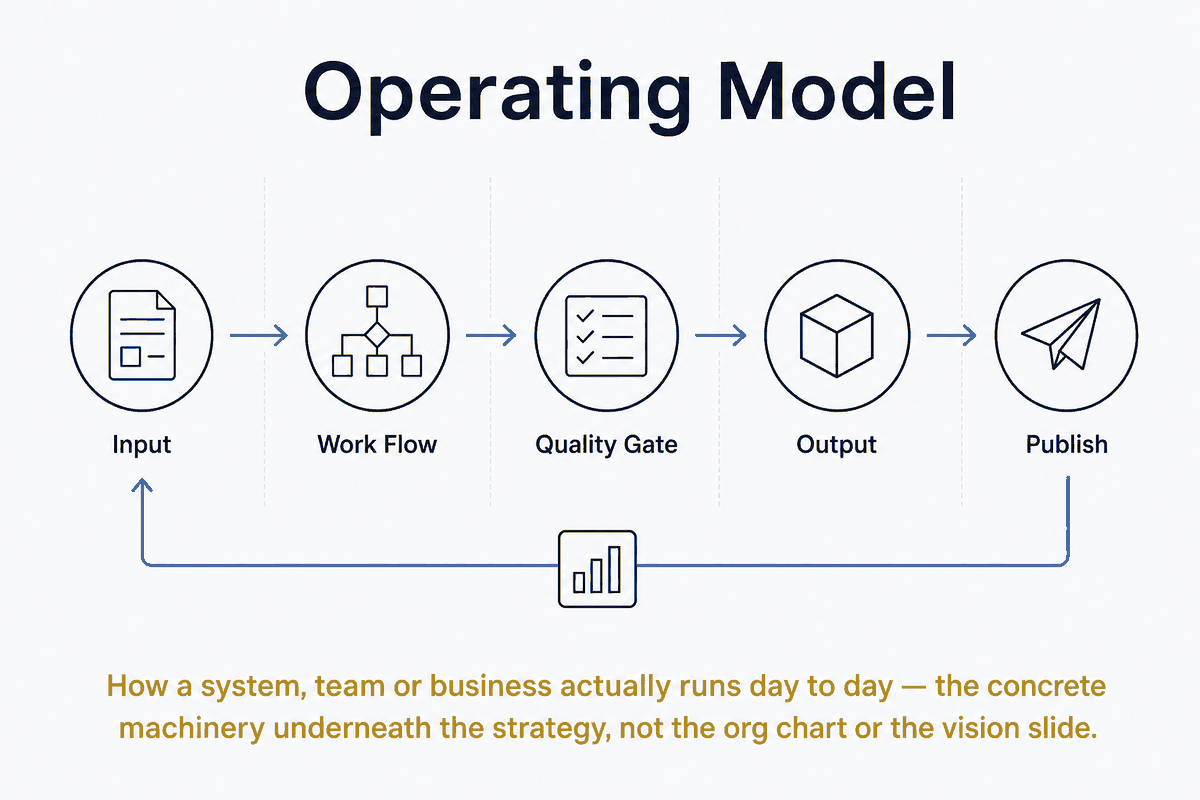
How a system, team or business actually runs day to day — the concrete machinery underneath the strategy, not the org chart or the vision slide.
An operating model is the answer to "how does this actually work on a Tuesday" — the specific, repeatable way work flows, decisions get made, and outputs get produced. It sits below strategy (the what and why) and above tooling (the which product): strategy says "we sell structured knowledge as training and consultancy"; the operating model says "one knowledge base stored as atomic units feeds every output, AI recomposes it, humans hold the quality gates, and it publishes itself." It's not the vision and it's not the software — it's the running machinery in between, described concretely enough that someone could operate it.
The distinction that matters: most people confuse the operating model with either the strategy deck (too abstract to run) or the tool stack (too low to explain the flow). A real operating model is neither — it's the structure of how the work moves. That's why it's a structure-first idea: a good operating model is mostly deliberate structure (who prepares what, in what form, feeding which step), so that the expensive human moments shrink to just the parts that need judgment. The Smart Teams version of this is exactly that move — structure carries the context, so the meeting is just the merge. The content backbone is another instance: the operating model of turning knowledge into content, training and consultancy, where the machinery (content-to-training) does the heavy lifting so the marginal cost of a new output drops toward curation.
Two tests of a good operating model: it's concrete (you could hand it to someone and they'd know what to do next), and it's built on structure (the flow works because the inputs are already shaped, not because everyone hustles). When the operating model is the method you sell, running it well is also the proof that the method works.
Related: Smart teams · Content to training · Practice what you evangelize · The meeting is just the merge · Structure beats magic · Deliberate by design.