The parts of you an AI can't infer — your taste, your limits, your voice, your history — written down as durable data the system reads instead of guessing at.
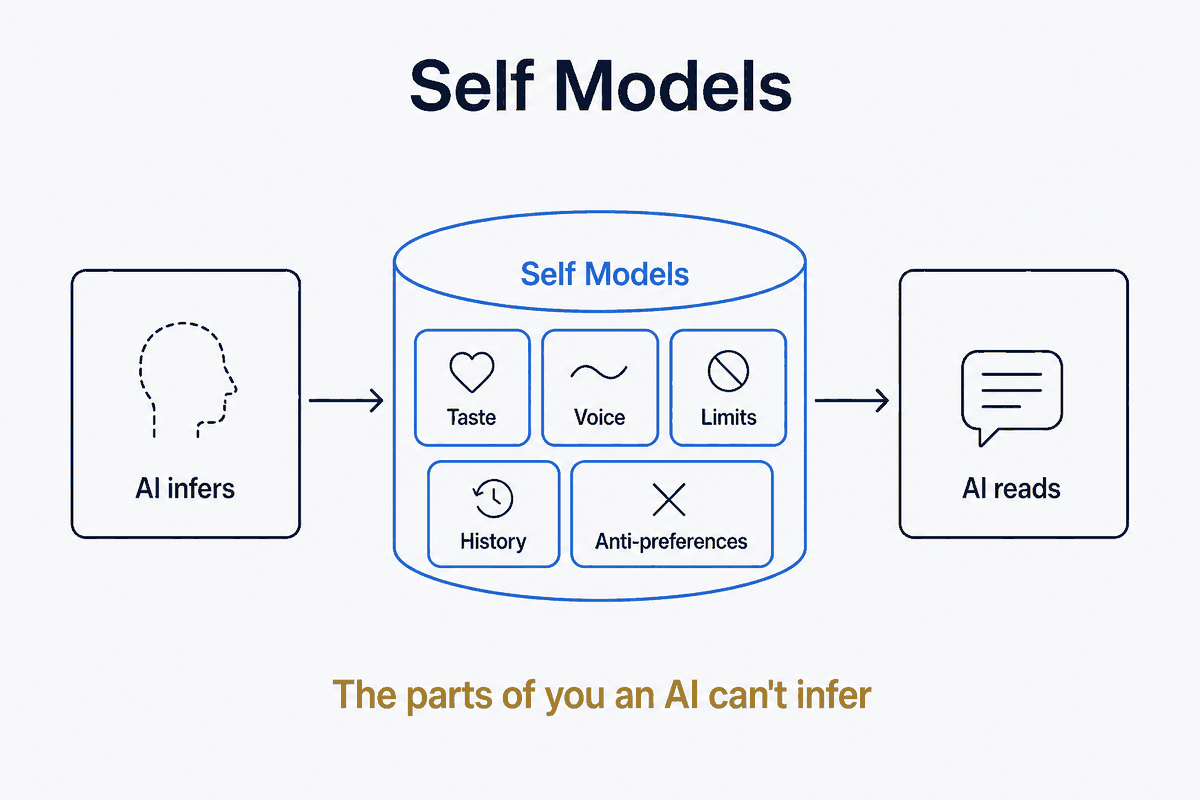
A self model is a written, structured description of one facet of who you are — held as data the system can read, rather than a thing an AI has to infer from the last few messages. Your taste is a self model. Your risk appetite is a self model. Your voice, your anti-preferences, your history, the lessons you've actually paid for — each is a distinct model of some part of you, and together they are what turn a generic assistant into one that answers for you instead of for a plausible average person.
The reason to name the category is that these models keep getting rediscovered one at a time. You write down what you're not interested in and call it anti-interests. You write down how you sound and call it a voice layer. You write down where your line is on danger and call it a risk profile. They look like separate tricks, but they're the same move applied to different facets: take a part of yourself the AI would otherwise guess at, and make it explicit, durable, and readable. Seeing them as one family — self models — is what lets you ask the useful question: which facets of me has the system actually got, and which is it still guessing?
Each model earns its place the same way. It holds still, so the version of you captured on a calm day doesn't drift with mood or pressure. It's specific, because "who I am" is uselessly broad but "I avoid high-tourism places" and "an irreversible consequence is a no" are things a system can act on. And it's composable — the models stack. A trip planner that reads your anti-interests and your risk profile and your history produces something none of them could alone: options that fit your taste, sit inside your limits, and don't repeat a past mistake. The whole point of a modeled self is that the facets reinforce each other.
None of this is a form you fill in once. A self model is a loop, and the loop is where the value compounds. The AI drafts a first version from the data it can already see — your notes, your history, your past decisions — because a rough draft you correct beats a blank page you're supposed to fill. You revise it: that's wrong, this is sharper, you missed that I stopped doing this years ago. The corrected model is stored at real detail and read back into the next answer, so the system's picture of you improves. Then the move that makes it genuinely alive: the AI works on the models themselves. It reads across them for connections (your risk appetite and your travel history explain each other), for inconsistencies (you say you avoid crowds but keep booking the famous sites), and it proposes experiments — small things to try that would resolve an open question about you. You correct, it re-reads, you both learn. The model of you and the system that uses it sharpen each other, turn after turn.
Two of the models deserve their opposite framing, because it's easy to only capture the positive. Most people, asked to describe themselves, list what they are and want. But the negative space carries as much signal: what you're not interested in (anti-interests) and how much risk you won't take (your risk profile) define you as sharply as your preferences do, and a system that only models the positives will keep suggesting things that are technically on-topic and completely wrong for you. Focus and safety both live in the boundaries, not the appetites.
And it changes over time — of course it does. Holding still and evolving aren't a contradiction; they operate on different clocks. Within a decision the model holds still, so a keen group or a good mood can't move your line in the moment. Across the years it moves, because you do: the parachute jump that fit at thirty may not fit at sixty, the taste sharpens, the appetite for one kind of risk grows as another fades. A self model that can't change becomes a portrait of a person who no longer exists. So the loop carries a second job beyond keeping the model accurate to now — it watches for drift: the system should notice when your recent choices stop matching the recorded model and ask whether you've changed or just slipped, rather than silently trusting a version of you that's five years stale. The history stays (it's evidence of who you were); the active line moves.
There's a trap in all of this, and naming it is what keeps the models honest: a system that only ever reflects your stated preferences back at you builds a cage. Feed it nothing but "here is who I am" and it returns a narrower and narrower version of you — every suggestion inside the lines you already drew, nothing that stretches them. That's not a modeled self, it's an echo. So the AI's job isn't only to honour the profile; it's to challenge it. It should propose things just outside the recorded taste, activities the risk profile hasn't ruled out but you've never tried, the occasional deliberate step past the edge — and then watch how you react, because your response is new data either way. You loved it: the model was too narrow. You hated it: the line was right, now confirmed by evidence instead of assumption. Preferences define the default; the challenge is how the default gets to grow. A self model that only conserves is dead; one that also expands is alive — which is the same fun and expansion the whole system is ultimately for.
The deeper point is where these models come from. The most valuable parts of a self model are exactly the parts you never wrote down — the constraint so obvious to you it never seemed worth stating, the line you'd only notice being crossed. No amount of reading your files extracts what isn't in them, which is why the reliable way to build a self model is to let the AI interview you: each question converts a silent assumption into an explicit answer, and the answer goes into the model where it stops having to be re-explained. That's the quiet compounding of taking yourself seriously as data — the system's picture of you gets sharper every time, and the territory it has to guess at gets smaller.