You do not know it until you have written it in your own words — articulation is the test, not the record of learning.
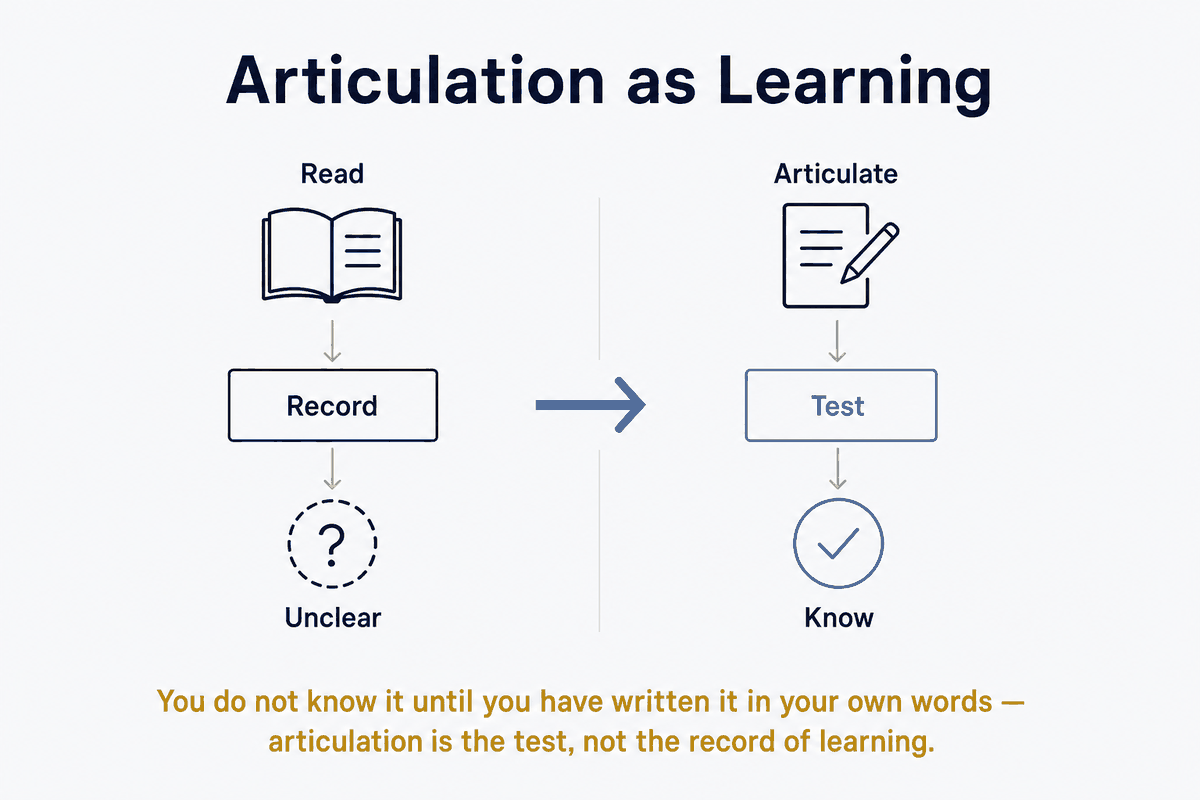
You do not learn a subject most deeply by reading it, but by having to formulate it — explicitly enough to steer, judge and correct. Being forced to articulate anchors deeper than taking something in. Having an article drafted and sharply redirecting it is therefore not only a way to produce a text, but a way to learn.
Why it works
The underlying mechanism is active recall versus passive recognition — the same one that makes Spaced Repetition (Flashcards) effective. Reading an existing article is recognition: it feels like learning but stays on the surface. Deciding yourself what a thing is, which kinds you distinguish, what the hook is and what hangs off it — that is production, and producing anchors deeper than consuming.
Articulating also forces decisions you would otherwise postpone. "Is this system or content?" "Is a director a curated source?" "Do I mean the publish, data or stage variant?" Reading passively lets you dodge those questions; steering an article makes you answer them. Every forced decision is a piece of knowledge you pin down instead of skirt.
The role of the AI
An AI drafting the article works here as a gate: you have to make your thought explicit enough to get through it. The AI produces the text; your steering, judging and correcting is where the learning sits. The article is the product; the thinking it forces is the yield.
The honest condition
The learning effect lives in your thinking, not in the generated text. Have an article generated and file it unread, and the effect evaporates: you have a text, but no knowledge. Pushing back, correcting and forcing decisions is exactly what makes it work. The article you do not read critically teaches you nothing.
Place in the system
This is the productive variant of Continuous Learning: not knowledge bites returning to you, but knowledge you anchor by externalising it. It connects to "start with why" — you do not write to have a text, but to understand, and the article is the residue of that understanding.