The learning mechanism under Continuous Learning: see something again just before you would forget it, so it stays with minimal effort.
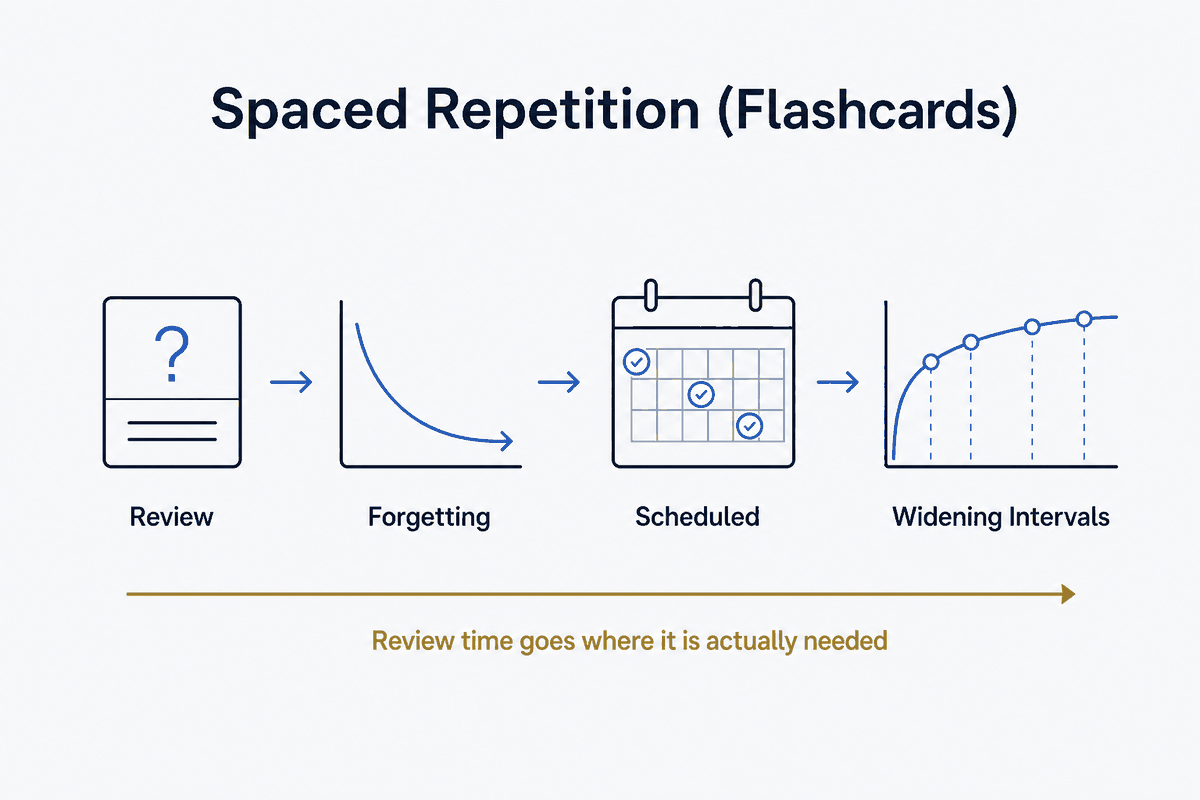
The learning mechanism underneath Continuous Learning: see something again just before you forget it, so it stays with minimal effort. A flashcard is the smallest unit — one question, one answer; spaced repetition is the rhythm in which those cards return.
The principle
Memory fades along a curve. Repeat too early and you spend effort on something still fresh; repeat too late and it is gone, so you start over. Spaced repetition aims at the moment just before forgetting: each successful repetition pushes the next one further out, so the intervals grow and the knowledge stays with steadily fewer reviews. Know something well and you see it less often; stumble and it comes back sooner.
Why flashcards
The flashcard forces active recall instead of rereading. Rereading feels like learning but is recognition; reproducing the answer yourself is what consolidates it. The small format — one question, one answer — is exactly what spaced repetition needs in order to time each piece separately.
Place in the system
This is the proven, generic mechanism; Continuous Learning is its daily application to your own vault. The vault supplies the material (knowledge bites from what you have captured), spaced repetition sets the timing, and the flashcard is the form in which it returns. Together they turn a vault you have into knowledge you own.