A folder of saved material is a promise to your future self that you rarely keep. Retrieval practice is what converts a collection into capability.
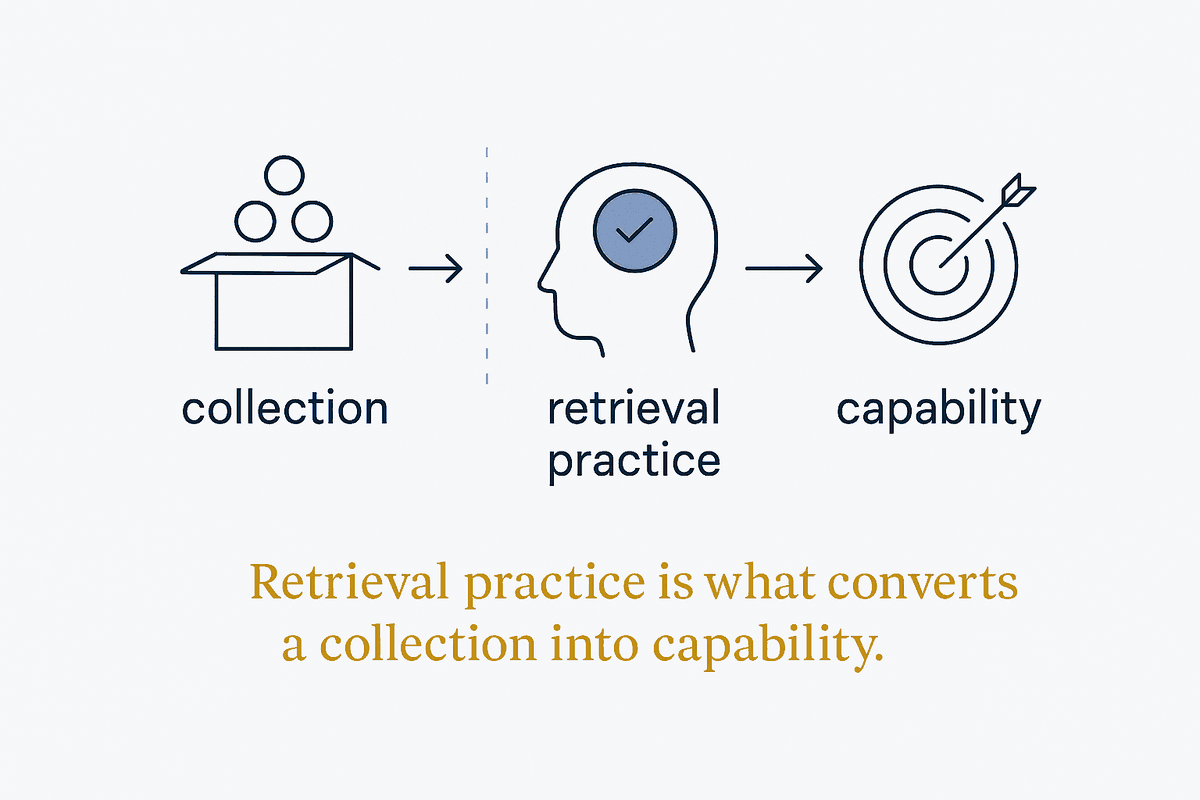
The saving feels productive because it involves recognition — you read the thing, you understood it, you filed it. Recognition is not retention, and the gap between them is invisible at the moment of saving. What you actually acquired was the ability to recognise the idea again when prompted, which is a much weaker capability than being able to produce it unprompted.
The correction is uncomfortable and well-established: retrieval, not review. Being asked to explain something without the source in front of you, at a moment far enough from the last attempt that it is genuinely hard, is what consolidates it. Re-reading feels easier precisely because it is easier — the fluency is the material's, not yours. Difficulty is the signal that learning is occurring rather than a sign of doing it wrong.
Which reframes what a collection is for. Four hundred saved plates are not knowledge; they are raw material, and their value is realised only when something extracts the claims, forces you to restate them, and returns at the moment before you would have forgotten. The library supplies the material and the timing mechanism supplies the learning — neither works alone, and the one everyone builds is the library.
The sharpest version of the test is explanation. If you cannot state the idea in your own words, name what it contrasts with, and give one concrete instance, you have a bookmark rather than a concept. That standard is uncomfortable applied to your own archive, and it is the only one that distinguishes a collection you own from one you merely possess.