
Structure Beats Magic
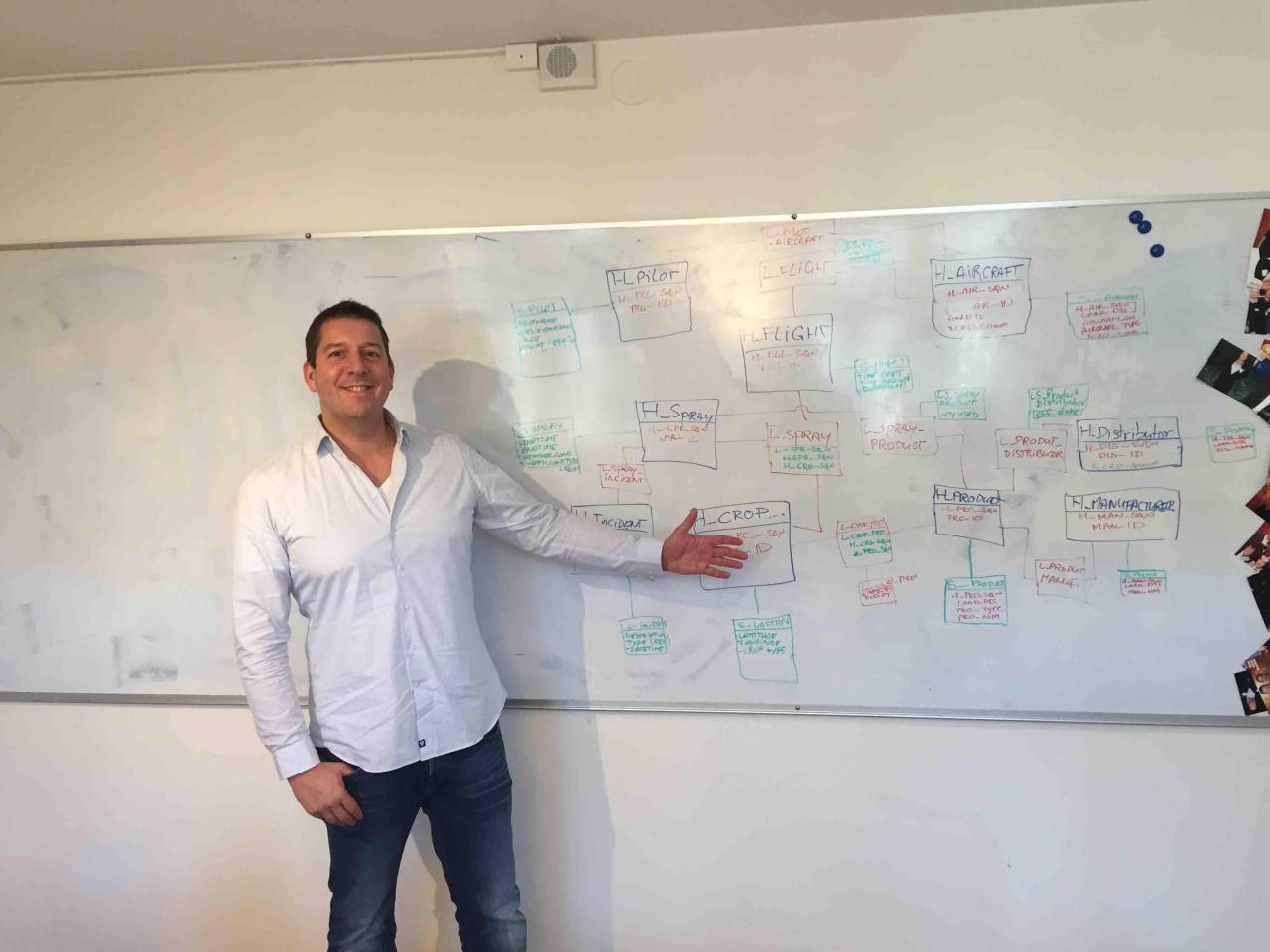
Jaco van der Laan at a whiteboard covered in a hand-drawn data model
Structure Beats Magic

I rebuilt my own life as data. This is what that gives you.

Twenty-five years of data architecture, then turned loose on my own life — photos, trips, books, health, finances. Not because I had to, but to see what happens when you take structure seriously. What I learned holds just as well for you as for an organisation: get the structure right, and good output stops being luck. It becomes repeatable.

Proven on my own life — over 150,000 photos, 271 books, a decade of trips made queryable. Applied in business, from 25 years of data architecture.

Jaco working from a laptop
For yourself

Your knowledge, your life, your AI

Turn your notes, photos and data into a second brain that AI can actually use. Start with yourself — the lowest-stakes, richest place to learn what's possible.

See the principles →
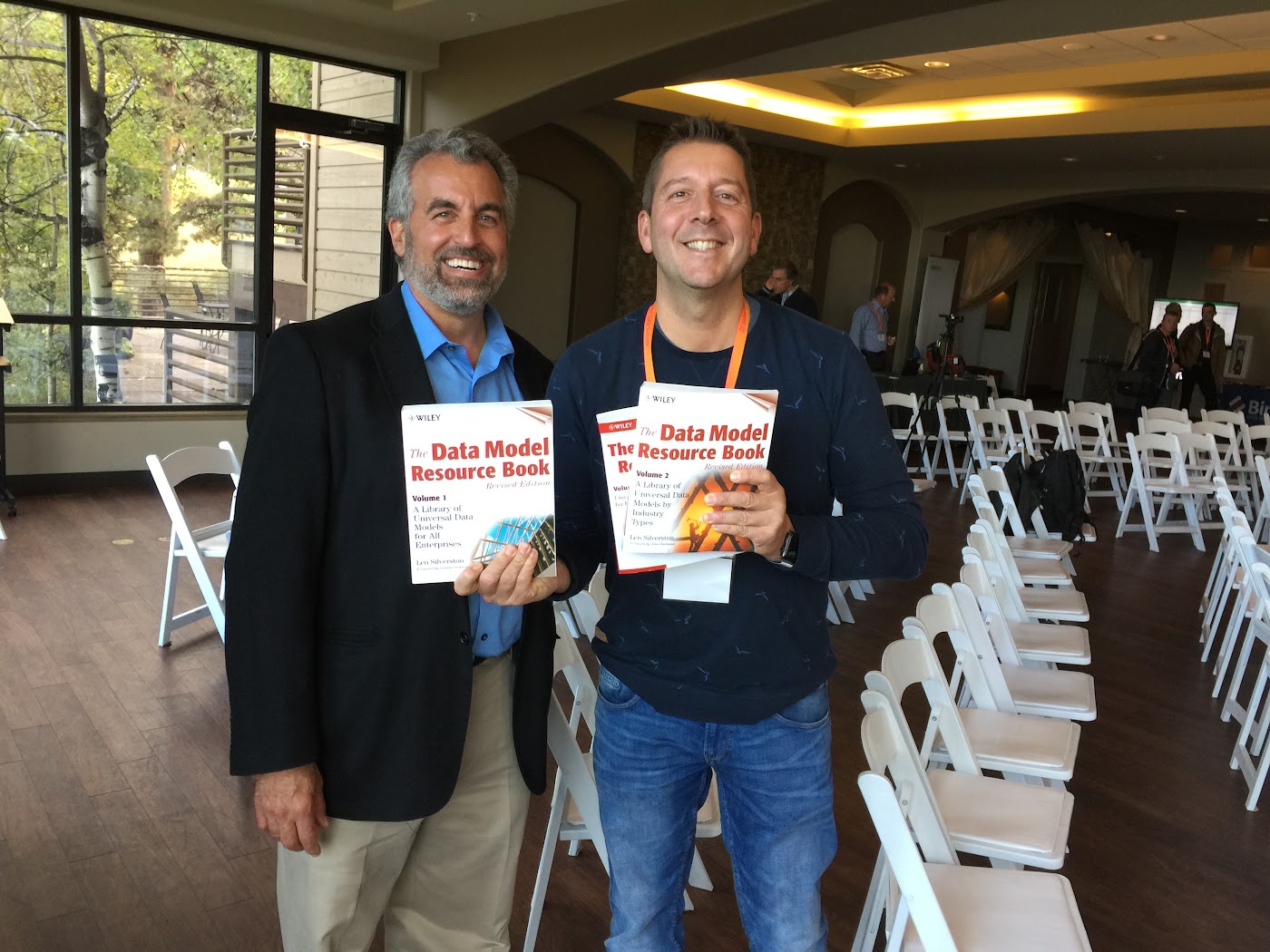
Jaco at a data conference
For your organisation

Data + AI that becomes reliable

The same architecture at company scale: structure, rules and validation that make AI output trustworthy and explainable — not impressive once, but repeatable.

For enterprises →
Structure + Data + AI + Rules + Skills Systems
The road here

Two worlds, one shape

For twenty-five years I organised data for a living — the enterprise kind, where structure is everything. And for just as long, off the clock, I was obsessed with the other kind: my own notes, highlights, tags, knowledge. Obsidian, Notion, Readwise — capturing, organising, connecting. It took me a while to see that they were the same thing.

1The data world

Twenty-five years of model-driven data engineering: taking an organisation's messy records and giving them a structure they can be trusted on. Rules, validation, one source of truth.

2The second-brain world

In parallel, the personal one: Obsidian, Notion, Readwise — endless capturing and tagging, trying to build a knowledge base that actually gave something back.

3The realisation

One day it clicked: these aren't two hobbies. They're one discipline at two scales. My vault and a data warehouse have the same shape. And neither is really about the data — both are systems.
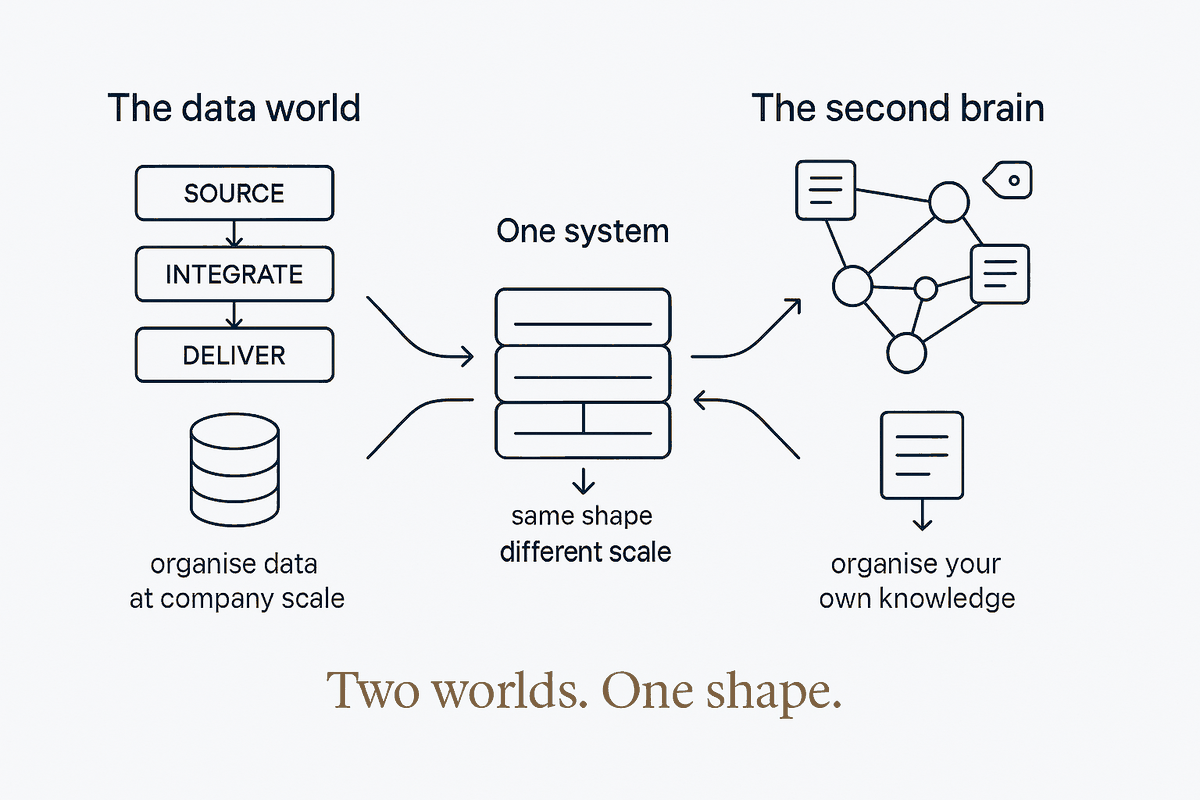
The data world (source, integrate, deliver) and the second brain (linked notes and tags) meet in the middle as one system — the same shape at a different scale

4Data is necessary, not sufficient

AI can play an enormous role in these systems. Quality data is the non-negotiable foundation — but here's the part people miss: good data alone is not enough for AI. There's so much more needed — structure, rules, validation, gates — before it supports you in a way that's genuinely smart and reliable. Skip that layer and even clean data gives you confident nonsense.
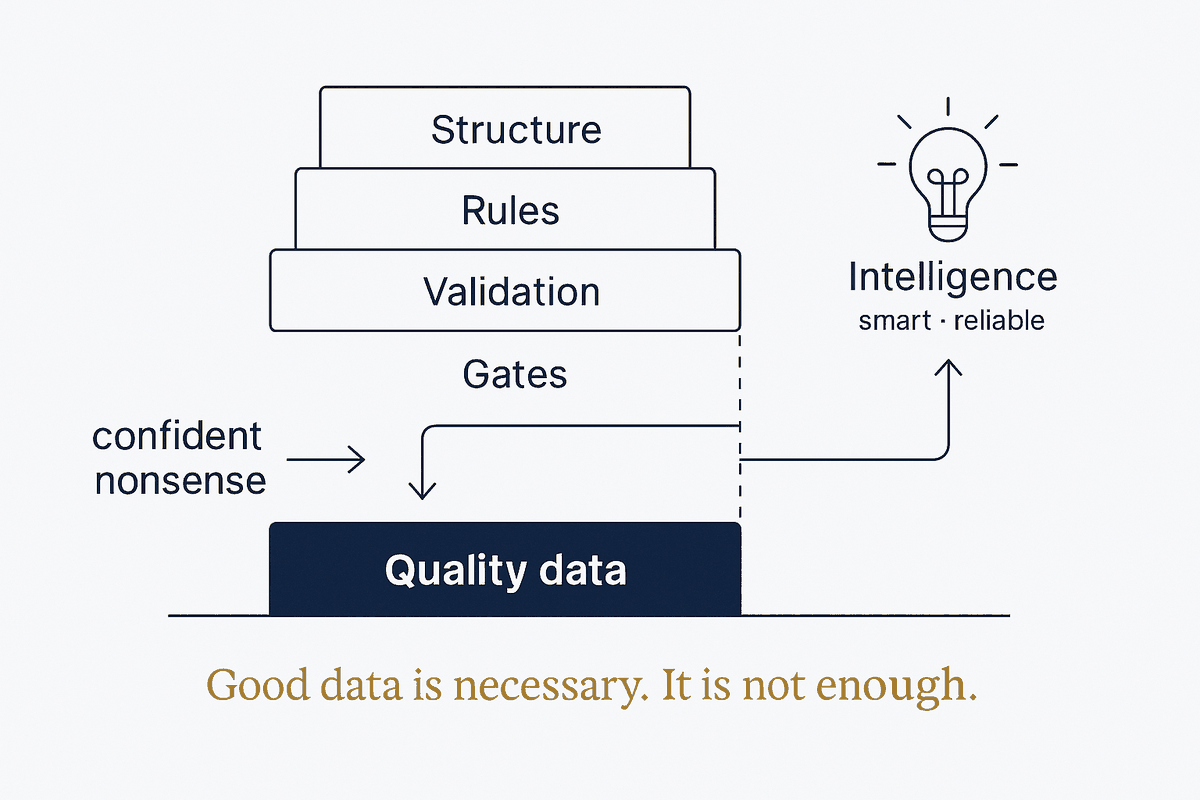
Quality data is the foundation; structure, rules, validation and gates stack on top before it becomes intelligence that is smart and reliable — data alone gives confident nonsense

5Personal first, then company

The beauty: you can test all of this privately, on your own data, at zero stakes. Learn what works. Then apply the exact same pattern at company scale — a company brain.

Data is the foundation, never the goal. Intelligence is the goal — the kind that supports you reliably, at home and at work.
How this site is built

Concepts first. Articles hang off them.

For me it starts with concepts — the essence, the underlying idea. Each one is a named, reusable thing. The articles hang off the concepts, or connect them. Want the distilled ideas? Start with the concepts. Want them in action? Read the writing.

Every concept, every article — aimed at one goal: a smart, reliable system that turns quality data into intelligence you can actually use, privately and at work.

Universal principles

The same architecture, at every scale

Two words, one shape. A second brain is a personal knowledge system — your notes, photos, mail and data, organised so you (and an AI) can actually use them. A data warehouse is the business version — an organisation's records, cleaned and connected so anyone can query them and trust the answer. Different scale, different owner. Same underlying design.

Because both are designed in layers. When you architect data — personal or enterprise — you don't pile everything in one place; you think in layers: one for the raw records as they arrive, one where they're cleaned and connected, one that serves trustworthy answers. Each layer has a single job. That's what makes the whole thing reliable at any size.

So a second brain and a data warehouse are the same shape: source → integration → delivery. The principles don't change between a person and an organisation — only the data does.

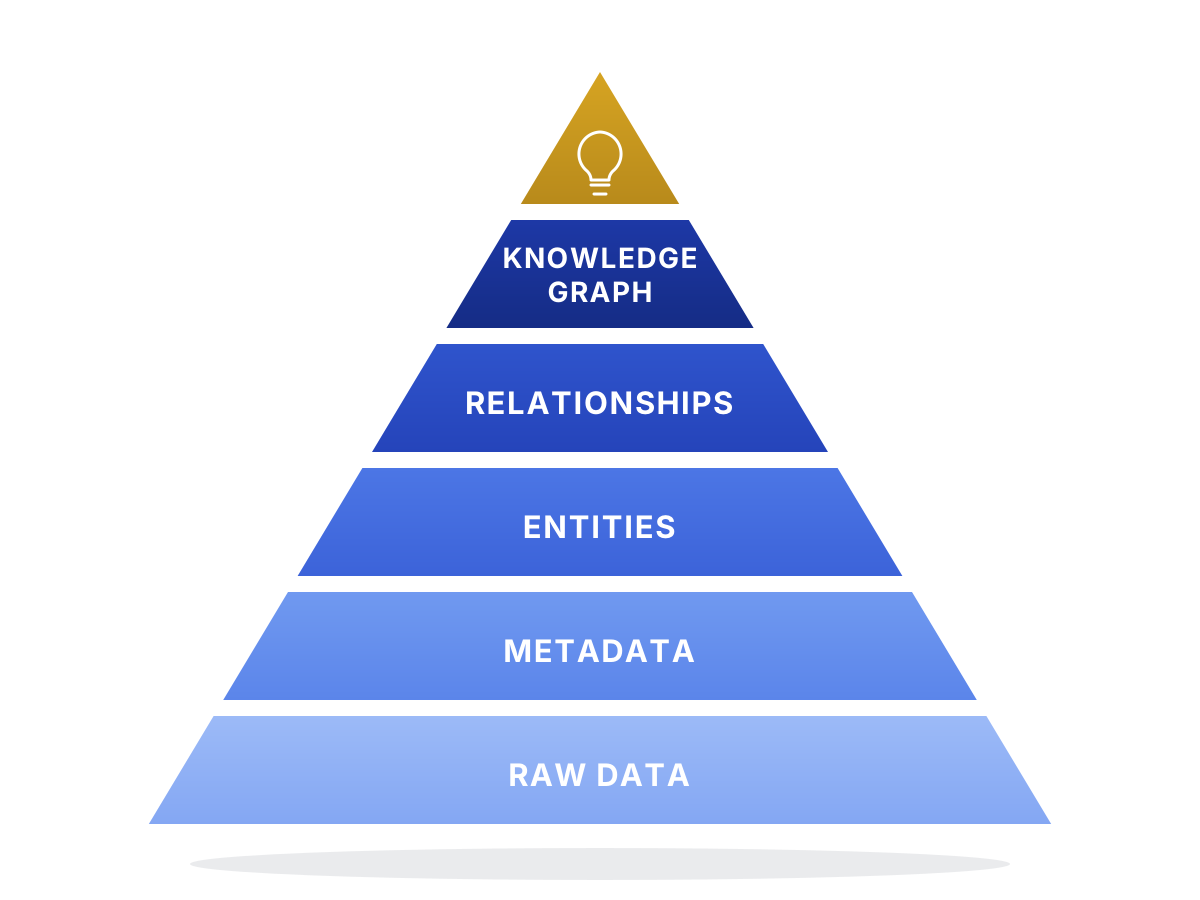
The structure pyramid — raw data, metadata, entities, relationships, knowledge graph, understanding
The structure pyramid: raw data → metadata → entities → relationships → knowledge graph → understanding. AI doesn't invent it; it structures what's already there.
Source

Raw

The records you already have — notes, files, mail, data — wherever they live.

Integration

Cleaned & structured

Shaped, validated against rules, made consistent and queryable.

Delivery

Published

Answers, pages, decisions — output you can trust because it's engineered.

The same three steps run at every scale — a person, a team, an organisation.
Structure

Context lives in the structure

Not in the prompt, not in the meeting. A connected, well-shaped knowledge base is what makes the rest work.

Data

Records you own, made readable

Archive becomes source the moment something can query it. The information is usually already there — unread.

AI

The commodity layer

The model is roughly the same for everyone. It's leverage, not the moat. Rent the AI; own the structure.

Rules

The missing word

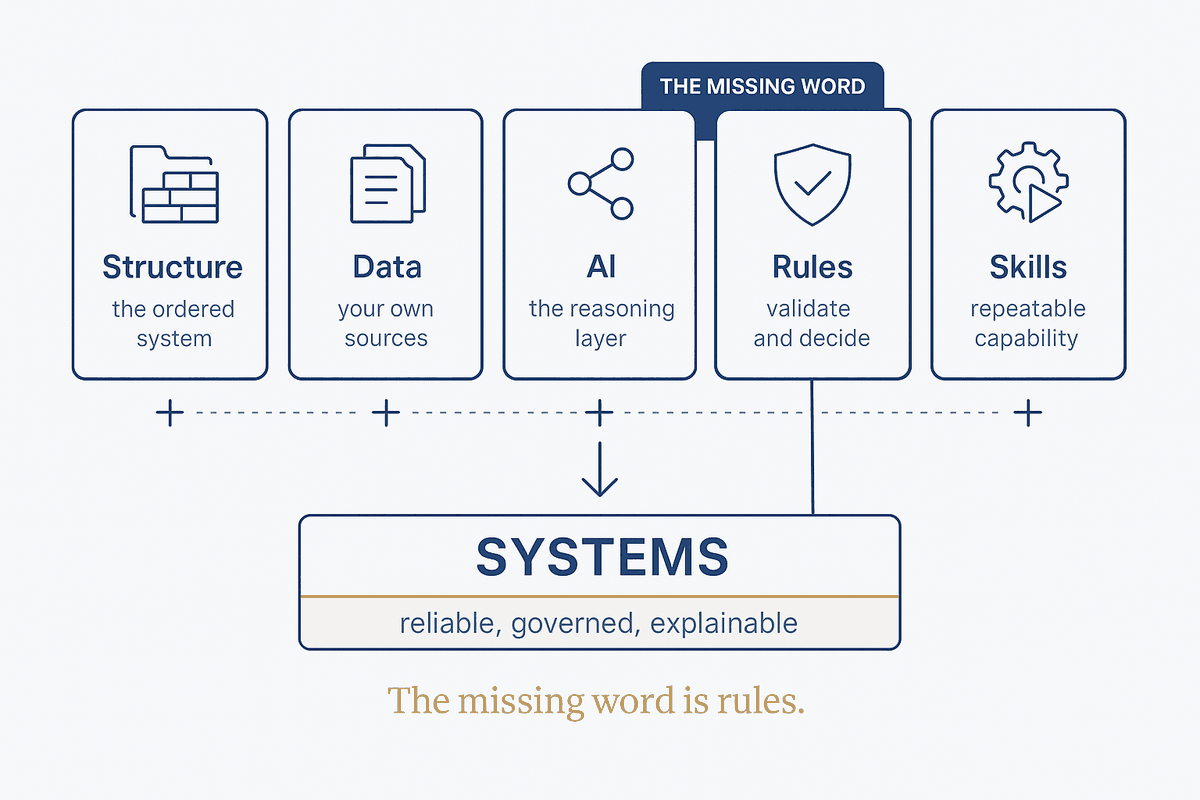
Everyone says "data + AI". Rules are what make output reliable and explainable: generate, validate against known context, flag don't guess.

Skills

Repeatable capability

Codified workflows and know-how, so a result is engineered — not improvised once and lost.

Systems

The payoff

Structure + data + AI + rules + skills compounds into a system — the difference between a toy and an instrument.

The formula: Structure, Data, AI, Rules and Skills combine into Systems. Rules is singled out as the missing word — the layer that makes the result reliable, governed and explainable.
Everyone says “data + AI.” The missing word — the one that makes output reliable and explainable — is rules.
The mindset

Play with the blocks first

Like Lego — snap, try, rebuild.

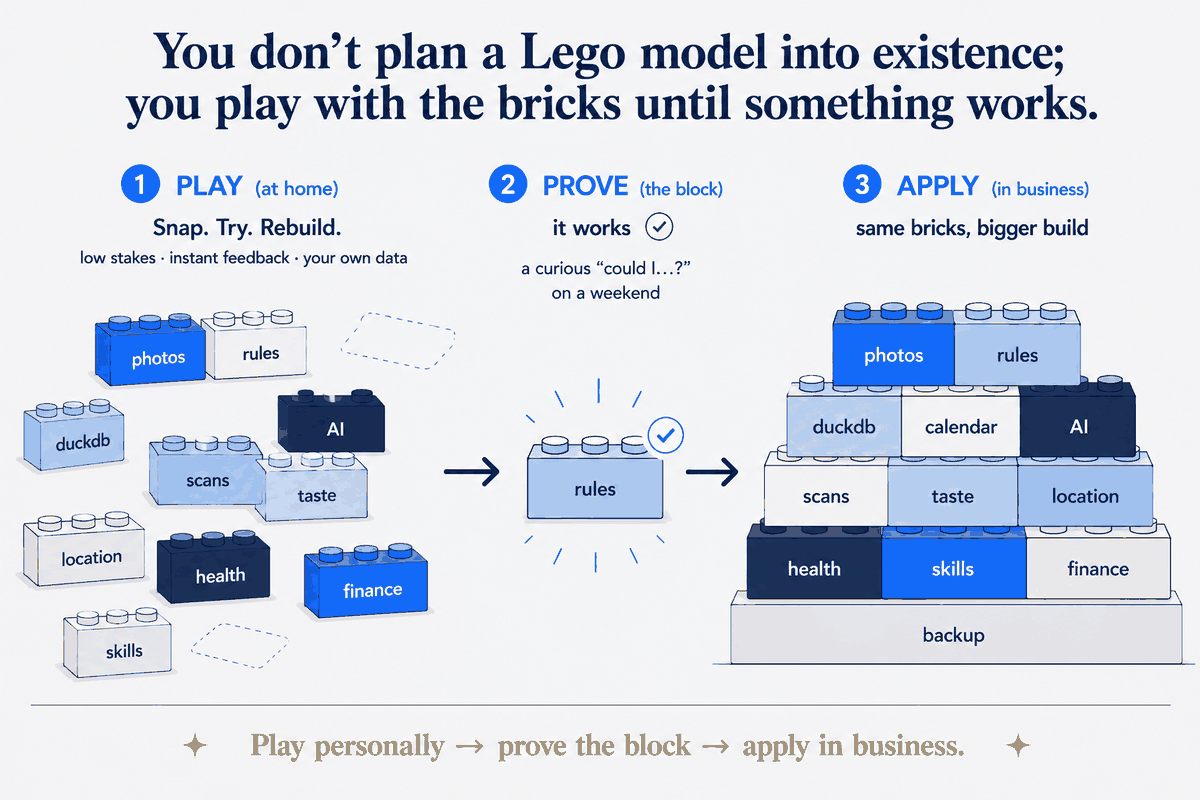
You don't plan a Lego model into existence; you play with the bricks until something works. Data and AI are the same. The fastest way to learn what's possible is to tinker in your own life — low stakes, instant feedback, real data you care about.

Every demo here started as play: a curious "could I…?" on a weekend. The personal sphere is the safest, richest sandbox there is.

And here's the move: in parallel, the blocks that prove themselves at home get applied — step by step — in business and across organisations. Same bricks, bigger build.

Play with the blocks: the same bricks — photos, rules, duckdb, calendar, AI, scans, taste, location, health, skills, finance, backup — scattered and snapped together at home, then one brick proven to work, then the same bricks assembled into a bigger, ordered build for business.
Beat three is the argument: the bricks that get built into the bigger thing are the same bricks you were playing with at home. Nothing new had to be invented — only proven.

Play personally → prove the block → apply in business. Curiosity at home becomes capability at work.

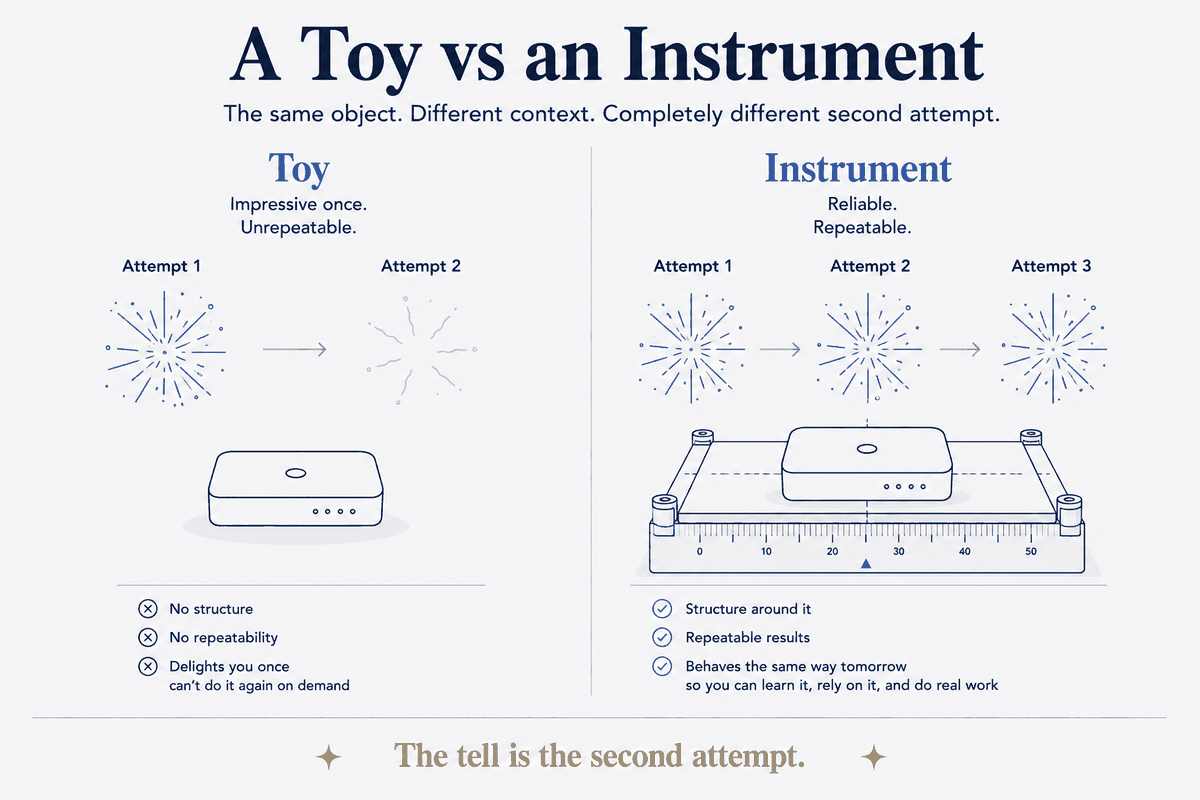
A toy vs an instrument: the same object in different contexts. Without structure the second attempt fizzles out; with structure around it, attempts one, two and three all land the same way — repeatable, reliable, something you can do real work with.
Without structure, AI is a toy: impressive once, unreliable twice. With structure, it becomes an instrument — the tell is the second attempt.
One honest warning

Play to live better — don't let the system become the goal

There's a trap here, and PKM and home automation are full of people stuck in it: the system becomes a hobby that eats the time it was meant to save. You tinker forever, optimise the optimiser, chase a vault that's never quite perfect. It will never be perfect — even with AI. Build it to live better, not to admire it. Good enough, in service of a real life, beats perfect-and-endless every time.

Why this matters more, not less

AI made code cheap. That makes structure precious.

Anyone can now write an import script, wire a pipeline, vibe-code a tool in an afternoon. Generating code stopped being the bottleneck. So the value moved — to the thing AI doesn't hand you for free.

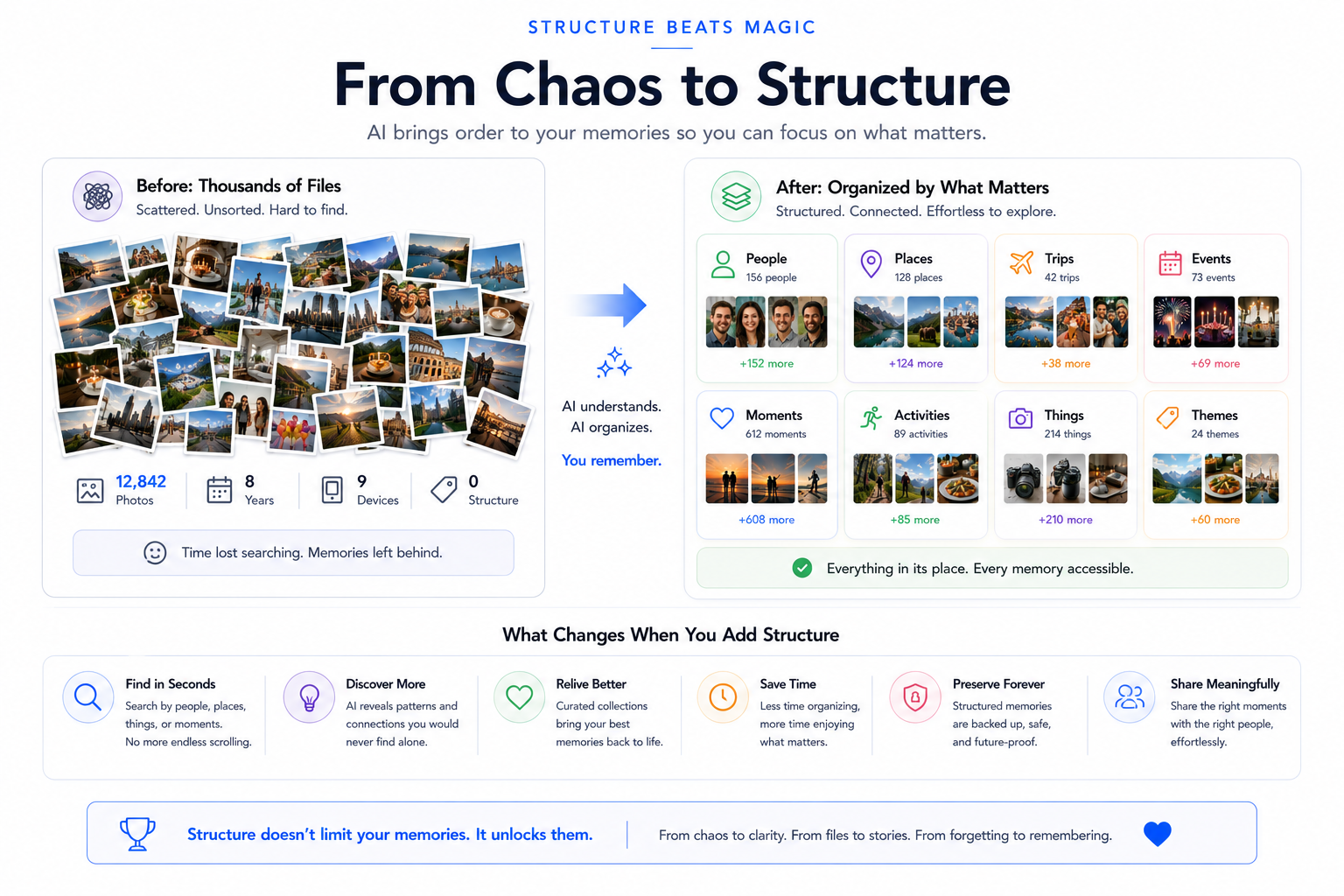
From chaos to structure — thousands of scattered files become organised by what matters
From chaos to structure: the same thousands of files, before and after. Structure doesn't limit your memories — it unlocks them.
Without structure

Cheap code → fast chaos

Scripts that don't fit together. Data in five shapes. Nobody remembers why. It gets messy, time-consuming, and brittle — and the promise inverts: the system stops saving time and starts costing it.

With structure

Cheap code → compounding leverage

The same easy code lands on a foundation — consistent shapes, rules, validation — so each new piece adds instead of tangling. That's the whole bet: structure is what turns cheap generation into something that lasts.

Don't reinvent the wheel

Share the blocks — and feed them back to the AI

The blocks are reusable, so share them: insights, code, patterns, rules, skills. Two wins. Others don't rebuild what already works — and well-thought building blocks become high-quality input to your AI tooling, so the next system gets built fast and right. Reusable patterns + rules + skills, handed to an AI, are quality on tap. That's the opposite of everyone privately re-solving the same problem badly.

Share patterns & rules → build quality faster, together
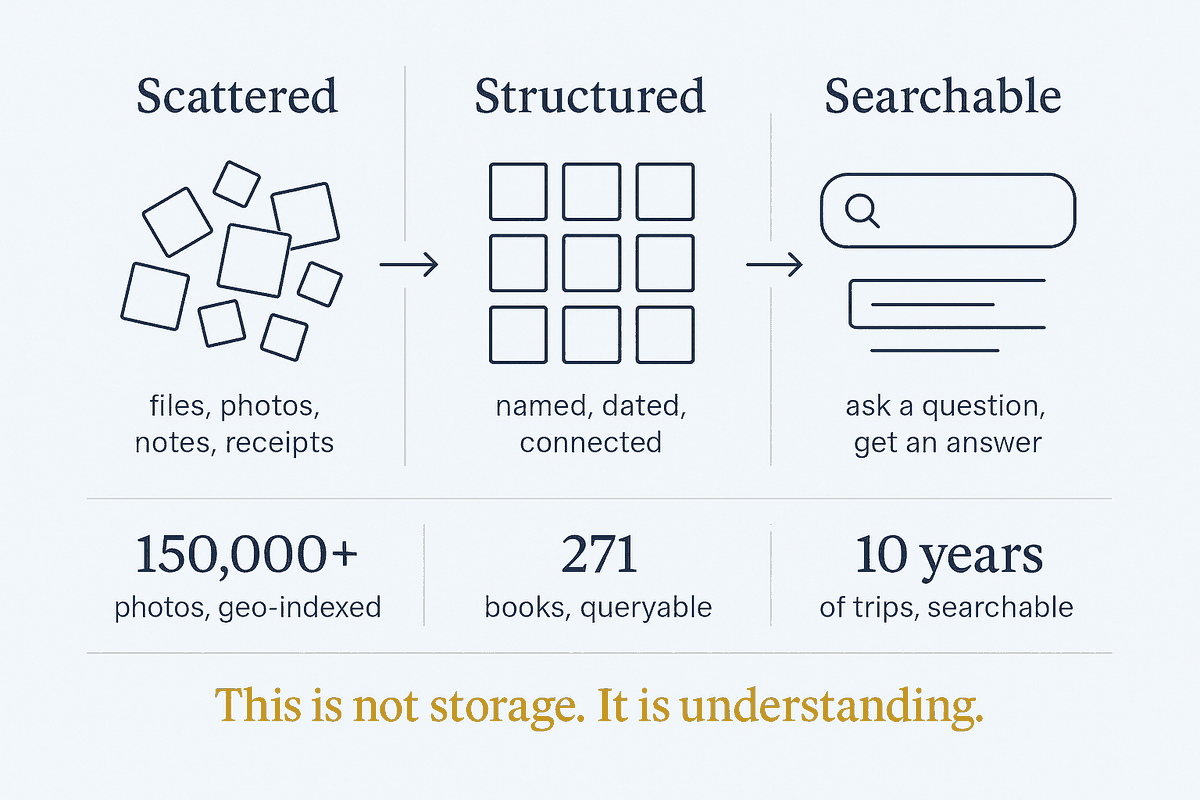
Three stages: a scattered pile of files, photos, notes and receipts becomes a neat, aligned grid — named, dated and connected — and then becomes searchable, so you can ask a question and get an answer. Over 150,000 photos geo-indexed, 271 books queryable, ten years of trips searchable.
The same material, three states: a pile you scroll past, the same things named and connected, and then something you can actually ask a question. Structure is what moves it one column to the right.
Why this is next-level

Notes organize. Architecture personalizes.

Storing notes is where most "second brain" advice stops. To make AI actually act for you — with focus — it needs a model of you: your history, your desires, your limits, what you want to exclude. Written down as data it can read, not guessed at each session. These are self models — and each facet you write down is one less the system has to guess.

And it's not a form you fill in once. The AI drafts a model from your data, you correct it, and then it works on the models themselves — finding connections, flagging inconsistencies, proposing experiments. It holds still within a decision and evolves across the years. It even challenges you: a system that only mirrors your preferences builds a cage, so it nudges you past the edge — and your reaction is new data either way.

This needs a solid data model, sound architecture, and the right application of AI — with rules, skills, and document structure. It's the difference between a chatbot that forgets you and an assistant grounded in who you actually are. That's the next level — and it's exactly the discipline I bring.

The vocabulary

A few names worth knowing

If structure beats magic, the structure is built like a brain — and the parts have names. These are the ideas I keep coming back to, mapped to the thing they're modelled on. Not jargon to sell; vocabulary to think with.

The senses

Curated Sources

Not everything that reaches you deserves attention. Like the senses filtering signal from noise, you curate and weight your sources — people, reading, mail — so only what matters gets through. Most systems take in everything; focus comes from choosing.

Long-term memory

The structured vault

The cortex where knowledge is stored and connected. A note in a folder is storage; a note linked into a graph is memory. Archive becomes source the moment something can read across all of it at once.

Executive function

Rules & Skills

The prefrontal cortex — judgment and repeatable procedure. Rules make output reliable and explainable; skills make a good result repeatable instead of improvised once and lost.

Neuroplasticity

The Compounding Brain

A brain rewires itself with use; a good system should too. Every piece of work feeds back in — the decision, the procedure, the lesson — so the structure is smarter next time than last. Tend it, and it compounds. The discipline, not a trick.

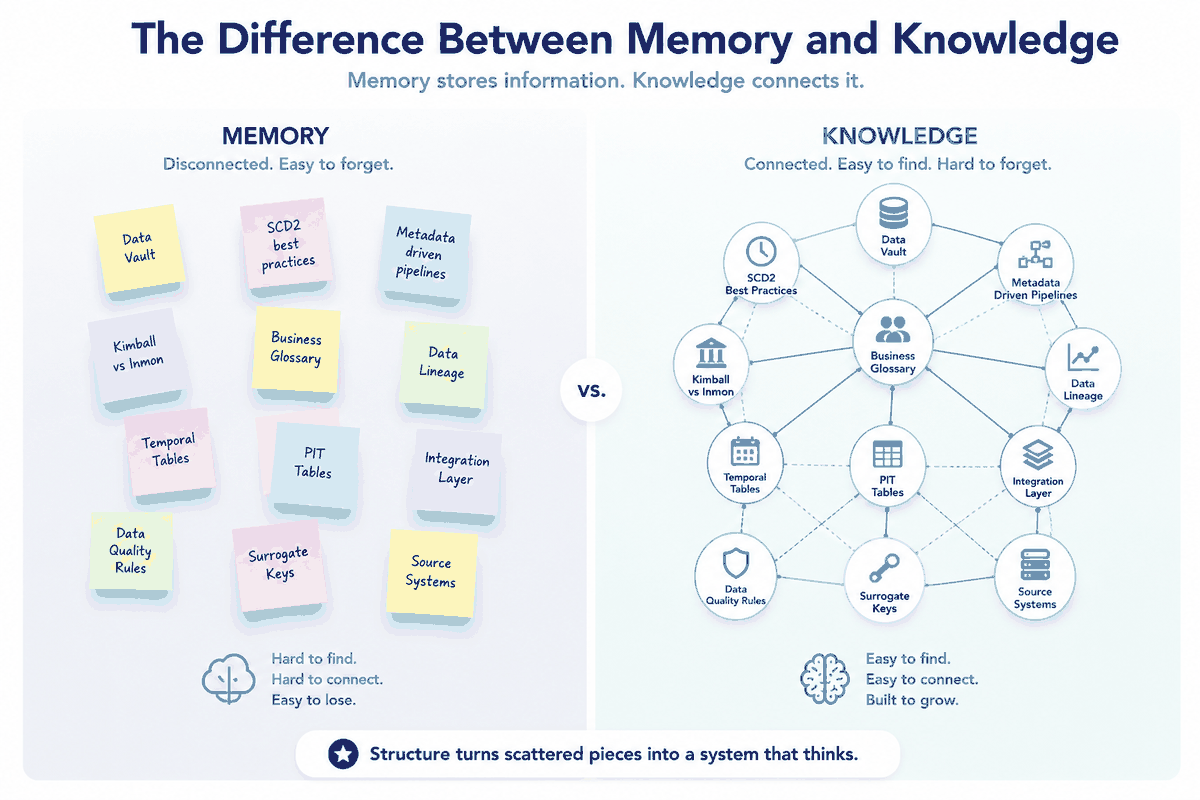
Memory stores information; knowledge connects it — scattered sticky notes on the left, a connected graph of the same ideas on the right
The whole vocabulary in one contrast. On the left the same ideas as loose notes — data vault, temporal tables, business glossary, lineage — easy to write down, easy to lose. On the right, the identical pieces wired into a graph: easy to find, easy to connect, hard to forget. Memory stores information; knowledge connects it. Structure is what turns scattered pieces into a system that thinks.

The AI isn't on this list on purpose — it's the commodity layer, the least interesting term. Rent the AI; own the structure. Give the recipe, sell the kitchen.

Proof, not slides

Use cases — the method applied to a real job

A use case is the thesis landed on one concrete situation: real data, real structure, real output. Not a slide about what's possible — a working system you can see. The recipe is here for free; the kitchen is where the work happens.

Live demo · curation

Travel curation engine

A DuckDB "brain" — sources, taste rubric, evidence — that scores venues and publishes a static site that grounds every recommendation in first-party, GPS-matched photos.

See how it's built →
Pattern · publishing

A brain that publishes itself

One source of truth in a database; a website derived from it at build time. No CMS, no runtime database, no drift.

Read the write-up →
Pattern · personal data

Your photos are already a map

150k+ photos, the metadata already present, turned into a queryable geography — and matched to the places a guide recommends.

Read the write-up →
Live demo · taste

AI movie library

Recommends films from your taste and the list of what you've already seen — focus from a modeled preference, not generic "popular now".

How the modelling works →

See all use cases →

Two implementations

Proven on a life. Applied in a business.

The thesis isn't borrowed — it's lived. The same formula runs at personal scale (proof in the life) and organisational scale (proof in the work).

Personal scale — proof in the life

Your own knowledge & productivity, as a system

  • Over 150,000 photos turned into a geo-indexed, searchable map
  • 271 owned books turned into a queryable corpus
  • Mail, highlights, calendar — one connected, AI-readable brain
  • Life-hacking, GTD & personal productivity — built as systems, not tips

Not aspirational. Built, running, and the evidence the method is real.

Organisational scale — proof in the work

Governed system quality, beyond the enterprise

  • 25 years of data architecture as the blueprint
  • Structure carries the context, so the meeting becomes the merge
  • Validation & rules built in — reliable because engineered
  • The discipline learned at the banks, spoken in the language of builders

Bank-grade governance without bank-sized overhead.

The wedge

Bankers and Builders speak different languages. I speak both.

The banker's discipline

Governance, validation, explainability, control you can keep — the standards that make a system trustworthy and auditable. Learned over 25 years where it isn't optional.

The builder's leverage

Structure, generated tools, AI on a solid foundation — speed without the chaos. The way things actually get shipped.

Most people live in one camp and distrust the other. The work is translation: bringing bank-grade discipline into the way builders deliver — so a serious team, beyond the enterprise, gets governance and speed instead of choosing one. Structure is the shared language.

A readiness filter, not a funnel

Who this is for — and who it isn't

Structure rewards the willing. The method works for people and teams ready to build a foundation — and genuinely doesn't for those looking for a magic box.

This is for you if…

  • You want results that are repeatable, not lucky one-offs.
  • You'll invest in structure up front to buy speed and trust later.
  • You value output you can explain and defend, not just generate.
  • You're a builder — individual or mid-sized team — ready to own your data, AI and process.

This isn't for you if…

  • You want a magic box that thinks for you with zero setup.
  • You're chasing the newest model instead of fixing the foundation.
  • You won't commit to rules, validation, and a little discipline.
  • You want a vendor to own your stack so you don't have to understand it.
Writing

Practical pieces on structure, knowledge & AI

The recipe, free. Each piece takes one real, working system and shows the method behind it — so you can build your own.

For builders & teams

Reach the Machine, Not the Copy

Sync brings the data to you. Sometimes you need the opposite — to reach the machine where the data already lives, without opening a single port to the internet.

Structure Beats Magic

Why Concepts Come First

A named idea is a coat rack. Give someone the rack in two minutes and every example afterwards has somewhere to hang — without it, each new detail lands on the floor.

Structure Beats Magic

Sidecar Markdown — Giving a PDF the Thing It Can Never Have

A binary file can't be searched, can't be queried, and can't hold a single link. Put a markdown note beside it and all three problems go away at once.

For builders & teams

Mirror, Backup, History — Three Jobs, Three Tools, One File-Set

Syncthing replicates, Restic protects, Git remembers. Ask one of them to do another's job and it will fail you politely, at the worst possible moment.

For knowledge workers

A Hash Is Exact. It Is Also Naive.

I turned a shoebox of old drives into a database — every file fingerprinted, deduplication reduced to a single SQL query. It worked better than I expected, right up to the moment it confidently told me two identical photos were different. That's where the interesting part starts: knowing exactly what your certainty is blind to.

For knowledge workers

Hooks, Not Hopes

Half your rules are wishes you're hoping the machine remembers. The other half run whether it remembers or not. The gap between them is the whole game.

For knowledge workers

Eight Old Drives and the System That Emptied Them

A shoebox of old hard drives is a dread task everyone postpones: what's on them, what's worth keeping, what's safe to destroy? I stopped clearing them one at a time and built a small system instead — an index that makes each drive cheaper than the last, and a gate that never lets me delete before the data is safe. Structure beats effort, even here.

Structure Beats Magic

Almost Everything Is an Agreement

Contracts, subscriptions, family arrangements, the promise you made yourself about the gym — model them as one entity, link the evidence, and an expensive class of silent drift becomes a query.

For builders & teams

Your Database Is a View — The Rebuild Discipline That Keeps Files the Source of Truth

The files are canonical. The database is a rebuildable projection of them. Get that one arrow the right way round and everything downstream — queries, AI, sync — becomes trustworthy. Get it backwards and your data quietly rots.

All writing

See all 58 pieces →

The full collection — structure, knowledge and AI, newest first.

Go deeper

Explore the rest of the thesis

The full picture spans more than one page. Dive into how the system actually works, the intelligence systems built on it, and the thinking it stands on.

The person behind it

I build this on my own life first.

I'm Jaco van der Laan — 25 years in data architecture, governance learned at the banks, now applying that same discipline to my own knowledge, my own travel, my own decisions. Everything on this site is something I actually run.

The thesis isn't theory I'm selling. It's how I live — structure first, magic never.

— Jaco

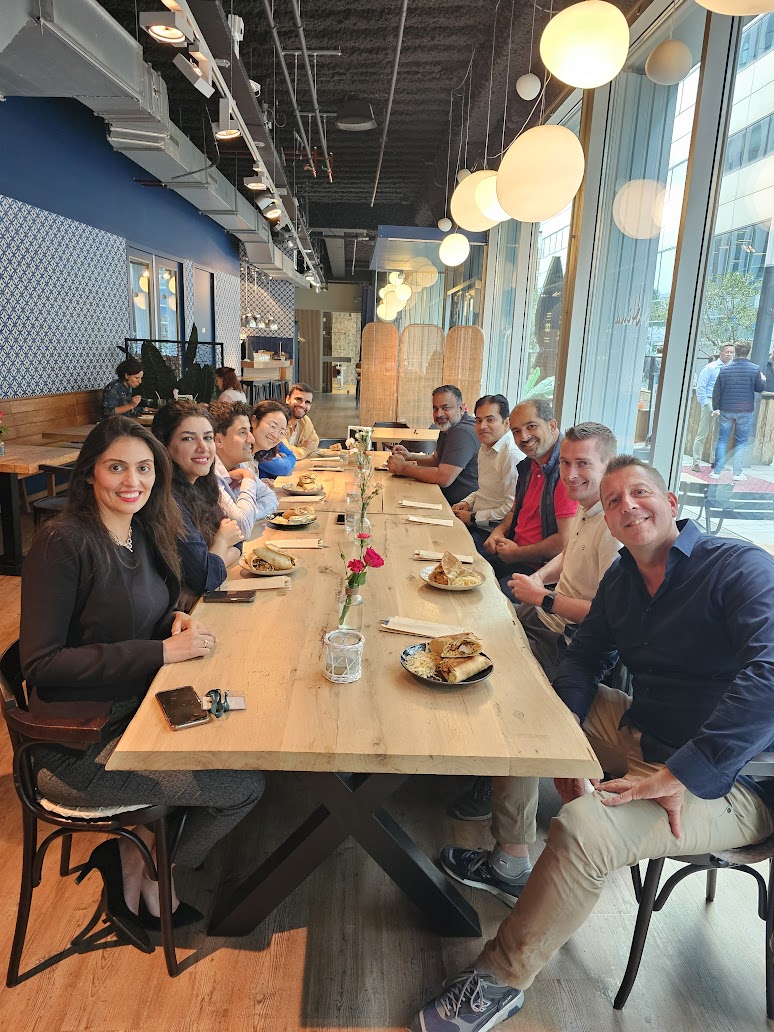
Jaco at Crater Lake, Oregon — one of over 150,000 geolocated photos Jaco at a data conference Jaco with a data team
For enterprises

When you're ready to build the foundation, not buy the magic box

High-value advisory and engagements for organisations serious about governed, AI-ready knowledge systems. Senior, hands-on, and selective — engagements, not day-rates.

Jaco van der Laan · Systems & Data →